All species › Birds of prey › Kites, Old World vultures, eagles and hawks › Plumbeous Kite
Plumbeous Kite | Ictinia plumbea
Donkergrijze wouw | Milano plomizo | Sovi
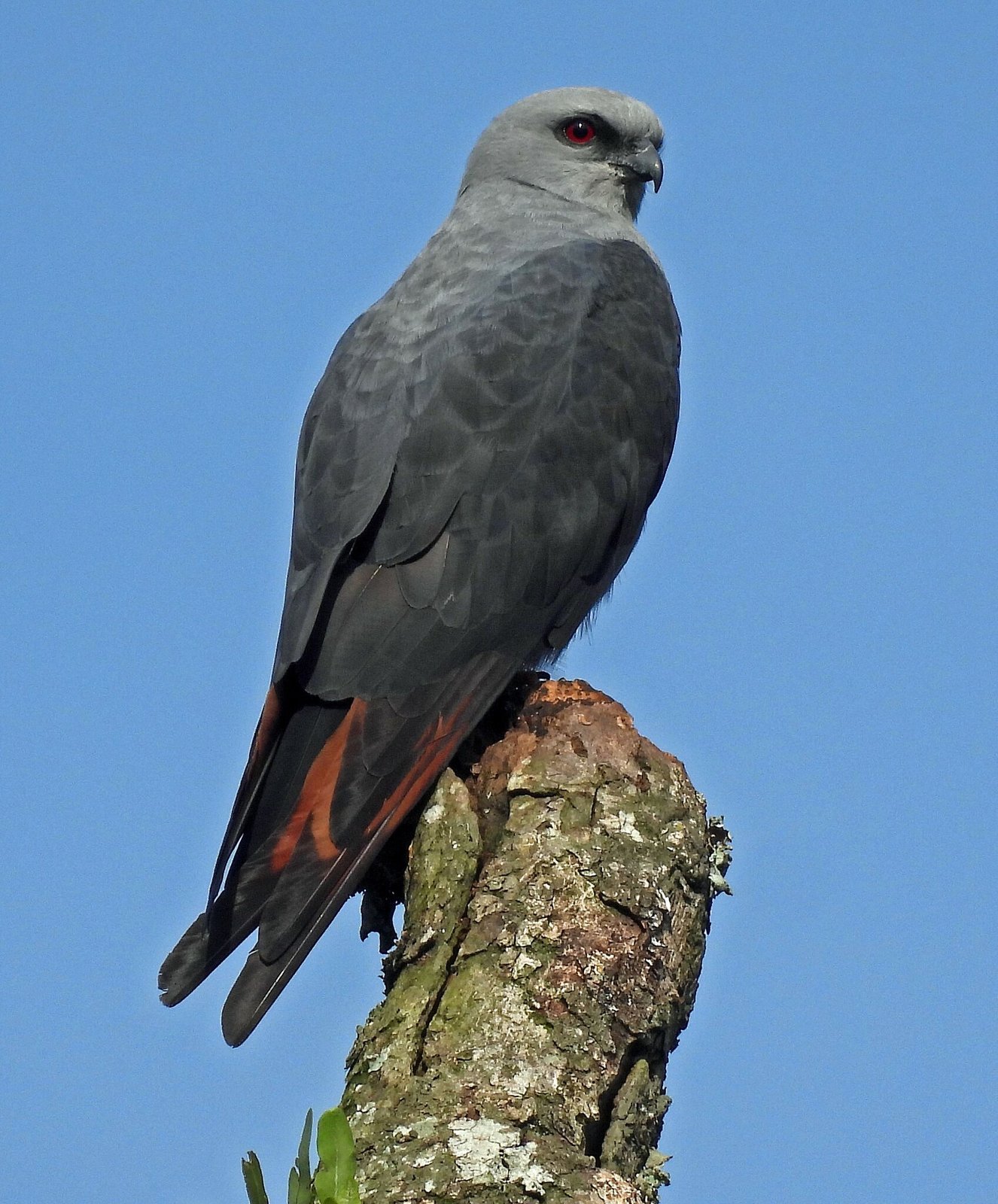
The Plumbeous Kite is a slender grey kite with long, pointed wings that hunts large flying insects over lowland forest. In flight the rufous patch in the primaries is visible. It often perches for long periods on a bare branch above the canopy.
Voice
Usually silent. Sometimes a thin, descending whistle, see-seeoo.
Recording: JAYRSON ARAUJO DE OLIVEIRA — CC BY-NC-SA 4.0 · xeno-canto
Identification
33–38 cm; the sexes are nearly alike. Entirely slate grey, with a paler grey head and red eyes. The wings are long and pointed and extend beyond the tail tip when perched. In flight a rufous patch at the base of the primaries can be seen. The black tail has two or three narrow white bands on the underside. The legs are orange-yellow. Juveniles are dark grey above with pale feather edges and white below with grey streaks; they show little or no rufous in the wing.
Confusion species
Mississippi Kite Ictinia mississippiensis has no rufous in the wing, a paler head and a plain black tail without white bands; when perched the wingtips reach about to the tail tip. In the guide area it is only a passage migrant and winter visitor. Slender-billed Kite Helicolestes hamatus has broader wings and a shorter tail and lives in swamp forest. Bat Falcon Falco rufigularis has blackish upperparts, a white throat and a rufous belly.
Habitat
Humid lowland forest and forest edges, especially along rivers, at clearings and in flooded forest, also semi-open country with scattered tall trees; mostly below 1000 m, locally higher in the Andean foothills. It hunts dragonflies, cicadas, beetles and other large insects in flight, catching them with its feet and eating them in the air; it also takes lizards in the canopy. The nest is a small stick cup high in a tree.
Where the bird is most at home, classified by the vegetation units of the Andes and the west coast.


Range and movements
In Colombia in the lowlands east and west of the Andes, also in the Magdalena valley. In Ecuador in the western and eastern lowlands. In Peru in the Amazonian lowlands. In Bolivia in the northern and eastern lowlands. Birds from the south of the range move north in the austral winter, and birds from Central America winter in South America, so numbers vary by season. Outside the guide area from eastern Mexico to northern Argentina.
- Resident
- dark = core range, pale = thinly spread
How and when to look
Search along large rivers in the Amazonian lowlands, from a boat or from a canopy tower; birds often perch on a bare branch above the forest and sally from there after insects. Small groups sometimes hunt together over the forest.
Conservation status
Least Concern. Widespread and fairly common in the lowlands.
Scientific name
Ictinia plumbea | (Gmelin, 1788)
Gmelin described the species in 1788 as Falco plumbeus; because it was later moved to another genus, the author and year stand in brackets. The genus Ictinia was introduced in 1816 by Vieillot. The genus name comes from Greek iktinos, 'kite'. The species name comes from Latin plumbeus, 'lead-grey'. The specimen the first description was based on came from Cayenne, French Guiana.