All species › Birds of prey › Kites, Old World vultures, eagles and hawks › Mississippi Kite
Mississippi Kite | Ictinia mississippiensis
Mississippiwouw | Elanio de Misisipi | Sovi-do-norte
The Mississippi Kite breeds in the southern and central United States and winters in the interior of South America. On migration it passes through the guide area in flocks, sometimes of hundreds of birds. It hunts large insects in flight.
Voice
Usually silent in the guide area. A thin, two-note whistle, phee-pheeoo.
Recording: Manuel Grosselet — CC BY-NC-SA 4.0 · xeno-canto
Identification
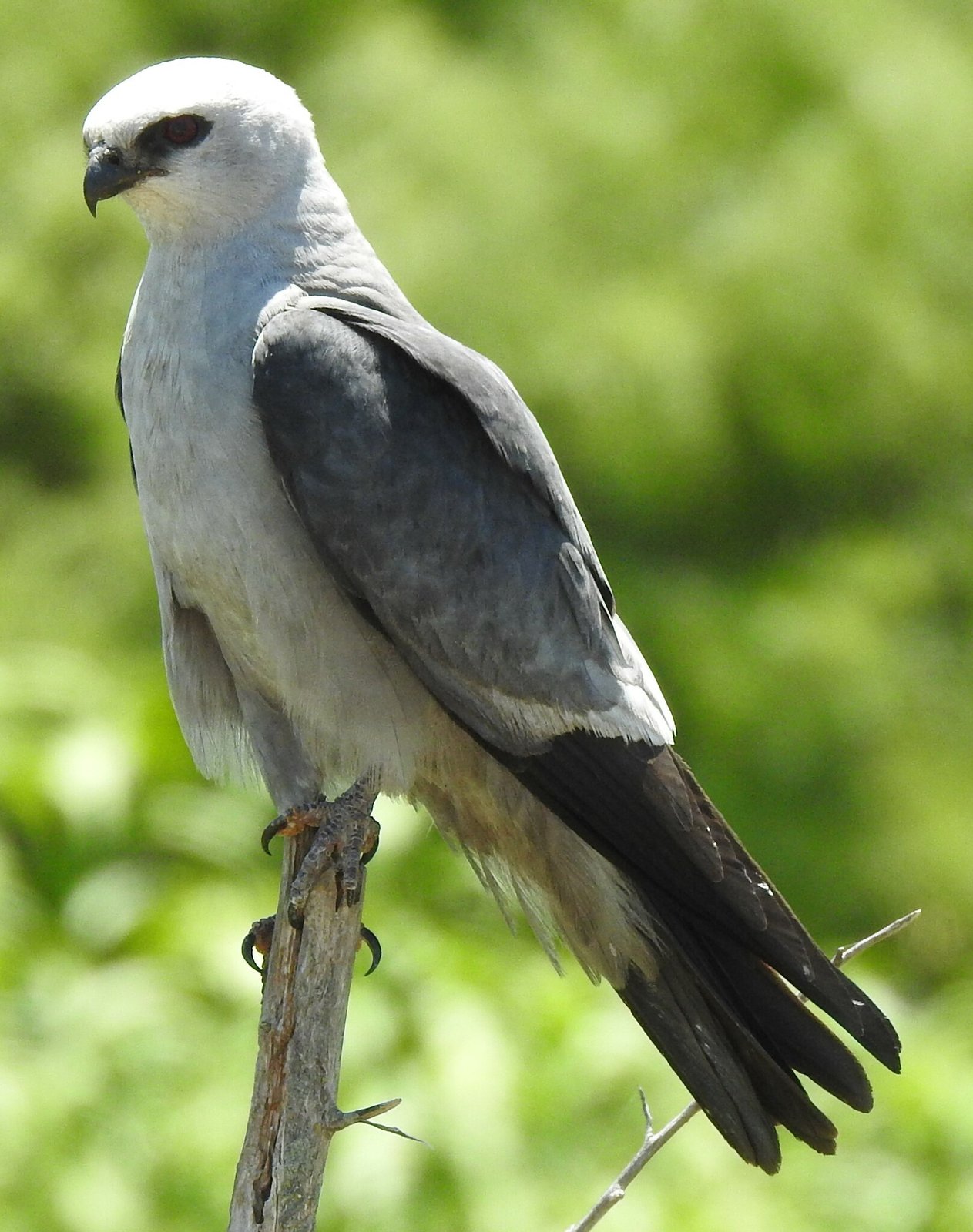
31–37 cm; slender, with long, pointed wings. Adults are grey, with a pale grey, almost white head, a plain black tail and a pale grey panel on the upper side of the secondaries; the eyes are red. There is no rufous in the wing. The female is slightly darker and has a less pale head. Juveniles are white below with coarse rufous streaks and have a banded tail; first-year birds have an adult body but still a banded tail and barred underwings.
Confusion species
Plumbeous Kite Ictinia plumbea has a rufous patch in the primaries, a darker head and narrow white bands in the tail, and when perched the wingtips extend beyond the tail tip; juveniles of the two species are separated mainly by tail pattern and wing length. Peregrine Falcon Falco peregrinus is more powerful, with a dark head, a broad moustache and stronger wingbeats.
Habitat
On migration over forest, rivers and semi-open country in the lowlands, often together with other migrating raptors; in the wintering area over forest, savanna and farmland with trees. It hunts dragonflies, cicadas and other large insects in flight. It does not breed in the guide area.
Where the bird is most at home, classified by the vegetation units of the Andes and the west coast.


Range and movements
In Colombia, Ecuador and Peru mainly a passage migrant, most often east of the Andes, southbound in September–November and northbound in March–April. In Bolivia a passage migrant and winter visitor in the lowlands. Breeds in the southern and central United States and winters mainly in Paraguay, northern Argentina and southern Brazil.
- Winter visitor (c. Oct–Mar)
- Passage (Mar–Apr, Oct–Nov)
- dark = core range, pale = thinly spread
How and when to look
In October and in March–April watch for flocks of small grey kites over the Amazonian lowlands, often with Swallow-tailed Kites Elanoides forficatus and Broad-winged Hawks Buteo platypterus; flocks circle up in thermals and then glide on in a straight line.
Conservation status
Least Concern. The North American breeding population has increased and expanded in recent decades.
Scientific name
Ictinia mississippiensis | (Wilson, 1811)
Wilson described the species in 1811 as Falco misisippiensis; because it was later moved to another genus, the author and year stand in brackets. The genus Ictinia was introduced in 1816 by Vieillot. The genus name comes from Greek iktinos, 'kite'. The species name refers to the Mississippi in the United States, not necessarily the type locality. The specimen the first description was based on came from Natchez, Mississippi, United States.