All species › Birds of prey › Kites, Old World vultures, eagles and hawks › Crane Hawk
Crane Hawk | Geranospiza caerulescens
Langpootkiekendief | Gavilán zancón | Gavião-pernilongo
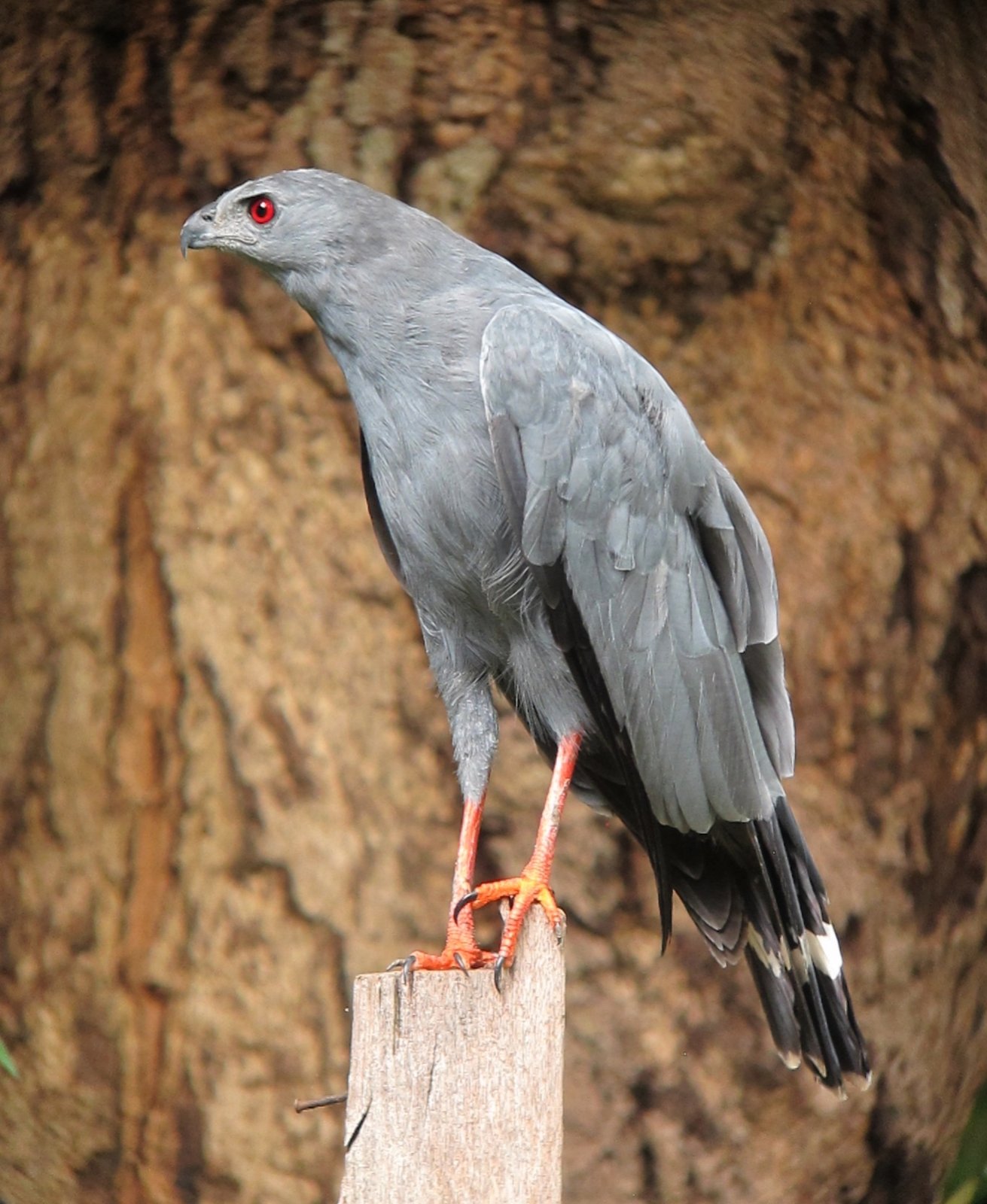
The Crane Hawk is a slender, slate-grey raptor with very long, orange-red legs. Thanks to a flexible joint in the tarsus it can also bend its leg backwards and so extract prey from tree holes, crevices and bromeliads. Although it resembles the harriers in shape, it is not closely related to the true harriers of the genus Circus.
Voice
A plaintive, whistled wheeoo, mainly around the nest and in flight.
Recording: Juan Freile — CC BY-NC-SA 4.0 · xeno-canto
Identification
43–51 cm; the female is slightly larger. Slender, with a small head, a long tail, rounded wings and long, thin, orange-red legs. Adults are slate grey to blackish grey, with red eyes; the belly and thighs often show fine pale barring. The tail is black with two white bands. In flight a white band or crescent at the base of the outer primaries is visible from below. Juveniles are browner, with pale streaks on the head and face and a paler belly.
Confusion species
Slate-colored Hawk Buteogallus schistaceus is stockier, with shorter legs, a shorter tail with a single white band and no white crescent in the wing. Snail Kite Rostrhamus sociabilis has a thin, strongly hooked bill and a white tail base. Great Black Hawk Buteogallus urubitinga is much larger and bulkier, with yellow legs and a white tail with a black terminal band.
Habitat
Forest near water: flooded forest, swamp forest, riparian forest, mangroves and lowland forest edges, and in the west also dry forest; mostly below 1000 m. It searches by clambering and flapping along trunks and in tree crowns for frogs, lizards, snakes, nestling birds and large insects, which it pulls from cavities and bromeliads. The nest is a stick cup high in a tree.
Where the bird is most at home, classified by the vegetation units of the Andes and the west coast.


Range and movements
In Colombia in the Caribbean lowlands, the Magdalena valley and the eastern lowlands. In Ecuador in the western lowlands and the Amazonian lowlands. In Peru in the north-west and the Amazonian lowlands. In Bolivia in the northern and eastern lowlands. Outside the guide area from Mexico to Venezuela, the Guianas, Brazil, Paraguay and northern Argentina.
- Resident
- dark = core range, pale = thinly spread
How and when to look
Search along rivers and swamp forest in the lowlands, for example from a boat, and look for a grey raptor clinging with half-spread wings to a trunk or in a bromeliad. In flight the long, orange-red legs and the white tail bands stand out.
Conservation status
Least Concern. Widespread, but dependent on forest and wetlands.
Scientific name
Geranospiza caerulescens | (Vieillot, 1817)
Vieillot described the species in 1817 as Sparvius caerulescens; because it was later moved to another genus, the author and year stand in brackets. The genus Geranospiza was introduced in 1847 by Kaup. The genus name comes from Greek geranos, 'crane', and spizias, 'hawk', for the long legs. The species name comes from Latin caerulescens, 'bluish'. The specimen the first description was based on came from Cayenne, French Guiana.