All species › Parrots › African and New World parrots › Tucuman Amazon
Tucuman Amazon | Amazona tucumana
Tucumanamazone | Amazona tucumana | Papagaio-tucumano
The Tucuman Amazon is a medium-sized amazon parrot of the montane forests of the southern Yungas, where it is tied to forests of alder and Podocarpus. In the guide area it occurs only in southern Bolivia. Outside the breeding season flocks move to lower slopes, where they gather at communal roosts.
Voice
Loud, harsh, screeching calls, mainly in flight and at the roost. Flocks call a lot when leaving and returning to the roost in the morning and evening.
Recording: Rosendo Manuel Fraga — CC BY-NC-SA 4.0 · xeno-canto
Identification
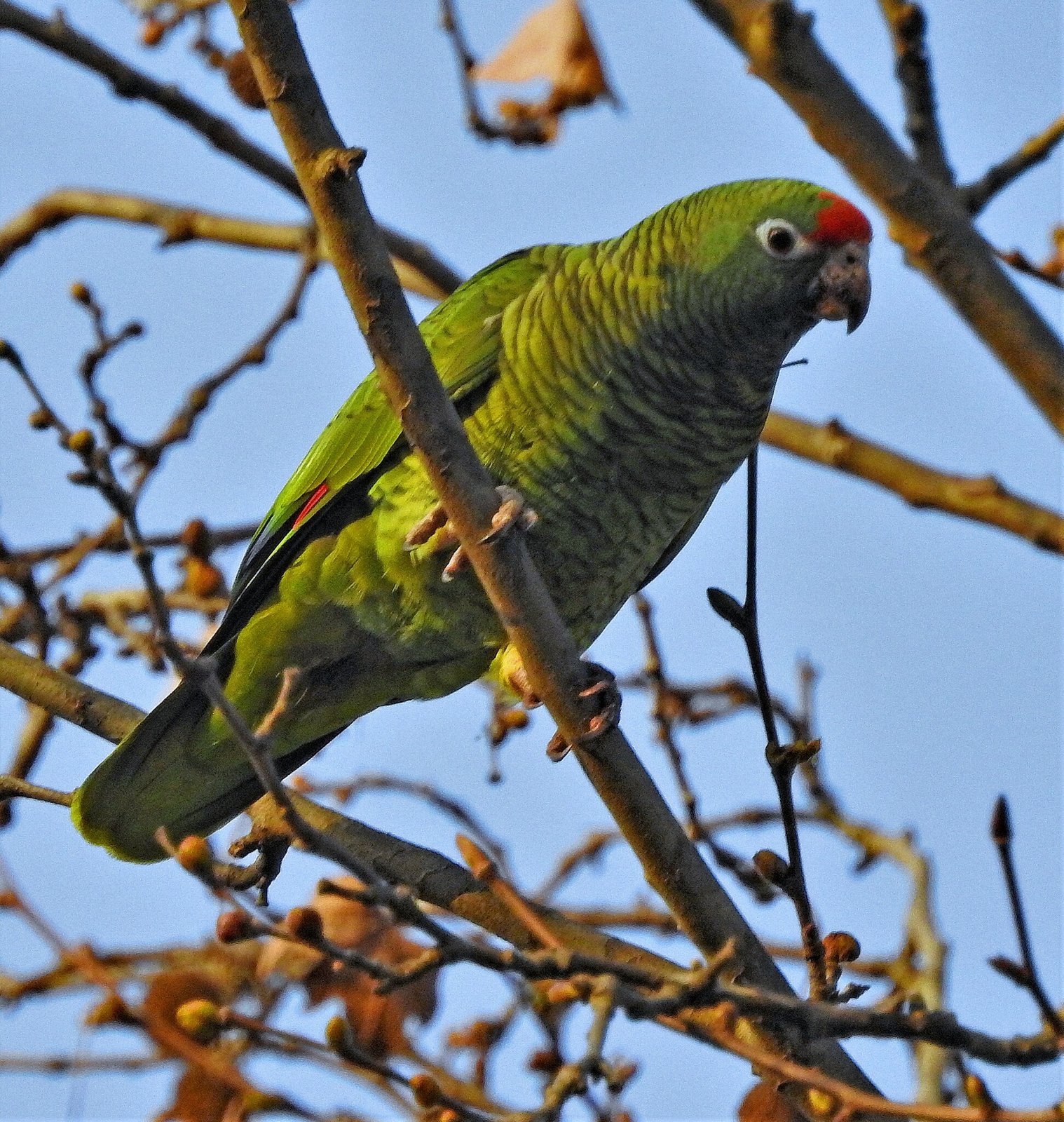
31 cm, stocky, with a short, rounded tail. The plumage is green, with black feather edges that give the head, neck and breast a scaly look. The forehead is red, sometimes also the lores; there is a bare white ring around the eye. The primary coverts are red and the tips of the primaries blue. The lower thighs are orange-yellow, the undertail coverts yellowish green and the tail tip yellowish. The bill is pale horn. The sexes are alike; juveniles have green thighs and less red on the head.
Confusion species
Turquoise-fronted Amazon Amazona aestiva is larger, with a blue forehead and yellow on the face, and lacks the scaly look. Scaly-headed Parrot Pionus maximiliani has a dark head with a bluish, scaly throat, red undertail coverts and no red on the forehead or wing. Speckle-faced Parrot Pionus tumultuosus has a purplish-red, white-speckled head and lives in more humid montane forest further north. In flight the red primary coverts of the Tucuman Amazon are visible.
Habitat
Montane forest of the southern Yungas, especially forests of alder (Alnus acuminata) and Podocarpus parlatorei, mostly between 1600 and 2600 m. From about August to October flocks move to lower forest down to about 500 m, in the transition to the Chaco. It eats fruit and seeds, mainly of Podocarpus, in winter many acacia seeds, and also flowers and fruit. It breeds from November to January in tree cavities, often old woodpecker holes in large trees.
Where the bird is most at home, classified by the vegetation units of the Andes and the west coast.


Range and movements
In Bolivia only in the south, on the eastern slope of the Andes in Chuquisaca, Tarija and southern Santa Cruz. Absent from Colombia, Ecuador, Peru and the Galápagos. Outside the guide area in north-western Argentina, south to Catamarca.
- Resident
- dark = core range, pale = thinly spread
How and when to look
Search the montane forests of Tarija, for example around Tariquía, for flocks flying along the slopes in the morning and evening. From August to October flocks can also be found lower down in the valleys.
Conservation status
Vulnerable. The population is estimated at fewer than 15,000 mature birds and is declining, mainly through trapping for the bird trade; loss of montane forest also plays a part.
Scientific name
Amazona tucumana | (Cabanis, 1885)
Cabanis described the species in 1885 as Chrysotis tucumana; because it was later moved to another genus, the author and year stand in brackets. The genus Amazona was introduced in 1830 by Lesson. The genus name is a Latinised form of Amazone, the name the French naturalist Buffon gave these parrots in the 18th century, believing they came from the Amazon jungles. The species name refers to Tucumán in Argentina, not necessarily the type locality. The specimen the first description was based on came from Tucumán, Argentina.