All species › Parrots › African and New World parrots › Red-lored Amazon
Red-lored Amazon | Amazona autumnalis
Geelwangamazone | Loro cachete amarillo | Papagaio-de-loro-vermelho
The Red-lored Amazon is an amazon parrot of the lowlands of Central America and north-western South America. In the guide area it is represented by the subspecies salvini, which occurs only in Colombia and has less yellow on the cheeks than Central American birds. Pairs and flocks fly between roost and feeding trees in the morning and evening, calling loudly.
Voice
Loud, harsh, biting calls, often repeated in pairs, and grating notes from feeding flocks. Flocks call a lot at the roost.
Recording: Juan Freile — CC BY-NC-SA 4.0 · xeno-canto
Identification
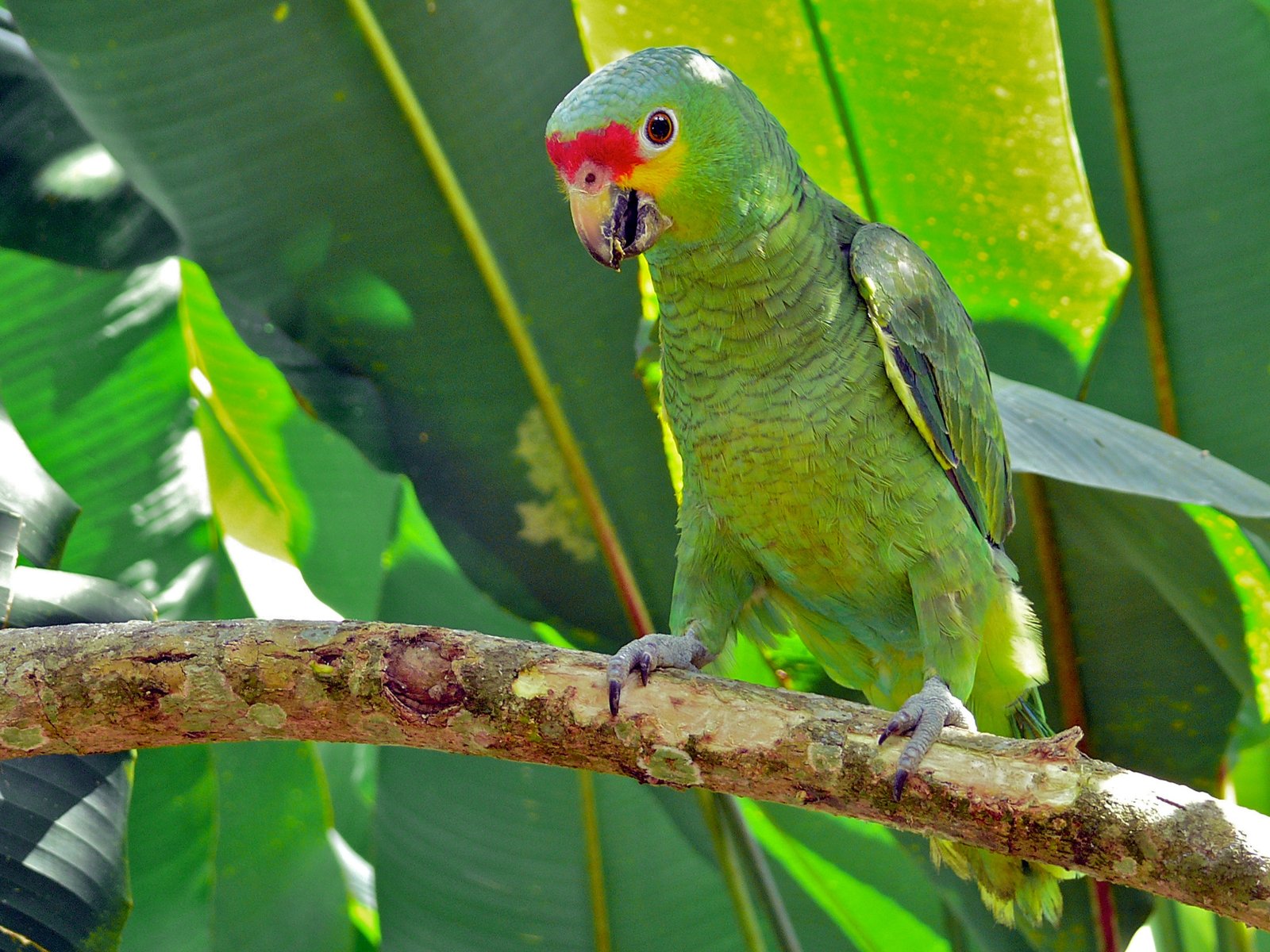
34 cm, with a short, square tail. The plumage is green. The forehead and lores are red, and the crown is blue to lilac. In the subspecies salvini the cheeks are mostly green, with at most a yellow wash; in Central American birds they are yellow. The wing has a red speculum on the secondaries and blue tips to the primaries. The upper mandible is horn-coloured with a dark tip, the lower mandible dark. The sexes are alike; juveniles have less red and blue on the head.
Confusion species
Lilacine Amazon Amazona lilacina has an entirely blackish bill and yellowish-green cheeks and lives in western Ecuador and the extreme south-west of Colombia. Yellow-crowned Amazon Amazona ochrocephala has a yellow forehead and red at the bend of the wing, without a red forehead. Mealy Amazon Amazona farinosa is larger, with a broad white eye-ring and a powdery back. Blue-headed Parrot Pionus menstruus is smaller, with a blue head and red undertail coverts.
Habitat
Humid lowland forest, forest edges, secondary forest and semi-open country with scattered trees, also mangroves and plantations, from sea level to about 800 m. It eats fruit, seeds, nuts and flowers in the canopy. It nests in tree cavities and roosts communally.
Where the bird is most at home, classified by the vegetation units of the Andes and the west coast.


Range and movements
In Colombia in the Pacific and Caribbean lowlands and in the Sinú and Magdalena valleys. In Ecuador replaced by Lilacine Amazon. Absent from Peru, Bolivia and the Galápagos. Outside the guide area from eastern Mexico through Central America to north-western Venezuela.
- Resident
- dark = core range, pale = thinly spread
How and when to look
In the morning and early evening watch for flocks flying over forest and pasture in the Chocó or the Caribbean lowlands of Colombia, calling loudly. Fruiting trees at forest edges attract pairs and small groups.
Conservation status
Least Concern. Locally the population is declining through deforestation and trapping for the bird trade; the species partly adapts to semi-open country.
Scientific name
Amazona autumnalis | (Linnaeus, 1758)
Linnaeus described the species in 1758 as Psittacus autumnalis; because it was later moved to another genus, the author and year stand in brackets. The genus Amazona was introduced in 1830 by Lesson. The genus name is a Latinised form of Amazone, the name the French naturalist Buffon gave these parrots in the 18th century, believing they came from the Amazon jungles. The species name comes from Latin autumnalis, 'of autumn'; the reason for this name is unclear. The specimen the first description was based on came from Southern Mexico.