All species › Parrots › African and New World parrots › Tui Parakeet
Tui Parakeet | Brotogeris sanctithomae
Tuiparkiet | Perico tui | Periquito-testinha
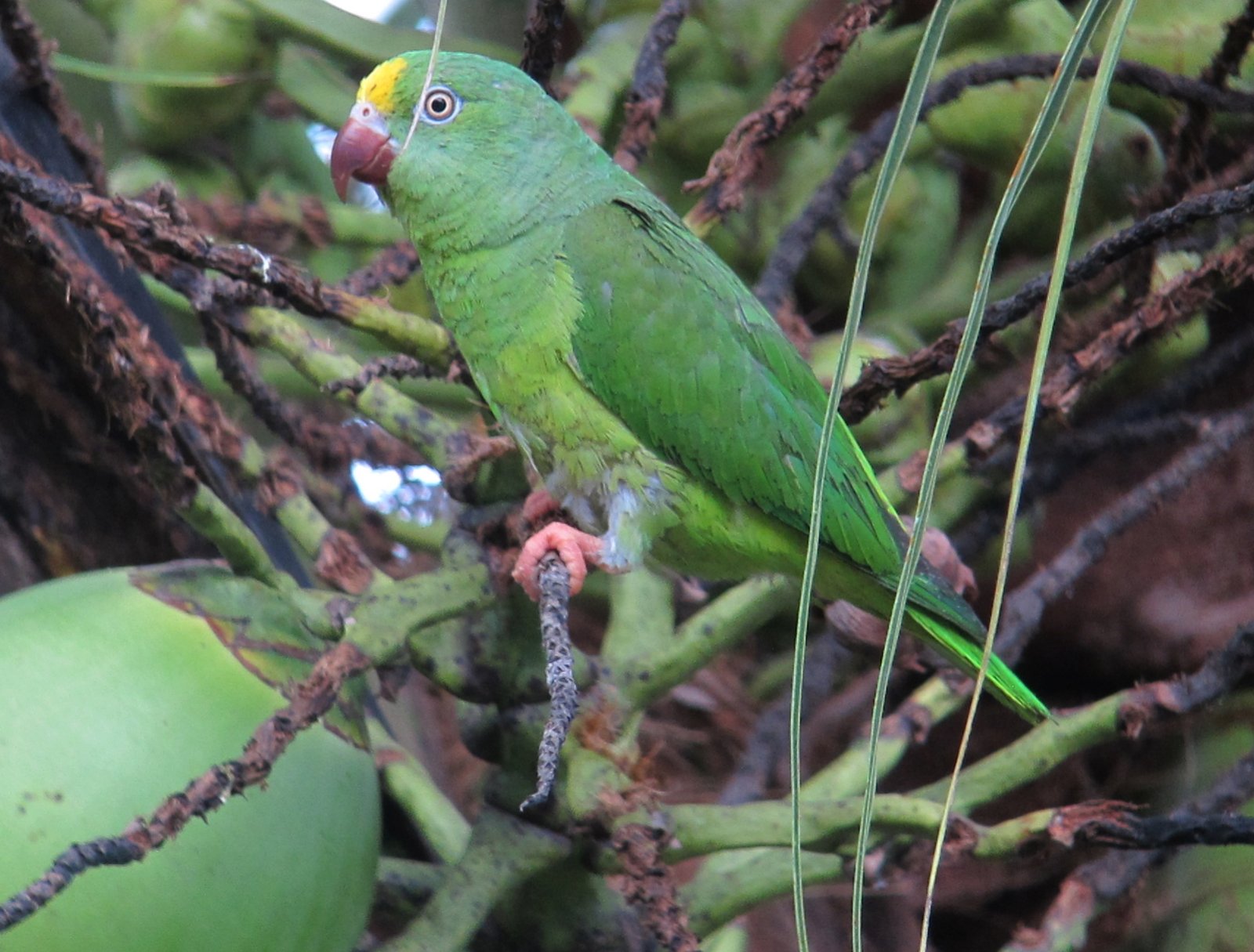
The Tui Parakeet is a small, green Brotogeris parakeet with a yellow forehead that lives mainly along the large rivers of Amazonia. Flocks fly fast with loud chattering over the banks and river islands. It also occurs in gardens and parks of riverside towns.
Voice
A high, shrill, rapidly repeated shreek and continuous chattering, mainly in flight.
Recording: Dante Buzzetti — CC BY-NC-SA 4.0 · xeno-canto
Identification
17 cm, with a fairly short, pointed tail and a brown bill. The plumage is bright green, slightly yellower below. The forehead and forecrown are yellow. Birds of the west (takatsukasae) also have a yellow patch behind the eye. In flight the flight feathers are darker bluish green. The sexes are alike. Juveniles have less yellow on the head.
Confusion species
Cobalt-winged Parakeet Brotogeris cyanoptera lacks the yellow forehead but has an orange chin spot and cobalt-blue flight feathers, and lives mainly in the forest canopy. White-winged Parakeet Brotogeris versicolurus is larger, with a longer tail and white and yellow in the wing. Cobalt-rumped Parrotlet Forpus xanthopterygius is smaller, with a short tail and a pale bill. Manu Parrotlet Nannopsittaca dachilleae has a pale blue forehead.
Habitat
Flooded forest (várzea), forest and scrub on river islands, forest edges along rivers, young forest, gardens and parks in villages and towns, mostly below 400 m. It eats fruit, seeds, flowers and nectar. It nests in a tree cavity or in a termite nest.
Where the bird is most at home, classified by the vegetation units of the Andes and the west coast.


Range and movements
In Colombia in the far south, along the Amazon near Leticia. In Ecuador scarce in the east, along the large rivers such as the Napo. In Peru in the north-eastern lowlands, along the Amazon, the Marañón and the Ucayali, and more scarcely south to Madre de Dios. In Bolivia in the northern lowlands. Absent from the Galápagos. Outside the guide area along the Amazon in Brazil.
- Resident
- dark = core range, pale = thinly spread
How and when to look
Along the banks of the Amazon at Iquitos and Leticia, where flocks fly over the river and between the trees along the waterfront. In flowering trees look for the yellow forehead.
Conservation status
Least Concern. The species is common over most of its range and adapts to landscapes altered by people.
Scientific name
Brotogeris sanctithomae | (Müller, 1776)
Müller described the species in 1776 as Psittacus St. Thoma; because it was later moved to another genus, the author and year stand in brackets. The genus Brotogeris was introduced in 1825 by Vigors. The genus name comes from Greek brotos, 'man, mortal', and gērus, 'voice, speech', for the ability to mimic human speech. The species name means 'of Saint Thomas': Müller wrongly believed the bird came from the island of St Thomas. The specimen the first description was based on came from Brazilian Amazon.