All species › Parrots › African and New World parrots › White-winged Parakeet
White-winged Parakeet | Brotogeris versicolurus
Witvleugelparkiet | Catita Versicolor | Periquito-de-asa-branca
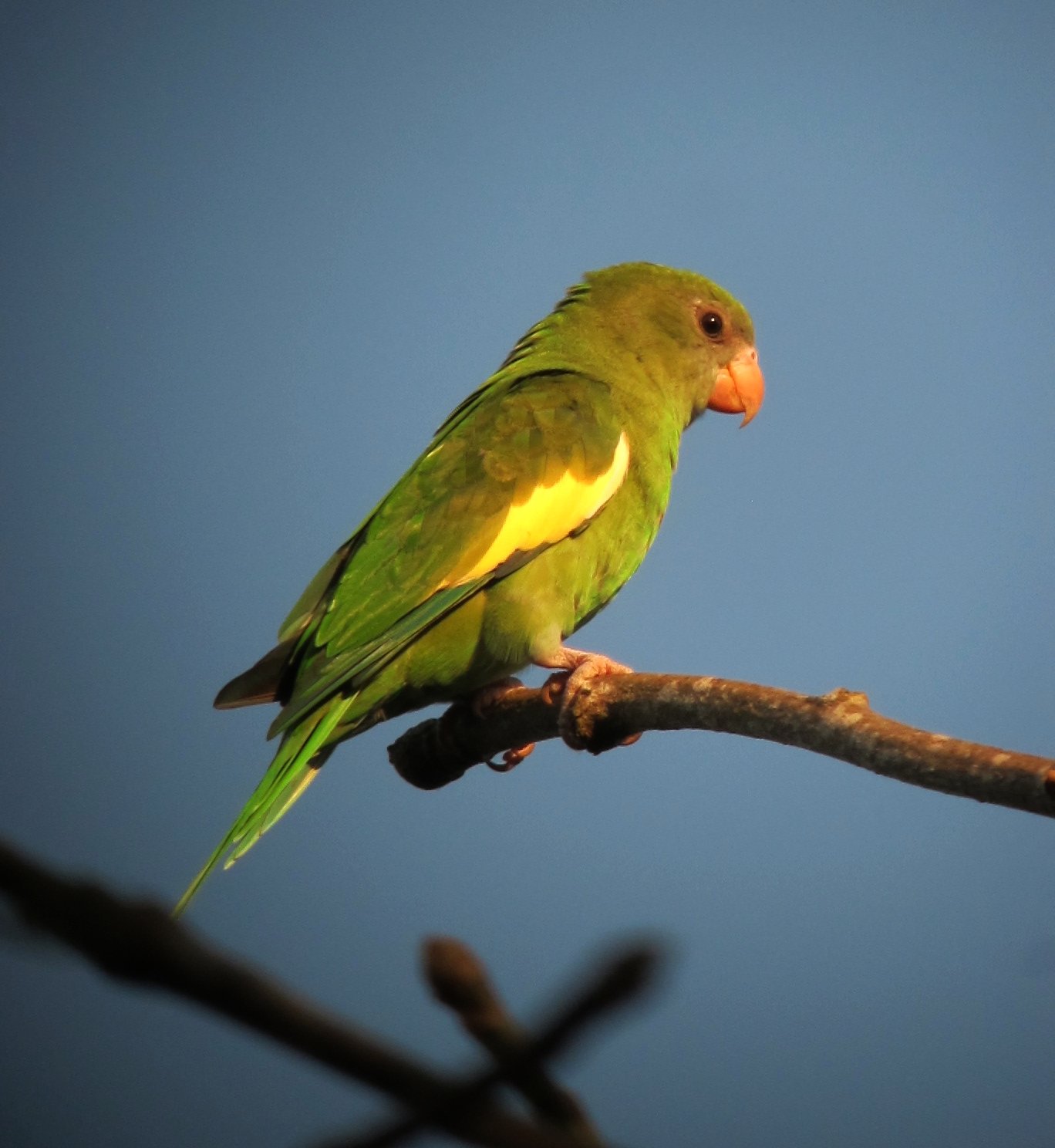
The White-winged Parakeet is a slender, green parakeet of the rivers of Amazonia, with white and yellow in the wing that shows mainly in flight. It lives in flocks on river islands and along the banks and also occurs in towns. In Lima there is a feral population descended from escaped cage birds.
Voice
A shrill, grating cheet and loud, harsh chattering, mainly from flocks in flight.
Recording: JAYRSON ARAUJO DE OLIVEIRA — CC BY-NC-SA 4.0 · xeno-canto
Identification
21–23 cm, with a fairly long, pointed tail and a pale, horn-coloured bill. The plumage is green, slightly greyish on the head and face. The inner primaries and the secondaries are white and the greater coverts yellow; in flight this forms a broad white and yellow wing patch, and at rest a white and yellow stripe along the folded wing. The sexes are alike. Juveniles have less white in the wing.
Confusion species
Yellow-chevroned Parakeet Brotogeris chiriri has only yellow and no white in the wing and lives in Bolivia, outside the range of White-winged Parakeet. Tui Parakeet Brotogeris sanctithomae is smaller, with a shorter tail, a yellow forehead and a brown bill. Cobalt-winged Parakeet Brotogeris cyanoptera is smaller, with cobalt-blue flight feathers and an orange chin spot.
Habitat
Forest and scrub on river islands, flooded forest (várzea), forest edges along rivers, gardens and parks in towns and villages; mostly below 300 m, feral also on the coast at Lima. It eats fruit, seeds, flowers and nectar. It nests in a termite nest in a tree, sometimes in a cavity in a palm.
Where the bird is most at home, classified by the vegetation units of the Andes and the west coast.


Range and movements
In Colombia in the far south, along the Amazon near Leticia. In Ecuador scarce in the far east, along the lower Napo. In Peru in the north-eastern lowlands, along the Amazon, the lower Marañón and the Ucayali; in addition a feral population in Lima. Absent from Bolivia and the Galápagos. Outside the guide area along the Amazon in Brazil to French Guiana; established in Florida and Puerto Rico, among other places.
- Resident
- dark = core range, pale = thinly spread
How and when to look
In Iquitos and on the river islands of the Amazon, where flocks cross the river in the morning and evening between roost and feeding areas. In flight look for the white wing patch. In Lima in parks with flowering trees.
Conservation status
Least Concern. The species is common along the large rivers and adapts well to urban areas; in the past it was trapped on a large scale for the cage-bird trade.
Scientific name
Brotogeris versicolurus | (Müller, 1776)
Müller described the species in 1776 as Psittacus versicolurus; because it was later moved to another genus, the author and year stand in brackets. The genus Brotogeris was introduced in 1825 by Vigors. The genus name comes from Greek brotos, 'man, mortal', and gērus, 'voice, speech', for the ability to mimic human speech. The species name comes from Latin versicolor, 'variegated', and Greek -ouros, 'tailed', from oura, 'tail'. The specimen the first description was based on came from Cayenne, French Guiana.