All species › Parrots › African and New World parrots › Yellow-chevroned Parakeet
Yellow-chevroned Parakeet | Brotogeris chiriri
Chiririparkiet | Catita chirirí | Periquito-de-encontro-amarelo
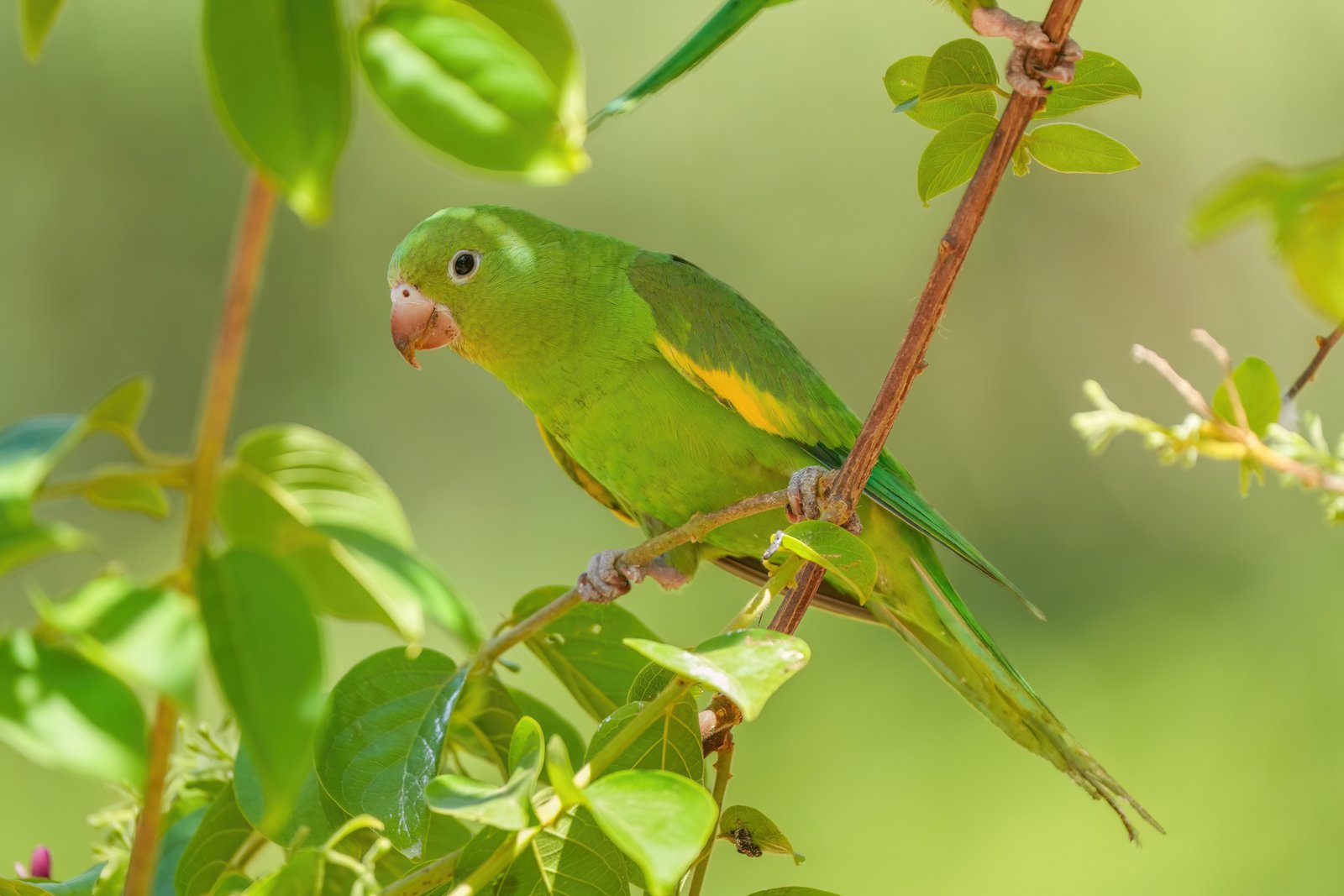
The Yellow-chevroned Parakeet is a slender, green parakeet with a yellow stripe along the folded wing. In the guide area it lives in the lowlands of Bolivia, in dry forest, savanna and built-up areas. It was formerly lumped with White-winged Parakeet, but lacks the white in the wing.
Voice
A shrill, grating chiree and loud chattering, often from flocks in flight.
Recording: Franco Vushurovich — CC BY-NC-SA 4.0 · xeno-canto
Identification
21–23 cm, with a fairly long, pointed tail and a pale, horn-coloured bill. The plumage is green, slightly yellower below. The greater wing coverts are bright yellow and form a yellow stripe along the folded wing and a yellow band in flight. The flight feathers are green to bluish green, without white. The sexes are alike. Juveniles have less yellow in the wing.
Confusion species
White-winged Parakeet Brotogeris versicolurus has white as well as yellow in the wing and lives along the rivers of northern Amazonia, not in Bolivia. Cobalt-winged Parakeet Brotogeris cyanoptera and Tui Parakeet Brotogeris sanctithomae are smaller and have no yellow in the wing. Monk Parakeet Myiopsitta monachus is larger, with a grey face and a grey breast.
Habitat
Dry forest and Chaco forest, cerrado and savanna with trees, edges of humid and riverine forest, fields with trees, gardens and parks in villages and towns; mainly in the lowlands, locally to roughly 1500 m in the Andean foothills. It eats fruit, seeds, flowers and nectar. It nests in a tree cavity or in a termite nest.
Where the bird is most at home, classified by the vegetation units of the Andes and the west coast.


Range and movements
In Bolivia in the northern, eastern and southern lowlands, in Beni, Santa Cruz, Chuquisaca and Tarija, and in the lower Andean foothills. Absent from Colombia, Ecuador and the Galápagos; in Peru at most exceptional in the far south-east. Outside the guide area in central and southern Brazil, Paraguay and northern Argentina.
- Resident
- dark = core range, pale = thinly spread
How and when to look
In parks and avenues of Santa Cruz de la Sierra and in dry forest around the city, where flocks fly with loud chattering between flowering trees. In flight look for the yellow wing band without white.
Conservation status
Least Concern. The species is common over most of its range and frequent in built-up areas; it is trapped for the cage-bird trade.
Scientific name
Brotogeris chiriri | (Vieillot, 1818)
Vieillot described the species in 1818 as Psittacus chiriri; because it was later moved to another genus, the author and year stand in brackets. The genus Brotogeris was introduced in 1825 by Vigors. The genus name comes from Greek brotos, 'man, mortal', and gērus, 'voice, speech', for the ability to mimic human speech. The species name comes from chiriri, the onomatopoeic Guaraní name that Félix de Azara recorded for this parakeet in Paraguay. The specimen the first description was based on came from Paraguay.