All species › Birds of prey › Kites, Old World vultures, eagles and hawks › Variable Hawk
Variable Hawk | Geranoaetus polyosoma
Roodrugbuizerd | Aguilucho variable | Gavião-variável
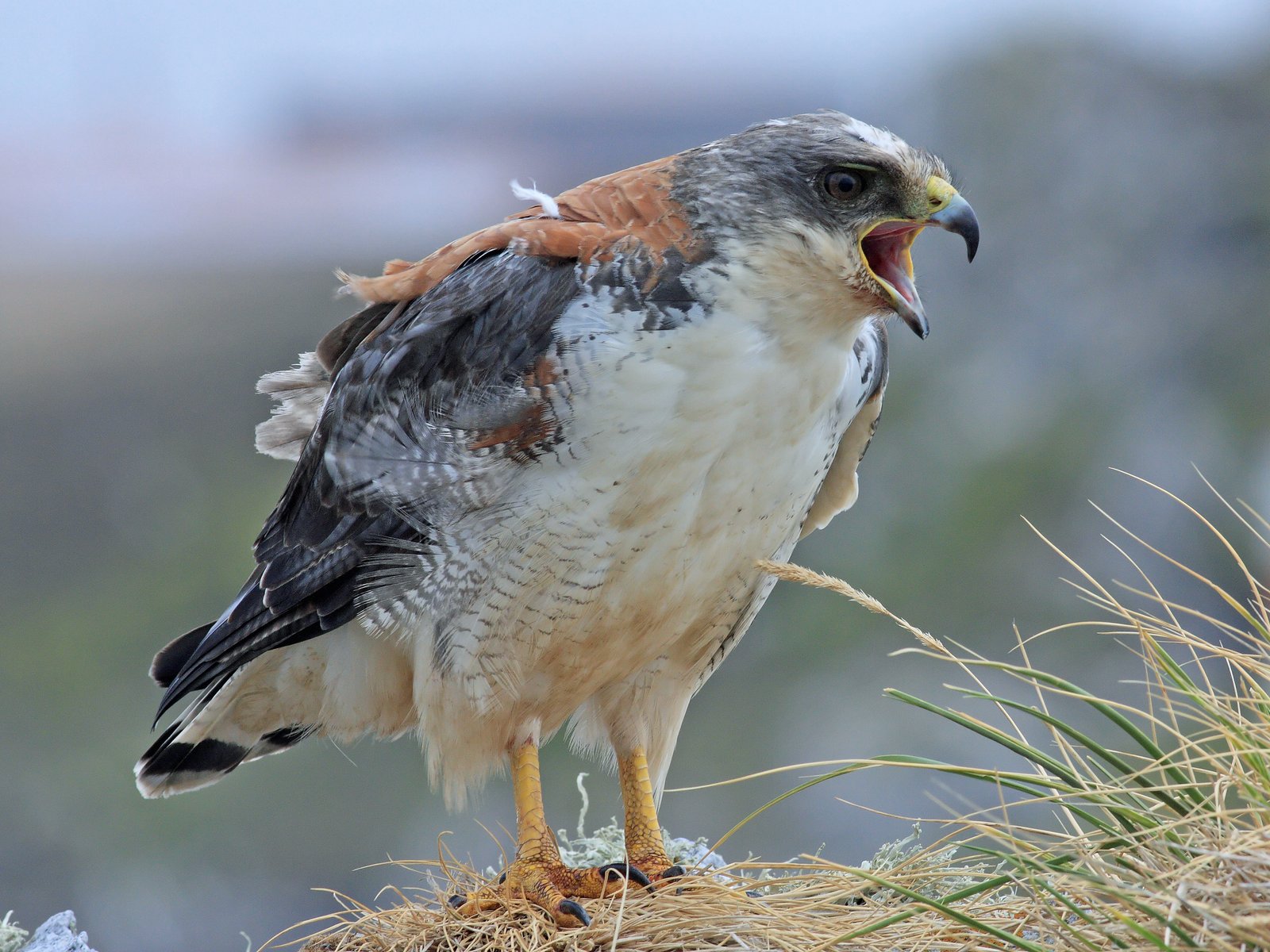
The Variable Hawk earns its name: there are pale, rufous and dark morphs, and male and female differ. All adults have a white tail with a black band. It is the commonest buteo of the open high Andes and of the dry Pacific coast.
Voice
A repeated, hoarse kyaa-kyaa-kyaa and a laughing cackle, mainly at the nest and in display flight.
Recording: Niels Krabbe — CC BY-NC-SA 3.0 · xeno-canto
Identification
46–56 cm; the female is larger than the male. In the pale morph the male is slate grey above and white below; the female also has a rufous back and often a grey head. In the dark morphs the underparts are wholly or partly rufous, dark grey or barred. In all morphs the tail is white with fine grey barring and a broad black band just before the tip. In flight the wings are broad, with dark tips and a finely barred trailing edge. Birds from the puna are on average larger and longer-winged and were formerly treated as a separate species, Geranoaetus poecilochrous. Juveniles are brown above and buff below with dark streaks, and have a greyish, finely barred tail.
Confusion species
Black-chested Buzzard-Eagle Geranoaetus melanoleucus is larger, with a very short, wedge-shaped dark tail and a dark breast. White-tailed Hawk Geranoaetus albicaudatus has longer wings that extend beyond the tail tip on a perched bird, and lives mainly in lowland savannas. Short-tailed Hawk Buteo brachyurus is smaller and has a finely barred tail that is not white. Juveniles are best identified by silhouette and the pale, finely barred tail.
Habitat
Open, dry to humid country from sea level to above 4500 m: páramo, puna, rocky slopes and canyons, fields and terraces in the Andes, and in the west coastal desert, lomas and dry scrub. It perches on posts, rocks and roadside poles and hunts rodents, reptiles, birds and large insects, often hovering in the wind. The nest is on a rock ledge, in a tree or cactus, or on a pole.
Where the bird is most at home, classified by the vegetation units of the Andes and the west coast.


Range and movements
In Colombia mainly in the south, in the Andes of Nariño and Cauca. In Ecuador throughout the Andes and in the dry west down to the coast. In Peru along the whole coast and in the Andes. In Bolivia in the Andes and on the altiplano. Outside the guide area through Chile and Argentina to Tierra del Fuego and the Falkland Islands; birds from the far south move north in winter.
- Resident
- dark = core range, pale = thinly spread
How and when to look
Drive through open high country or along the Peruvian coastal desert and watch for hawks on roadside posts. The white tail with a black band shows in flight in all morphs.
Conservation status
Least Concern. Widespread and common in open country.
Scientific name
Geranoaetus polyosoma | (Quoy & Gaimard, 1824) (GBIF: Buteo polyosoma)
Quoy & Gaimard described the species in 1824 as Falco polyosoma; because it was later moved to another genus, the author and year stand in brackets. The genus Geranoaetus was introduced in 1844 by Kaup. The genus name comes from Greek geranos, 'crane', and aetos, 'eagle'. The species name comes from Greek polios, 'grey', and sōma, 'body'. The specimen the first description was based on came from Falkland Islands.