All species › Birds of prey › Kites, Old World vultures, eagles and hawks › White-tailed Hawk
White-tailed Hawk | Geranoaetus albicaudatus
Witstaartbuizerd | Gavilán coliblanco | Gavião-de-rabo-branco
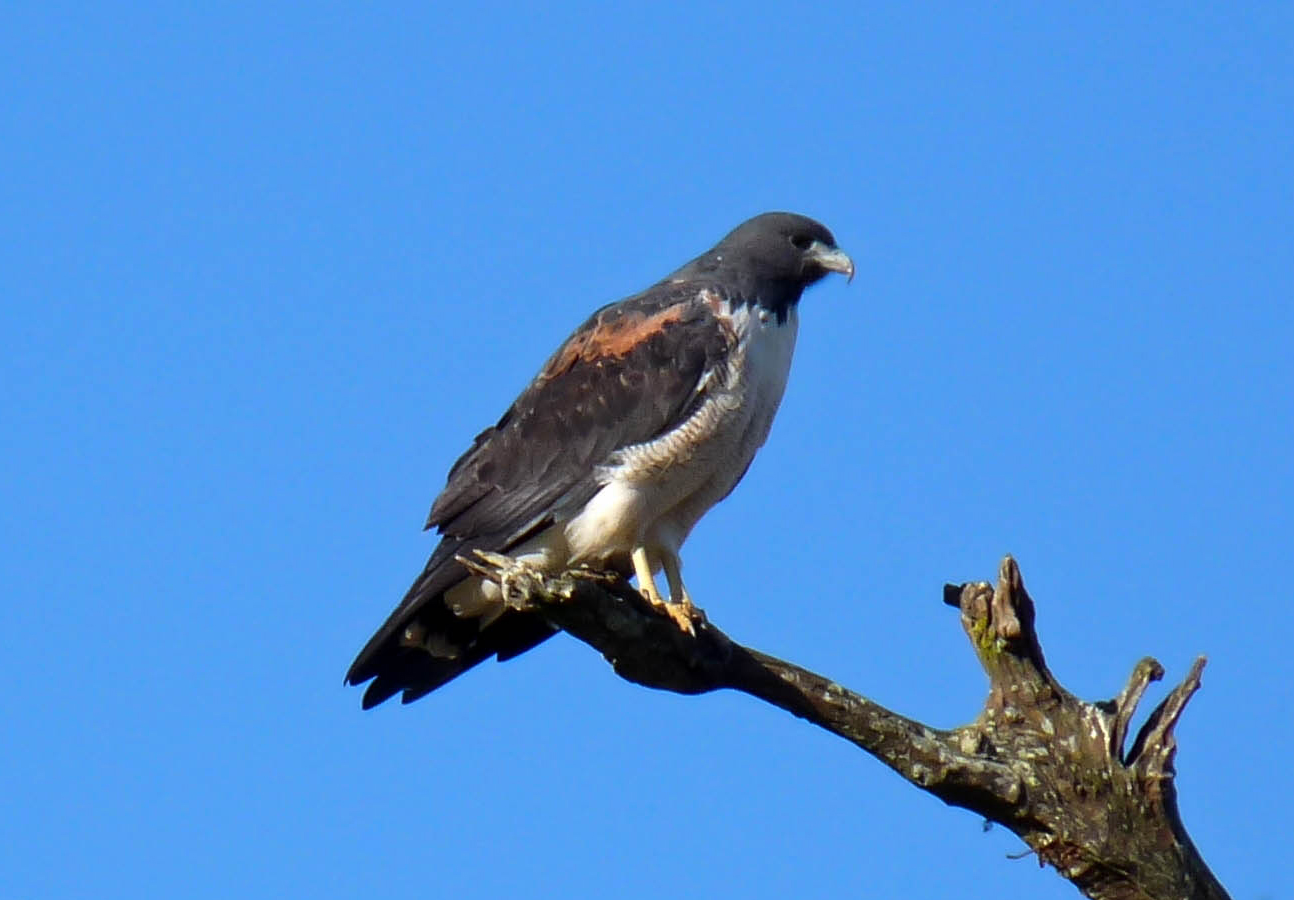
The White-tailed Hawk is a large, long-winged buteo of open savanna and grassland, with a white tail with a black band just before the tip. Adults have rufous shoulders, which can also be seen on a perched bird. In the guide area it lives mainly in the savannas of Colombia and eastern Bolivia.
Voice
Usually silent. At the nest a high, bleating, laughing ke-ke-ke-ke or kla-ha, kla-ha.
Recording: JAYRSON ARAUJO DE OLIVEIRA — CC BY-NC-SA 4.0 · xeno-canto
Identification
52–60 cm; the female is larger than the male. The wings are long and broad and on a perched bird extend beyond the tail tip. The adult is dark slate grey on the head and back, with rufous shoulders, a white throat and white underparts with fine grey barring on the flanks. The tail is white, finely barred grey, with a broad black band just before the tip. There is also a dark morph, which is grey-black but has the same white tail with a black band. In flight the underwings are white with dark tips to the flight feathers. Juveniles are blackish brown with a white patch on the breast and a greyish, finely barred tail without a clear band; adult plumage is reached only in the third year.
Confusion species
Variable Hawk Geranoaetus polyosoma also has a white tail with a black band, but is smaller, has wings that do not reach the tail tip, and lives mainly in the high mountains and on the Pacific coast. Black-chested Buzzard-Eagle Geranoaetus melanoleucus has a very short, wedge-shaped dark tail and a dark breast. Savanna Hawk Buteogallus meridionalis is rufous, with long legs and a black tail with a white band. Dark juveniles resemble the dark morph of Short-tailed Hawk Buteo brachyurus, which is smaller and has shorter wings.
Habitat
Open savanna, grassland with scattered trees and shrubs, pasture and cattle country, also around fields; mainly in the lowlands, in Colombia locally high into the Andes. It soars high or hovers in the wind and hunts rodents, reptiles, large insects and birds; it is attracted to grass fires to catch fleeing prey. The nest is a stick nest at the top of an isolated tree or shrub.
Where the bird is most at home, classified by the vegetation units of the Andes and the west coast.


Range and movements
In Colombia in the savannas of the Caribbean lowlands, in the llanos and locally in open country in the Andes. In Peru only scarce in the savannas of the extreme south-east (Pampas del Heath). In Bolivia in the lowland savannas of the north and east. Not known from Ecuador. Outside the guide area from Texas and Mexico through Central America to Venezuela, the Guianas and eastern South America into Argentina.
- Resident
- dark = core range, pale = thinly spread
How and when to look
Search along roads through the llanos and the savannas of Beni and Santa Cruz, where birds perch on posts or isolated trees or hover low over the grass. Several birds sometimes gather at grass fires.
Conservation status
Least Concern. Widespread and fairly common in open savanna; locally it benefits from forest clearance for cattle.
Scientific name
Geranoaetus albicaudatus | (Vieillot, 1816) (GBIF: Buteo albicaudatus)
Vieillot described the species in 1816 as Buteo albicaudatus; because it was later moved to another genus, the author and year stand in brackets. The genus Geranoaetus was introduced in 1844 by Kaup. The genus name comes from Greek geranos, 'crane', and aetos, 'eagle'. The species name comes from Latin albus, 'white', and caudatus, 'tailed'. The specimen the first description was based on came from Rio de Janeiro, Brazil.