All species › Birds of prey › Kites, Old World vultures, eagles and hawks › White Hawk
White Hawk | Pseudastur albicollis
Grote bonte buizerd | Aguililla blanca | Gavião-branco
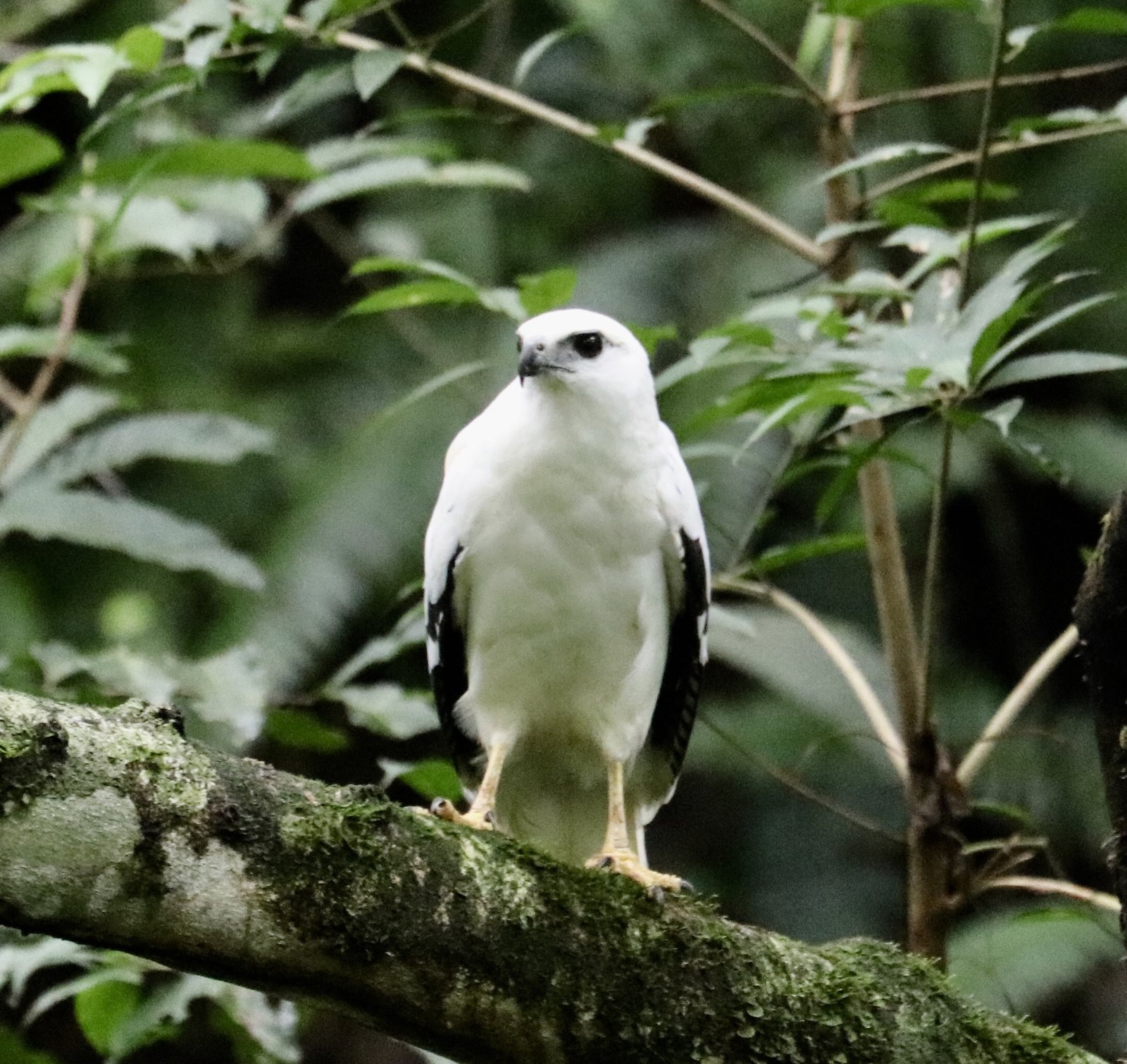
The White Hawk is a large, mostly white forest hawk of the humid lowlands and foothills. It often soars over the canopy in the morning, when its white body stands out against the green of the forest. In the guide area it occurs in all four countries, east and west of the Andes.
Voice
A hoarse, drawn-out, hissing scream, shhhreeeeer, often in flight.
Recording: JAYRSON ARAUJO DE OLIVEIRA — CC BY-NC-SA 4.0 · xeno-canto
Identification
46–56 cm; the female is larger than the male. The Amazonian form is almost entirely white, with black spots on the wing coverts, black tips to the primaries and a black tail with a broad white band. Birds of western Colombia have much blacker backs and wings. The eye is dark, the cere grey and the legs yellow. In flight the wings are broad and rounded and white below with dark tips. Juveniles have more black streaking on the head and back.
Confusion species
Grey-backed Hawk Pseudastur occidentalis in western Ecuador and north-western Peru has a dark grey back, a white tail with a black subterminal band and a streaked head. Black-faced Hawk Leucopternis melanops and White-browed Hawk Leucopternis kuhli are smaller, with a black mask, a black back and an orange cere. King Vulture Sarcoramphus papa shows a black trailing edge to the wings and a short black tail in flight.
Habitat
Humid lowland forest, foothill forest and lower montane forest, especially in hilly terrain, also forest edges and large clearings. Mainly below about 1500 m, locally higher. It often perches quietly in the canopy for long periods and hunts snakes, lizards, frogs and small mammals. The nest is a stick nest high in a tree.
Where the bird is most at home, classified by the vegetation units of the Andes and the west coast.


Range and movements
In Colombia in the Pacific lowlands, the Andean foothills, the Magdalena Valley and Amazonia. In Ecuador in the eastern lowlands and foothills and in the north-west. In Peru in the eastern lowlands and on the lower east slope of the Andes. In Bolivia in the north and centre of the lowlands and on the lower slopes. Outside the guide area from southern Mexico to the Guianas and Brazilian Amazonia.
- Resident
- dark = core range, pale = thinly spread
How and when to look
Search in the morning from a viewpoint or canopy tower over foothill forest, when the birds soar above the canopy. It also sometimes perches in the open on a branch along forest edges.
Conservation status
Least Concern. Widespread, but dependent on forest and therefore locally declining through deforestation.
Scientific name
Pseudastur albicollis | (Latham, 1790) (GBIF: Leucopternis albicollis)
Latham described the species in 1790 as Falco albicollis; because it was later moved to another genus, the author and year stand in brackets. The genus Pseudastur was introduced in 1849 by Gray. The genus name combines Greek pseudo-, 'false', with Latin astur, 'hawk'. The species name combines Latin albus, 'white', with collis, 'neck', thus 'white-necked'. The specimen the first description was based on came from Cayenne, French Guiana.