All species › Passerines › Finches, euphonias and allies › Violaceous Euphonia
Violaceous Euphonia | Euphonia violacea
Violette organist | Eufonia violácea | Gaturamo-verdadeiro
The Violaceous Euphonia is a euphonia of forest edges and gardens in north-eastern South America, from Venezuela and the Guianas to eastern Brazil and north-eastern Argentina. It is known as a skilful mimic of other birds. In the guide area it has only been recorded as a very rare vagrant.
Voice
A varied, chattering song with clear whistles and many imitated calls and alarm notes of other birds. The call is a clear, repeated dee-dee.
Recording: Marcos E. Sosa — CC BY-NC-SA 4.0 · xeno-canto
Identification
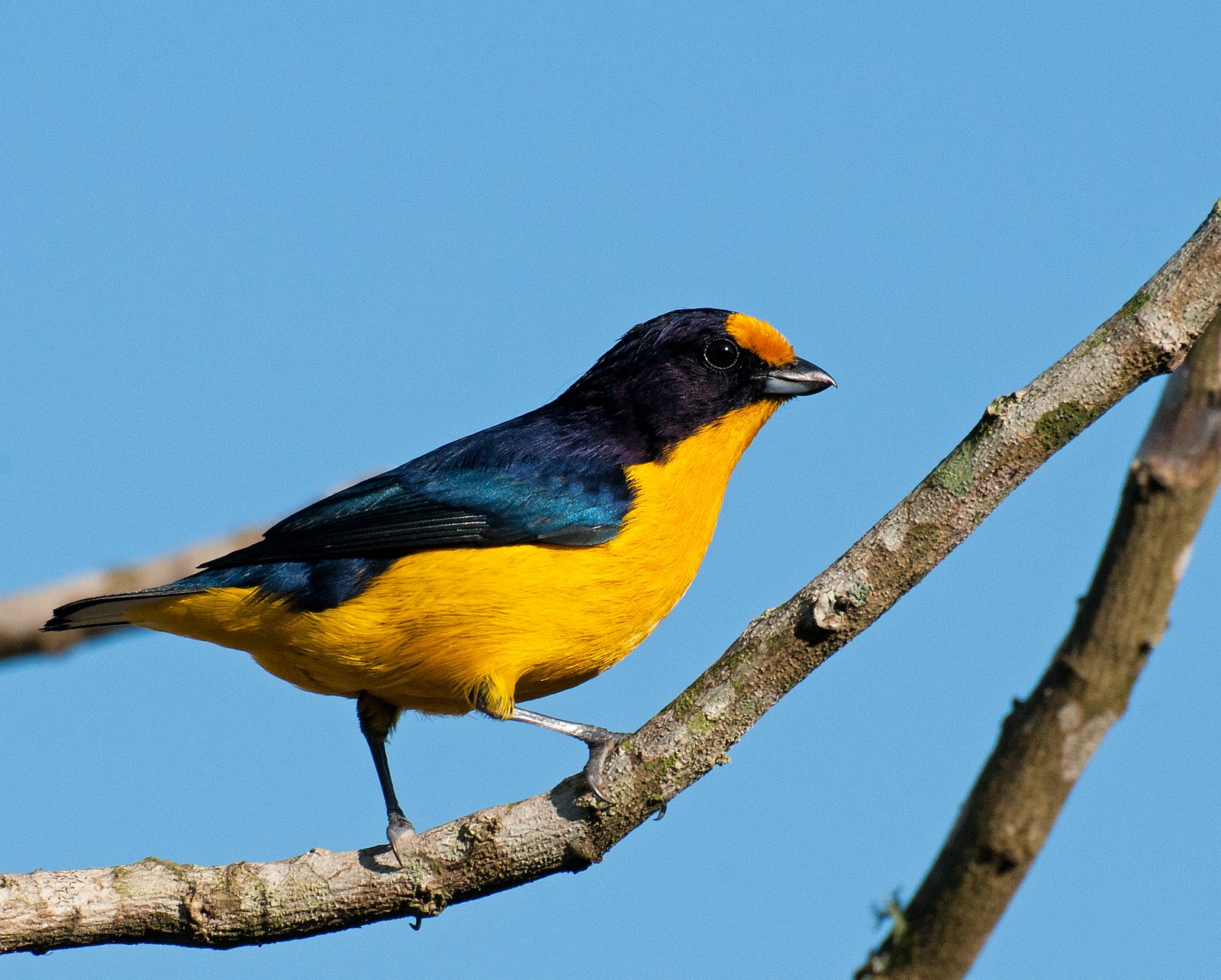
11 cm, with a short, thick bill. The male is glossy dark violet-blue above, with a yellow forecrown reaching to about above the eye. The throat and underparts are deep orange-yellow; the throat is therefore yellow, not dark. There are white spots on the underside of the tail. The female is olive-green above and olive-yellow below, without grey. Young males resemble the female.
Confusion species
Thick-billed Euphonia Euphonia laniirostris is the most similar: the male of that species also has a yellow throat, but it has a thicker bill, a yellow crown patch extending further back and slightly paler, less orange underparts. The females are almost identical. Dark-throated euphonias such as Purple-throated Euphonia Euphonia chlorotica can be ruled out at once in males. Any record in the guide area needs good photographs or sound recordings.
Habitat
In its own range forest edges, secondary forest, open woodland, plantations, gardens and parks, mainly in the lowlands up to about 1000 m. It feeds on mistletoe berries and other small fruit. The nest is a domed structure with a side entrance, hidden in a cavity, a bank or among epiphytes.
Where the bird is most at home, classified by the vegetation units of the Andes and the west coast.


Range and movements
In the guide area known only from a single recent record in Colombia, the first for the country. Not known from Ecuador, Peru, Bolivia or the Galápagos. Outside the guide area in eastern and southern Venezuela, the Guianas, Trinidad and Tobago, eastern and southern Brazil, Paraguay and north-eastern Argentina.
How and when to look
A Violaceous Euphonia in the guide area is most likely in eastern Colombia, at forest edges along the border with Venezuela. On every yellow-throated euphonia, check the bill thickness and the extent of the yellow crown patch.
Conservation status
Least Concern. In parts of its range the species is trapped as a cage bird, but it is widespread and tolerates man-altered landscapes.
Scientific name
Euphonia violacea | (Linnaeus, 1758)
Linnaeus described the species in 1758 as Fringilla violacea; because it was later moved to another genus, the author and year stand in brackets. The genus Euphonia was introduced in 1806 by Desmarest, A-G. The genus name comes from Greek euphōnos, from eu 'good' and phōnē 'sound', meaning 'sweet-voiced', after the calls of these birds. The species name is Latin violaceus, 'violet', after the violet-blue upperparts. The specimen the first description was based on came from Suriname.