All species › Passerines › Finches, euphonias and allies › Tawny-capped Euphonia
Tawny-capped Euphonia | Euphonia anneae
Bruinkaporganist | Eufonia coronirrufa | Gaturamo-de-coroa-fulva
The Tawny-capped Euphonia is a euphonia of the humid montane forest of Costa Rica and Panama, with a rufous cap instead of the yellow crown of most of its relatives. It reaches the guide area only in the far north-west of Colombia, in the mountains on the Panama border. It lives higher on the slopes than most other euphonias.
Voice
Harsh, nasal calls, often repeated. The song consists of a note or short phrase repeated two to four times, followed by a different one.
Recording: Yoann Blanchon — CC BY-NC-SA 4.0 · xeno-canto
Identification
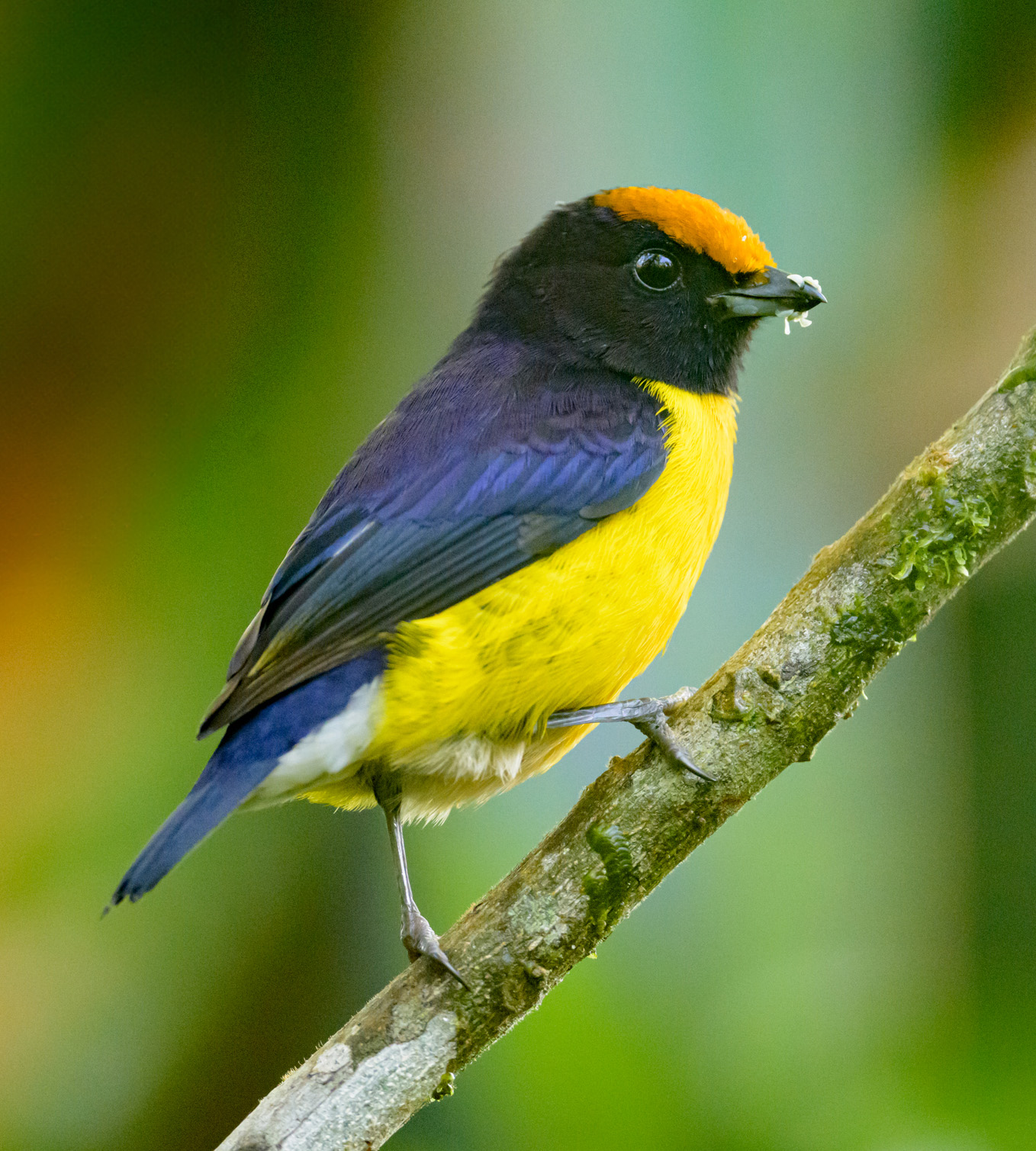
10–11 cm, with a short, thick bill. The male has a rufous to chestnut crown; the rest of the head, the throat and the upperparts are glossy blue-black. The underparts are yellow with a white centre to the lower belly and white undertail coverts; in birds of eastern Panama and Colombia the underparts are warmer, more ochre. The female is olive-green above, with a small rufous forehead and a grey crown and nape. The centre of the throat is grey to greyish white, the sides of the underparts olive-yellow and the belly and undertail ochre-buff.
Confusion species
The male is distinguished from all other euphonias of the guide area by its rufous cap. The female closely resembles the female Orange-bellied Euphonia Euphonia xanthogaster, which also has a rufous forehead and a grey nape, but a greyer belly without ochre undertail. The female Fulvous-vented Euphonia Euphonia fulvicrissa has an olive-green rather than grey crown and lives lower, in the lowlands.
Habitat
In its own range the interior, edges and clearings of humid montane and secondary forest, mainly between 400 and 2000 m; in Colombia around 1500 m. It feeds on mistletoe berries and other small fruit and also takes insects. It joins mixed flocks. The nest is a domed structure with a side entrance, in moss or epiphytes.
Where the bird is most at home, classified by the vegetation units of the Andes and the west coast.


Range and movements
In the guide area known only from the far north-west of Colombia, in the Darién mountains on the Panama border, around Cerro Tacarcuna. Not known from Ecuador, Peru, Bolivia or the Galápagos. Outside the guide area in Costa Rica and Panama.
How and when to look
The area around Cerro Tacarcuna is remote and seldom visited. In montane forest near the Panama border, watch for rufous-capped euphonias in mixed flocks.
Conservation status
Least Concern. The range is small, but the montane forest of the Darién is still largely intact.
Scientific name
Euphonia anneae | Cassin, 1865
Cassin described the species in 1865 and placed it straight away in the genus where it still stands. The genus Euphonia was introduced in 1806 by Desmarest, A-G. The genus name comes from Greek euphōnos, from eu 'good' and phōnē 'sound', meaning 'sweet-voiced', after the calls of these birds. The species name honours the wife of the zoologist Daniel Giraud Elliot (1835–1915), a friend of John Cassin. The specimen the first description was based on came from Santa Rosa, Costa Rica.