All species › Passerines › Finches, euphonias and allies › American Goldfinch
American Goldfinch | Spinus tristis
Treursijs | Jilguero canario | Pintassilgo-americano
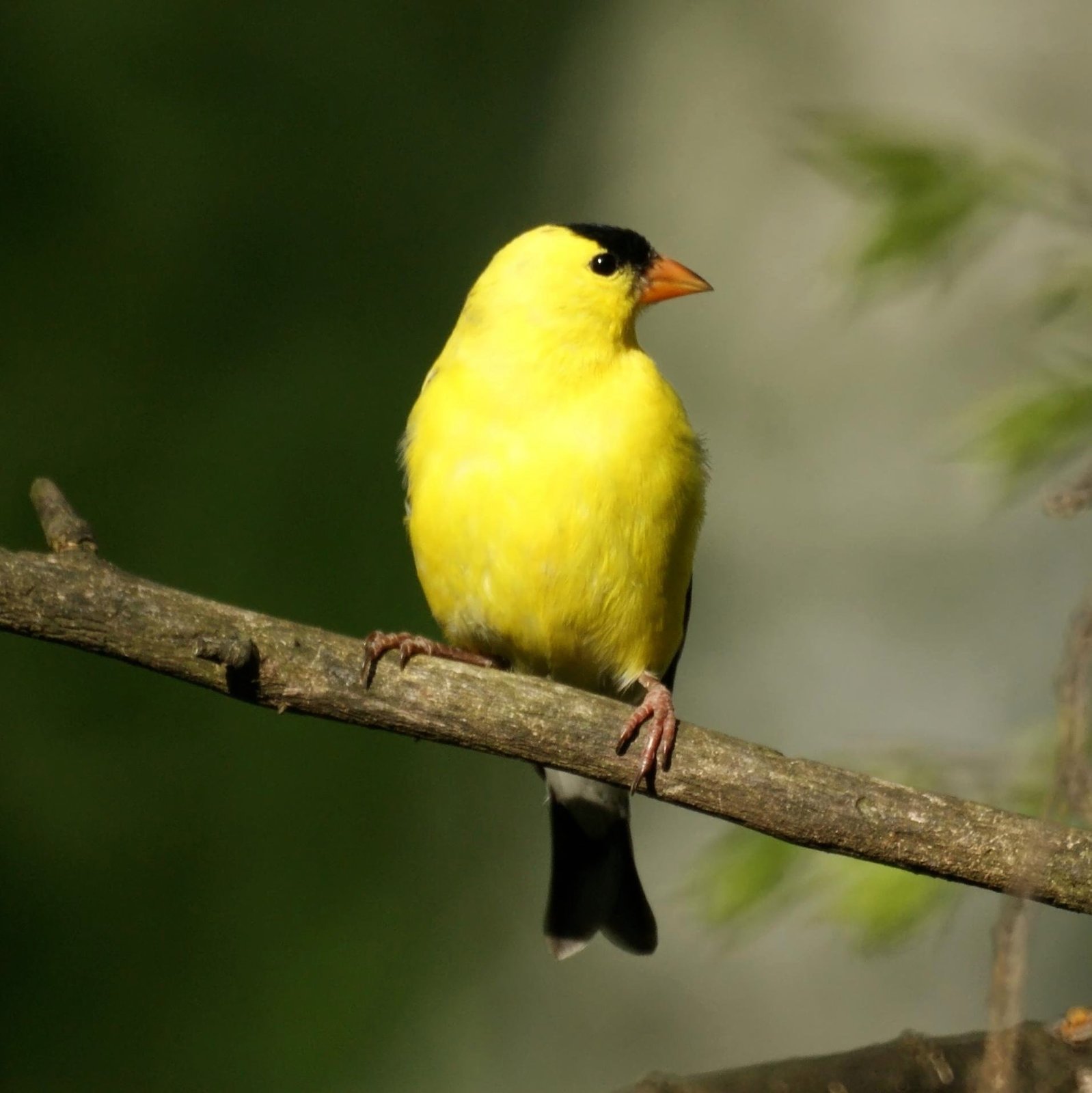
The American Goldfinch is a finch of North America, where it is one of the most widespread finches. In winter part of the population moves to the southern United States and Mexico. In the guide area it has only been reported as a very rare vagrant.
Voice
A characteristic four-syllable flight call, like per-chick-o-ree, and a plaintive rising tsoo-ee; the song is a long series of trills and twittering notes.
Recording: Manuel Grosselet — CC BY-NC-SA 4.0 · xeno-canto
Identification
11–13 cm, with a short, conical, pale bill and a notched tail. The breeding male is bright yellow with a black forehead and forecrown, black wings with white wing bars and a black tail with white. In non-breeding plumage, the plumage most likely in the guide area, both sexes are brownish grey to olive-brown with a yellowish throat, a pale belly, white undertail coverts and black wings with broad, pale wing bars; the male has yellow shoulders.
Confusion species
The female Lesser Goldfinch Spinus psaltria is smaller and greener, with yellow underparts including the undertail and a white patch at the base of the primaries. Females of Hooded Siskin Spinus magellanicus and Yellow-bellied Siskin Spinus xanthogastrus have yellow rather than white wing markings. Any record needs photographs.
Habitat
In its own range open country with shrubs and trees, forest edges, riparian woodland, field edges and gardens. It eats almost only seeds, mainly of composites such as thistles. The nest is a dense cup in a shrub or young tree; the species breeds late in summer.
Where the bird is most at home, classified by the vegetation units of the Andes and the west coast.


Range and movements
In the guide area only a few reports, mainly from Colombia; not known from Ecuador, Peru, Bolivia or the Galápagos. Outside the guide area it breeds in southern Canada and most of the United States and winters south to northern Mexico.
How and when to look
An American Goldfinch in the guide area is most likely between November and April in northern Colombia. On non-breeding goldfinches, check for the white undertail and the broad, pale wing bars.
Conservation status
Least Concern. The species is numerous and widespread in North America.
Scientific name
Spinus tristis | (Linnaeus, 1758)
Linnaeus described the species in 1758 as Fringilla tristis; because it was later moved to another genus, the author and year stand in brackets. The genus Spinus was introduced in 1816 by Koch. The genus name comes from Greek spinos, the name of a bird that can no longer be identified. The species name is Latin tristis, 'sorrowful' or 'dull', possibly after the drab winter plumage. The specimen the first description was based on came from South Carolina, United States.