All species › Passerines › Thrush-tanager › Rosy Thrush-Tanager
Rosy Thrush-Tanager | Rhodinocichla rosea
Troepiaaltangare | Tangara cuitlacoche | Sanhaço-sabiá-rosado
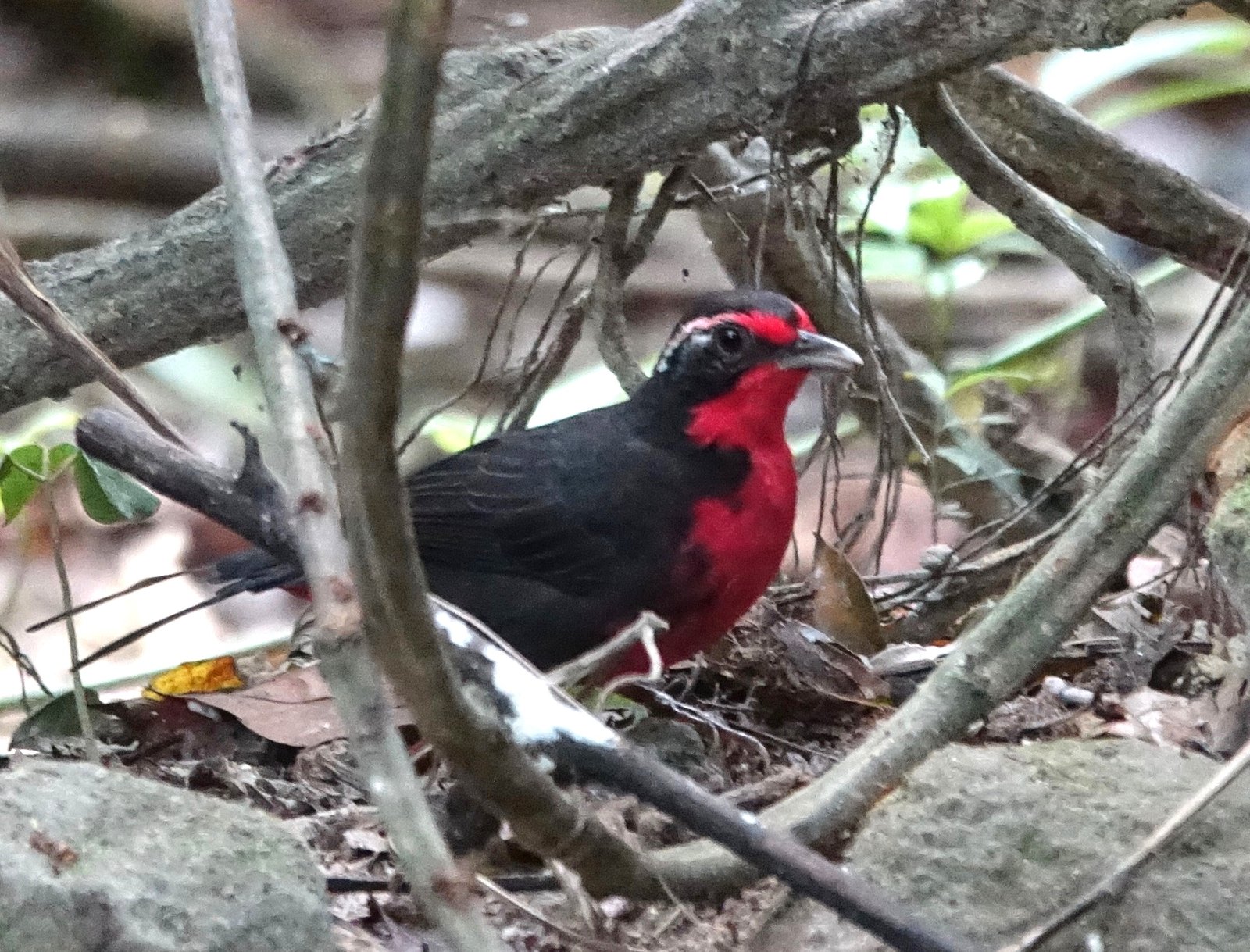
The Rosy Thrush-Tanager is the only species of its own family, whose relationships long remained unclear. It lives hidden in dense undergrowth and, like a thrush, searches for food in the leaf litter. The male has a rose-red throat, breast and eyebrow; pairs give loud, whistled duets.
Voice
A loud, rich, whistled song of short, melodious phrases, often as a duet by male and female, with repeated motifs such as cho-cho-wee. The call is a short, dry chak.
Recording: Charlie Vogt — CC BY-NC-SA 4.0 · xeno-canto
Identification
19–20 cm, with a fairly long, pointed, slightly decurved bill and a long tail. The male is dark slate-grey above, with a long supercilium that is rose-red in front of the eye and white or pink behind it. The throat, breast and centre of the belly are bright rose-red, and the flanks grey. The female has the same pattern, but with warm ochre-tawny instead of rose-red. Juveniles are duller and browner.
Confusion species
With its dark upperparts and rose-red or ochre underparts and supercilium it is hardly confusable in the guide area. The female Crimson-backed Tanager Ramphocelus dimidiatus is smaller, with a short, thick bill and a reddish belly, and lives at the forest edge rather than on the ground. Tropical Mockingbird Mimus gilvus lives in similar dry country but is grey and white.
Habitat
Dense thickets and undergrowth of dry and semi-humid forest, forest edges, old secondary forest and tangles with vines, from the lowlands to about 1000 m, locally higher. It forages on the ground in the leaf litter, which it tosses with its bill, for insects and other invertebrates, and also takes seeds and fruit. The nest is a cup low in a shrub or among vines.
Where the bird is most at home, classified by the vegetation units of the Andes and the west coast.


Range and movements
In Colombia in the north: the Caribbean lowlands and foothills, around the Sierra Nevada de Santa Marta and in the Magdalena Valley. Absent from Ecuador, Peru, Bolivia and the Galápagos. Outside the guide area in western Mexico, Panama and northern Venezuela.
- Resident
- dark = core range, pale = thinly spread
How and when to look
In the early morning, listen in dry forest and thickets in northern Colombia, for example around Santa Marta and in the Magdalena Valley, for the loud whistled duets. The birds usually stay low in cover; waiting at an opening in the undergrowth gives the best chance.
Conservation status
Least Concern. Dry forest in northern Colombia has largely been converted to farmland, but the species tolerates secondary growth.
Scientific name
Rhodinocichla rosea | (Lesson, 1832)
Lesson described the species in 1832 as Furnarius roseus; because it was later moved to another genus, the author and year stand in brackets. The genus Rhodinocichla was introduced in 1853 by Hartlaub. The genus name combines Greek rhodinos, 'rosy', and kikhlē, 'thrush'. The species name rosea is Latin for 'rosy'. The specimen the first description was based on came from Caracas, Venezuela.