All species › Passerines › New World sparrows › Tanager Finch
Tanager Finch | Oreothraupis arremonops
Tangarestruikgors | Cerquero tangarino | Tico-tico-sanhaço
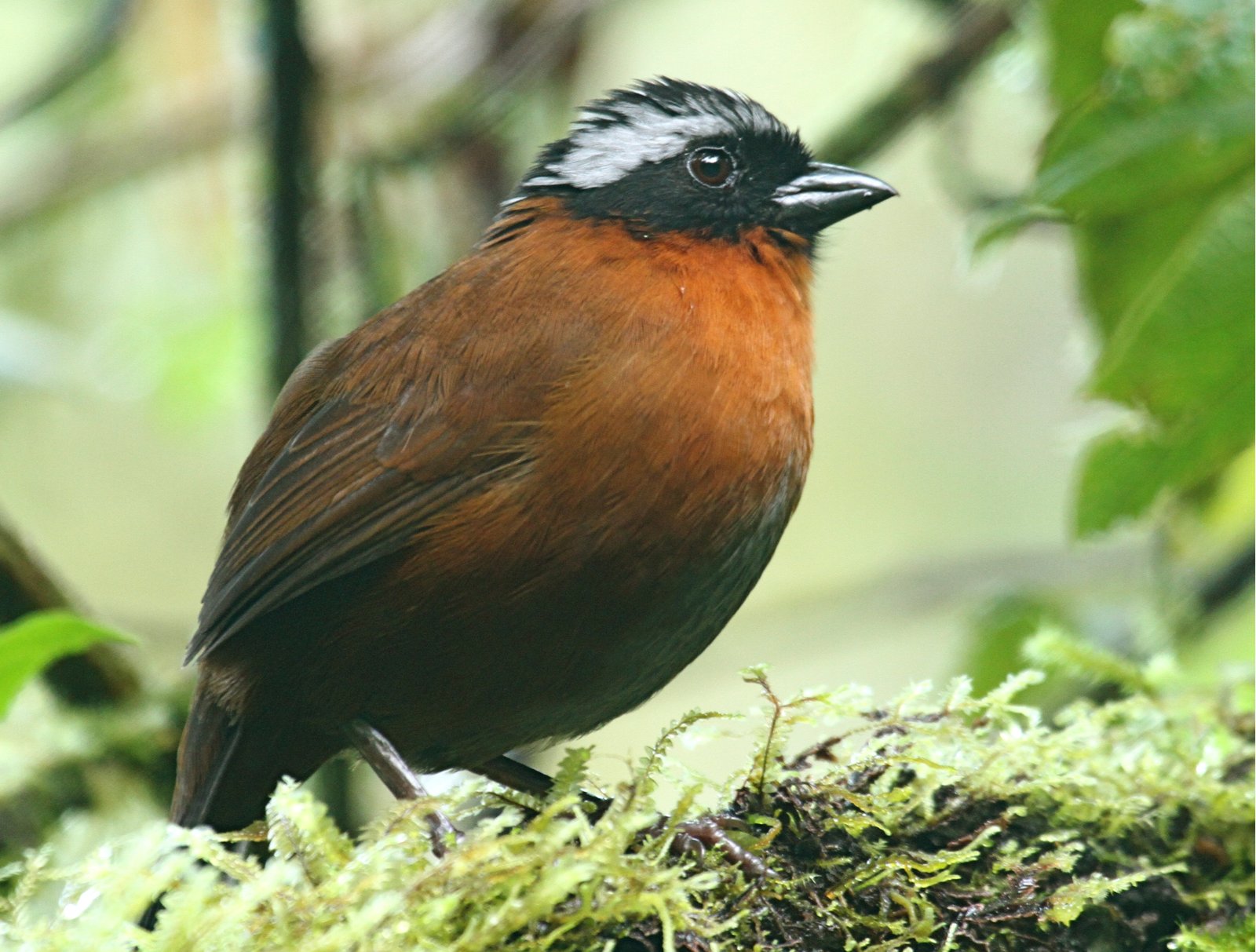
The Tanager Finch is a large, stocky sparrow of the wet cloud forests on the Pacific slope of the Andes in Colombia and Ecuador. With its black head striped with grey and its orange-rufous body it looks more like a tanager than a sparrow, which its name refers to. It lives in pairs or small groups close to the ground, often in bamboo.
Voice
High, thin, piercing calls, roughly tseet, with which the birds of a group keep in contact. The song is a short series of high, thin notes.
Recording: GABRIEL LEITE — CC BY-NC-SA 4.0 · xeno-canto
Identification
20–21 cm, large and sturdy, with a short, heavy, black bill and a fairly long tail. The head is black, with a broad grey median crown stripe and a grey supercilium that runs back to the nape. The back, throat and breast are bright orange-rufous; the belly is grey. The wings and tail are blackish. The legs are dark. The sexes are alike. Juveniles are duller and browner, with a less sharp head pattern.
Confusion species
Chestnut-capped Brushfinch Arremon brunneinucha lives in the same undergrowth, but has a chestnut crown, a white throat, a narrow black breast band and an olive-green back. Black-headed Brushfinch Arremon atricapillus is olive-green above and white below, with a grey head stripe, without any orange-rufous. Tricolored Brushfinch Atlapetes tricolor has a yellow crown and yellow underparts.
Habitat
Undergrowth of wet, mossy cloud forest and upper montane forest, especially where dense Chusquea bamboo grows, also at forest edges, roughly between 1700 and 2900 m. It searches on and just above the ground among leaves and moss for insects, other invertebrates and seeds, and sometimes joins mixed understorey flocks. Little is known about the nest.
Where the bird is most at home, classified by the vegetation units of the Andes and the west coast.


Range and movements
In Colombia on the western slope of the Western Andes, from Antioquia south to Nariño, local and scarce. In Ecuador on the western slope in the north, mainly in Carchi, Imbabura and Pichincha. Absent from Peru, Bolivia and the Galápagos. Does not occur outside the guide area.
- Resident
- dark = core range, pale = thinly spread
How and when to look
Search bamboo-rich cloud forest along mountain roads on the Pacific slope, for example at Tatamá in Colombia. Groups move noisily through the undergrowth; listen for their high calls in the early morning and look low along the edge of bamboo.
Conservation status
Least Concern. The range is small and threatened by forest clearance for cattle ranching and farming on the western slope of the Andes; part of the population lives in protected areas.
Scientific name
Oreothraupis arremonops | (Sclater, 1855)
Sclater described the species in 1855 as Saltator arremonops; because it was later moved to another genus, the author and year stand in brackets. The genus Oreothraupis was introduced in 1856 by Sclater. The genus name combines Greek oros, 'mountain', with thraupis, a small bird now used for tanagers: a mountain tanager. The species name combines the genus name Arremon with Greek ōps, 'appearance': resembling an Arremon sparrow. The specimen the first description was based on came from Andes north of Quito, Ecuador.