All species › Passerines › Tanagers and allies › Western Hemispingus
Western Hemispingus | Sphenopsis ochracea
Okerborstsfenops | Hemispingo ocráceo | Sanhaço-ocidental
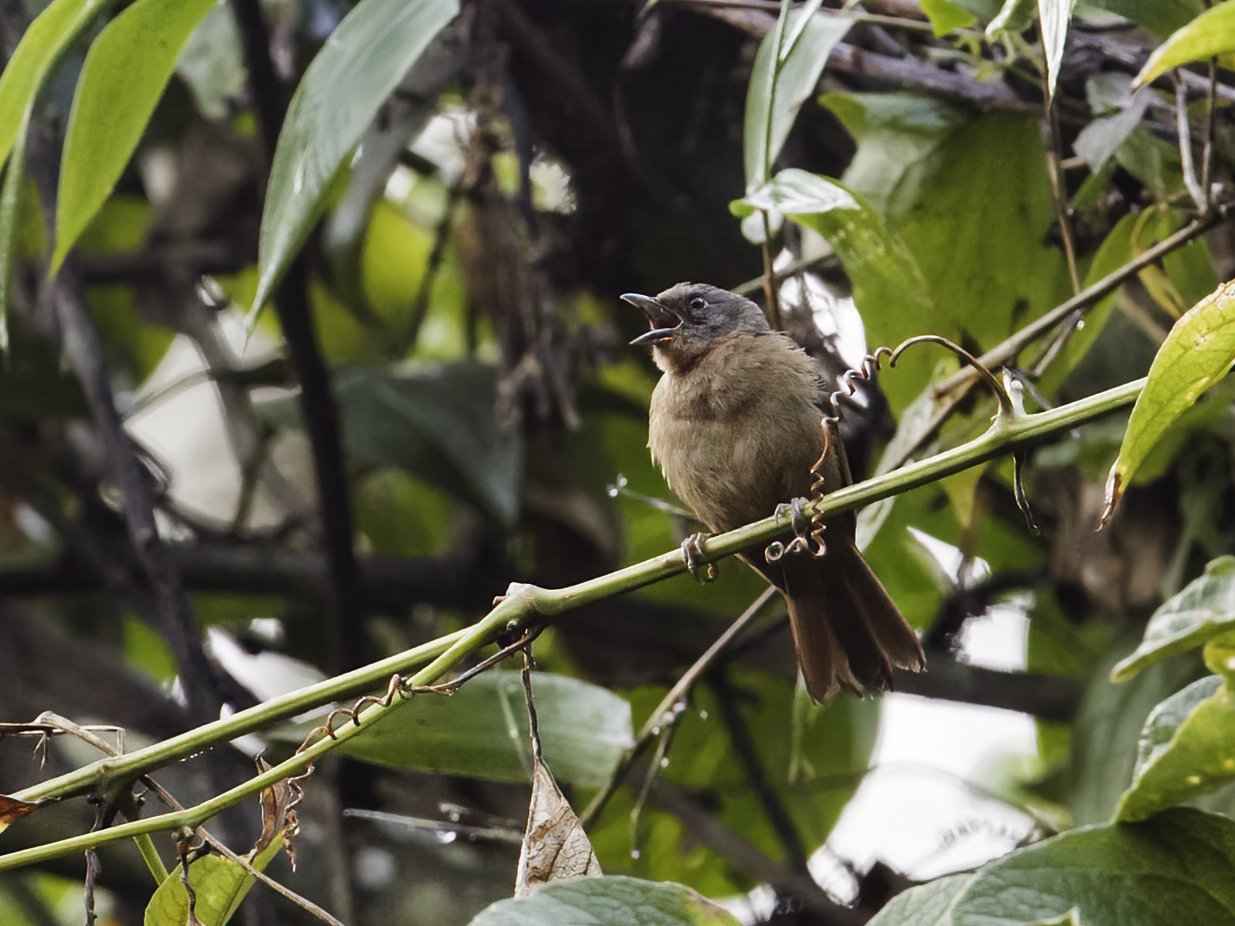
The Western Hemispingus is a small, dull-coloured tanager of montane forest on the western slope of the Andes in southwestern Colombia and northwestern Ecuador. It was long regarded as a form of Black-eared Hemispingus but differs in its much weaker head pattern and ochraceous underparts. Its song closely resembles that of Black-eared Hemispingus.
Voice
The song is a fast, rattling twitter, often given as a duet by a pair, almost identical to that of Black-eared Hemispingus. The call is a high tsit.
Recording: Jerome Fischer — CC BY-NC-SA 4.0 · xeno-canto
Identification
14 cm, with a thin, pointed, dark bill. Crown and nape olive-grey, with a faint dark ear patch and at most a weak pale supercilium. Upperparts, wings and tail olive-green. Underparts uniform ochraceous, washed olive on the flanks. Sexes alike. Young birds are duller.
Confusion species
Black-eared Hemispingus Sphenopsis melanotis of the eastern slope has a greyer crown, a clear black ear patch and a cinnamon throat and breast. Piura Hemispingus Sphenopsis piurae farther south has a black mask and a long white supercilium. Oleaginous Hemispingus Sphenopsis frontalis is greener, with a faint yellow supercilium and olive-yellow underparts.
Habitat
Understory and edges of humid montane forest and cloud forest on the western slope, also with bamboo, roughly between 1300 and 2600 m. It forages in pairs low in the undergrowth for insects, usually in mixed flocks. Little is known about the nest.
Where the bird is most at home, classified by the vegetation units of the Andes and the west coast.


Range and movements
In Colombia on the western slope of the Andes in the southwest, mainly in Nariño. In Ecuador on the western slope of the Andes in the north and centre. Absent from Peru, Bolivia and the Galápagos. Does not occur outside the guide area.
How and when to look
Follow mixed flocks in the understory of cloud forest on the western slope in northern Ecuador, for example along the old road to Mindo; the duet often reveals a pair that stays low in the undergrowth.
Conservation status
Least Concern. Deforestation on the western slope of the Andes has locally reduced its habitat considerably.
Scientific name
Sphenopsis ochracea | (Berlepsch & Taczanowski, 1884)
Berlepsch & Taczanowski described the species in 1884 as Chlorospingus ochraceus; because it was later moved to another genus, the author and year stand in brackets. The genus Sphenopsis was introduced in 1862 by Sclater. The genus name combines Greek sphēn, 'wedge', and opsis, 'appearance'. The species name comes from Latin ochraceus, 'ochre-coloured'. The specimen the first description was based on came from Cayandeled, western Ecuador.