All species › Passerines › Tyrant flycatchers and allies › White-crested Tyrannulet
White-crested Tyrannulet | Serpophaga subcristata
Witkuiftachuri | Piojito común | Alegrinho
The White-crested Tyrannulet is a small grey tyrant of dry forest, scrub and woodland edges in southern and eastern South America. The black-bordered white crown patch is usually concealed and becomes visible only when the bird raises its crown feathers. The form munda of the dry Andean valleys of Bolivia, with a white rather than yellow belly, was formerly treated as a separate species.
Voice
A short, dry trill, often preceded by a few high notes, and sharp, high calls.
Recording: Marcos E. Sosa — CC BY-NC-SA 4.0 · xeno-canto
Identification
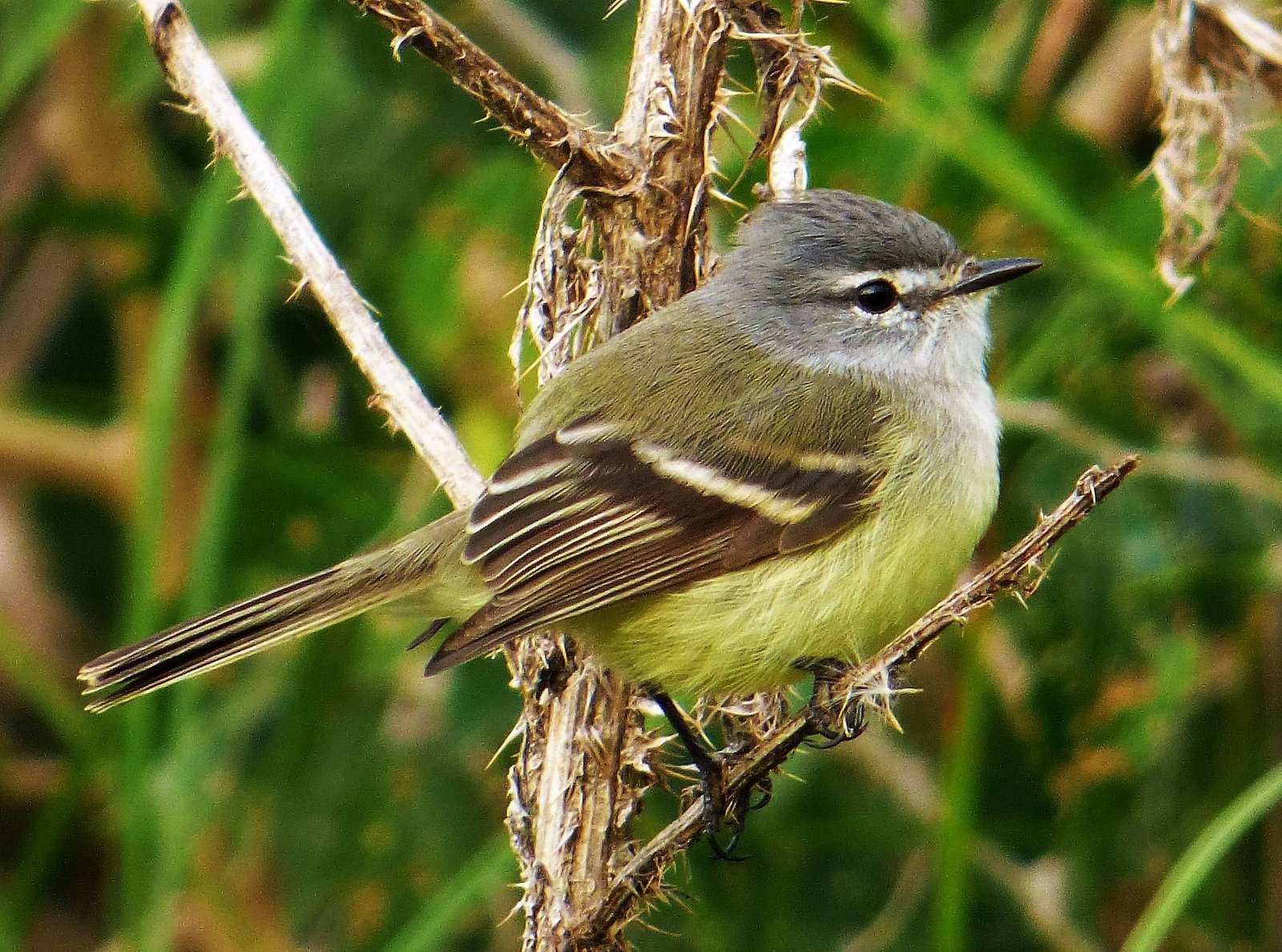
10–11 cm, with a short black bill and a fairly long tail. The head and nape are grey, with a black-bordered white crown patch that is usually partly hidden, and a short white supercilium. The back is olive-grey; the wings are dark, with two whitish wing bars. The throat is whitish, the breast grey and the belly pale yellow; in the form munda the underparts are whitish. The sexes are alike.
Confusion species
Straneck's Tyrannulet Serpophaga griseicapilla is very similar and best told by voice; it has little or no black around the crown patch and often buffy wing bars. Southern Beardless Tyrannulet Camptostoma obsoletum has a shorter tail, a rusty crest and a pale bill base. Plain Inezia Inezia inornata has a white eye-ring and no crown patch. White-crested Elaenia Elaenia albiceps is larger, with a longer bill.
Habitat
Dry forest, Chaco thorn scrub, woodland edges, riparian woodland, parks and gardens; the form munda in scrub and dry woodland in inter-Andean valleys. From the lowlands to about 3000 m. It searches for small insects among the leaves, often in mixed flocks. The nest is a small, compact cup in a fork of a branch.
Where the bird is most at home, classified by the vegetation units of the Andes and the west coast.


Range and movements
In Bolivia widespread in the lowlands of the east and south and in the dry Andean valleys of Cochabamba, Chuquisaca, Santa Cruz, Potosí and Tarija. Not confirmed with certainty in Peru. Absent from Colombia, Ecuador and the Galápagos. Outside the guide area in Paraguay, Brazil, Uruguay and Argentina.
- Resident
- dark = core range, pale = thinly spread
How and when to look
Search dry woodland and scrub in the valleys around Cochabamba and Sucre or in the Chaco, and follow mixed flocks; the white crown patch shows when the bird is excited.
Conservation status
Least Concern. The species is widespread and common, also in landscapes altered by people.
Scientific name
Serpophaga subcristata | (Vieillot, 1817)
Vieillot described the species in 1817 as Sylvia subcristata; because it was later moved to another genus, the author and year stand in brackets. The genus Serpophaga was introduced in 1839 by Gould. The genus name comes from Greek serphos, 'gnat, small insect', and -phagos, '-eating'. The species name comes from Latin sub, 'somewhat', and cristatus, 'crested': 'slightly crested'. The specimen the first description was based on came from Paraguay.