All species › Jacamars and puffbirds › Puffbirds › White-eared Puffbird
White-eared Puffbird | Nystalus chacuru
Witoorbaardkoekoek | Buco chacurú | João-bobo
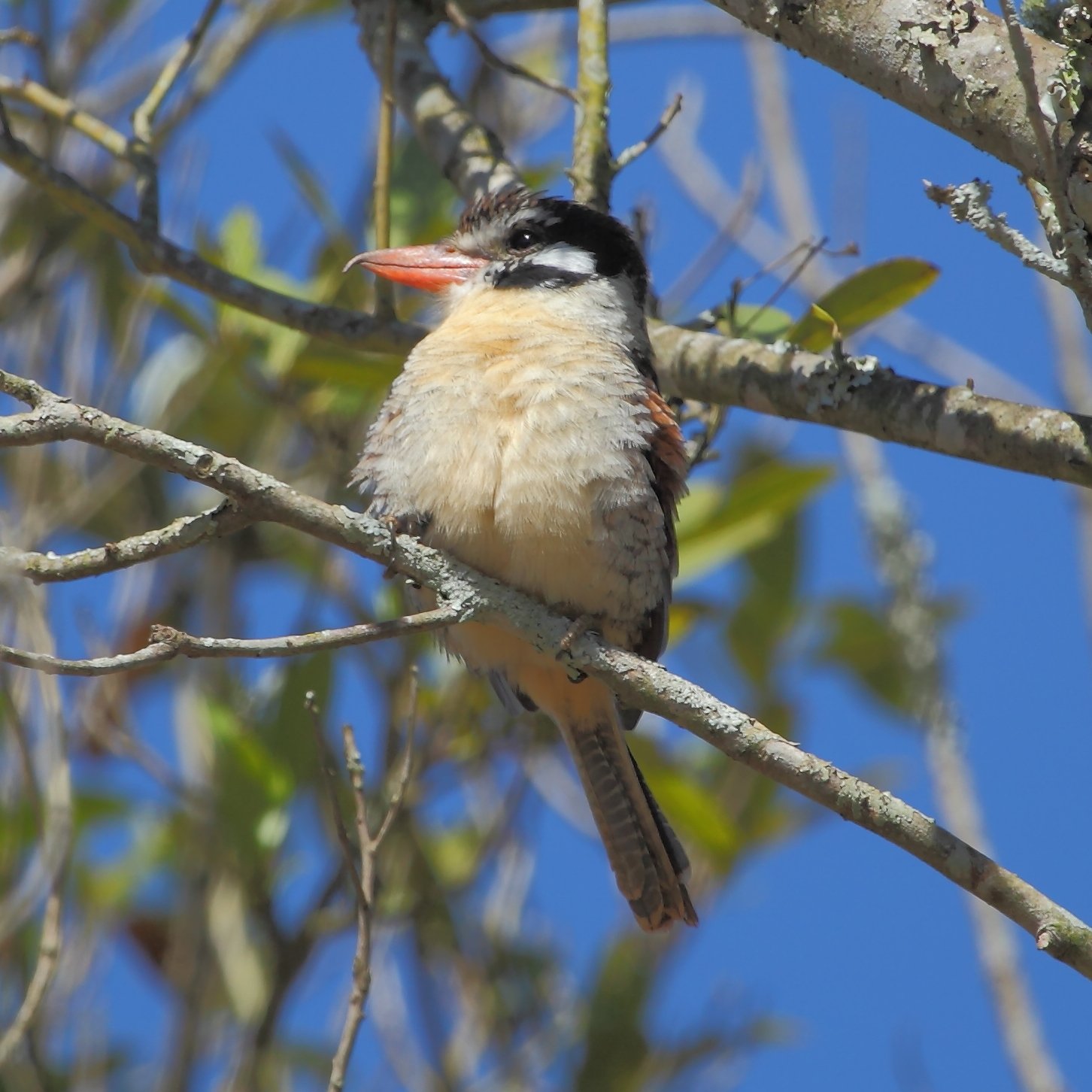
The White-eared Puffbird is a puffbird of open savannas and grassy slopes, which in the guide area occurs only in Bolivia and locally in Peru. It sits motionless for long periods on an open branch, post or wire and drops from there onto prey on the ground. The coral-red bill and the white cheek mark the head.
Voice
A loud, rhythmically repeated whistled song, often a duet by a pair, mainly in the early morning and at dusk. Also soft, plaintive whistles.
Recording: Fabrício Grigolin — CC BY-NC-SA 4.0 · xeno-canto
Identification
20–21 cm, with a large head, a short tail and a heavy, coral-red bill. The forehead and a broad supercilium are white, and the crown is brown with fine pale spots. A black stripe runs through the eye, with a white cheek and ear patch below it. A rufous band crosses the hindneck. The upperparts are brown with rufous-buff barring. The throat is white, and the underparts are creamy white to pale brown with dark streaks on the flanks. The sexes are alike; juveniles are duller, with a less red bill.
Confusion species
Western Striolated Puffbird Nystalus obamai, in the forests of the eastern Andean foothills, has a greenish-grey bill, heavily streaked underparts and no white cheek, and usually sits in the canopy. Spot-backed Puffbird Nystalus maculatus, in the dry south-east of Bolivia, is smaller, with an orange band across the upper breast and a dark-tipped bill.
Habitat
Open savanna, cerrado, grassy slopes with scattered trees, forest edges and pasture with shrubs, from the lowlands up to about 2000 m. It waits motionless on a lookout and takes large insects, spiders and small lizards, mostly on the ground. The nest is at the end of a tunnel that the bird digs in the ground or in an earth bank.
Where the bird is most at home, classified by the vegetation units of the Andes and the west coast.


Range and movements
In Peru locally in grassy, open areas in the valleys and foothills of the eastern slope of the Andes, and in the savannas of the Pampas del Heath in the south-east. In Bolivia in the savannas of Beni and Santa Cruz and in open parts of the lower eastern slope. Absent from Colombia, Ecuador and the Galápagos. Outside the guide area in central and eastern Brazil, Paraguay and north-eastern Argentina.
- Resident
- dark = core range, pale = thinly spread
How and when to look
Drive or walk along roads through savannas and open, grassy slopes and look for birds sitting still on posts, wires and isolated branches. The red bill contrasts with the pale head.
Conservation status
Least Concern. The species tolerates open, human-modified land with scattered trees and may benefit locally from deforestation.
Scientific name
Nystalus chacuru | (Vieillot, 1816)
Vieillot described the species in 1816 as Bucco chacuru; because it was later moved to another genus, the author and year stand in brackets. The genus Nystalus was introduced in 1863 by Cabanis & Heine. The genus name comes from Greek nustalos, 'drowsy'. The species name comes from Chakurú, an onomatopoeic Guaraní name; Félix de Azara wrote that the Guaraní call the bird this after its voice. The specimen the first description was based on came from Paraguay.