All species › Jacamars and puffbirds › Puffbirds › Spot-backed Puffbird
Spot-backed Puffbird | Nystalus maculatus
Vlekrugbaardkoekoek | Buco durmilí | Rapazinho-dos-velhos
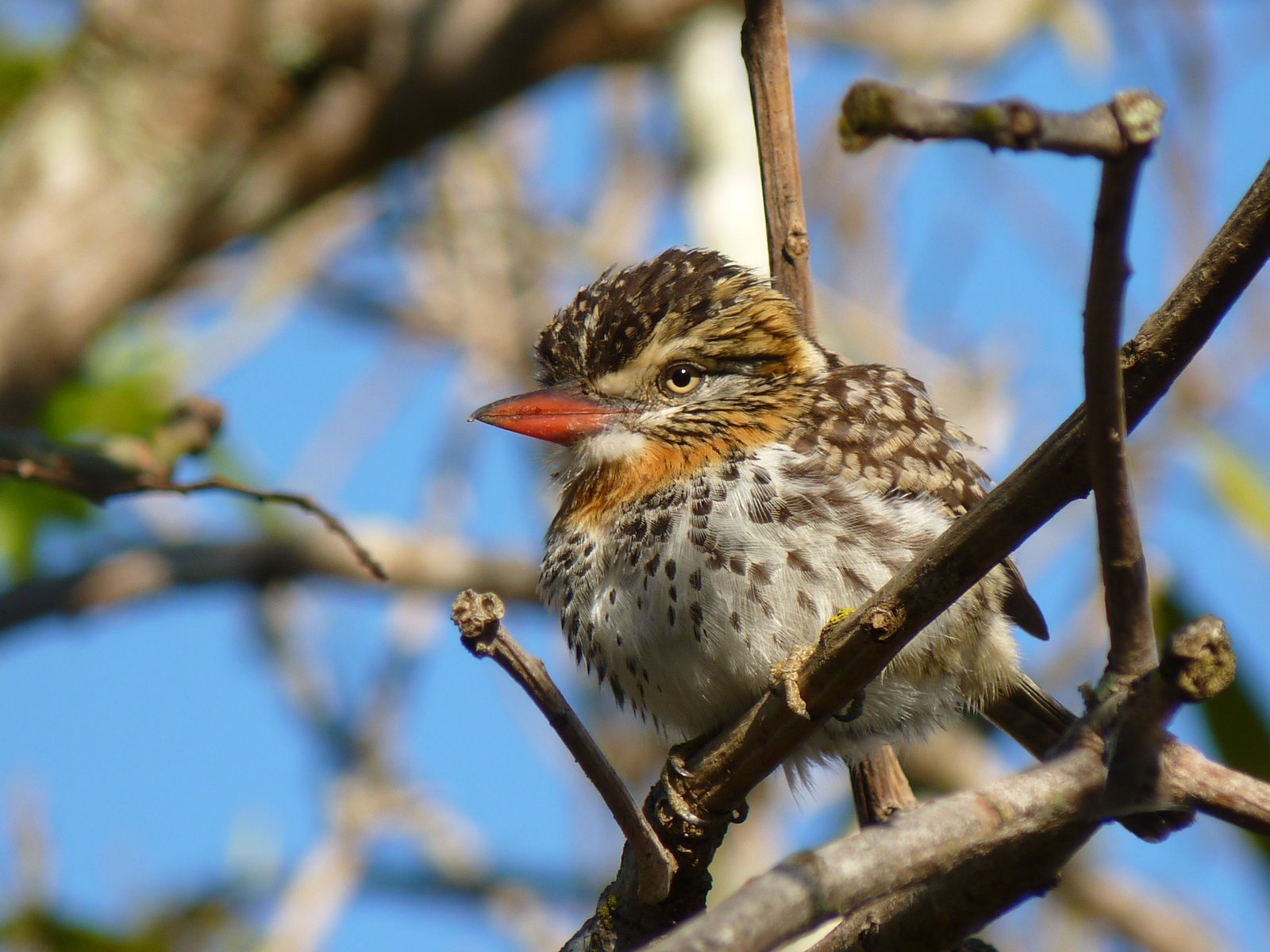
The Spot-backed Puffbird is a small puffbird of dry forest and scrub. In the guide area only the form striatipectus occurs, in south-eastern Bolivia; some authors treat it as a separate species, Nystalus striatipectus. It sits still for long periods in the low canopy and mainly gives itself away by its whistled duets.
Voice
A repeated series of whistled notes, often a duet by a pair, mainly in the early morning and at dusk.
Recording: JAYRSON ARAUJO DE OLIVEIRA — CC BY-NC-SA 4.0 · xeno-canto
Identification
18–19 cm, with a large head and an orange-red bill with a dark tip. The upperparts are brown with pale, rufous-buff spots and bars. The face is patterned black and white, with a pale supercilium and a pale cheek. The throat is white, with an orange to rufous band across the upper breast below it. The rest of the underparts is white with black spots or streaks; in the form in the guide area the breast and flanks are mainly streaked and the orange band is narrower. The sexes are alike.
Confusion species
White-eared Puffbird Nystalus chacuru is larger, with an all coral-red bill, a white cheek, a rufous nuchal band and no orange breast band; it lives in open savanna. Western Striolated Puffbird Nystalus obamai, in the humid forests of the eastern slope, has a greenish-grey bill and no orange breast band.
Habitat
Dry forest, Chaco woodland, thorn scrub and open woodland with scattered trees, also in dry valleys at the foot of the Andes, from the lowlands up to about 2000 m. It waits on a sheltered branch and takes large insects and other small animals on the ground or in the foliage. The nest is at the end of a tunnel in the ground.
Where the bird is most at home, classified by the vegetation units of the Andes and the west coast.


Range and movements
In Bolivia in the dry forests and Chaco of the south-east and in the dry valleys at the foot of the eastern slope. Absent from Colombia, Ecuador, Peru and the Galápagos. Outside the guide area in western Paraguay and northern Argentina, and as the nominate form in the dry north-east and centre of Brazil.
- Resident
- dark = core range, pale = thinly spread
How and when to look
Search the dry forests of south-eastern Bolivia, along forest edges and trails through the Chaco. Listen in the early morning for the whistled duets and then look for the still bird in the low canopy.
Conservation status
Least Concern. The Chaco forests are, however, being converted to farmland on a large scale.
Scientific name
Nystalus maculatus | (Gmelin, 1788)
Gmelin described the species in 1788 as Alcedo maculata; because it was later moved to another genus, the author and year stand in brackets. The genus Nystalus was introduced in 1863 by Cabanis & Heine. The genus name comes from Greek nustalos, 'drowsy'. The species name maculatus is Latin for 'spotted'. The specimen the first description was based on came from Brazil.