All species › Jacamars and puffbirds › Puffbirds › Swallow-winged Puffbird
Swallow-winged Puffbird | Chelidoptera tenebrosa
Zwaluwbaardkoekoek | Buco golondrina | Urubuzinho
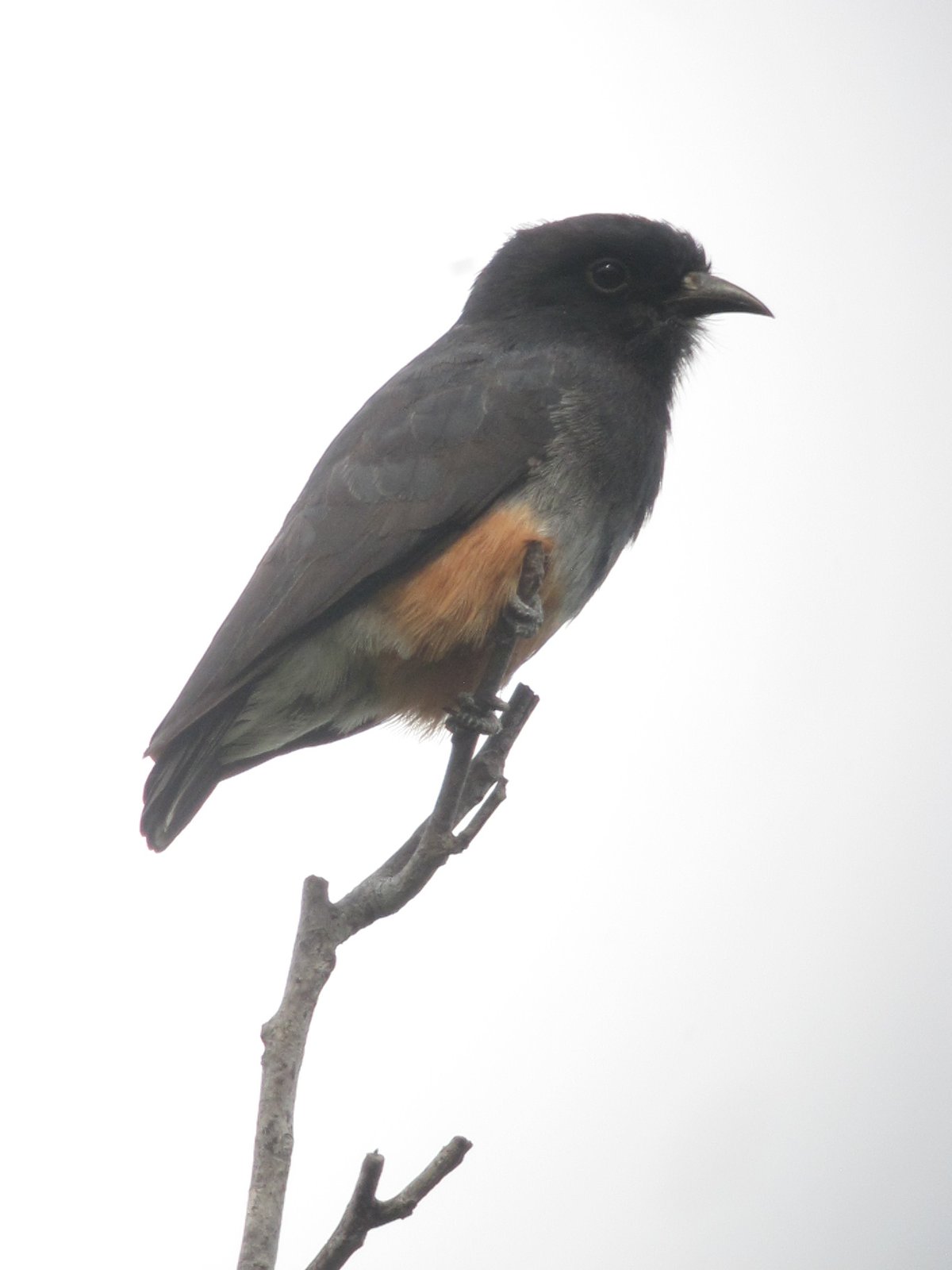
The Swallow-winged Puffbird is a small, stocky puffbird with long, broad wings and a very short tail, which looks like a swallow in flight. It often perches on bare branches high in trees along rivers and forest edges and makes short flights from there after flying insects. Of the puffbirds in the lowlands east of the Andes it is the one that most often sits in the open.
Voice
Mostly silent. Gives weak, high, squeaky notes and a short twitter, sometimes in a rapid series.
Recording: JAYRSON ARAUJO DE OLIVEIRA — CC BY-NC-SA 4.0 · xeno-canto
Identification
15–16 cm, with a short, black, slightly decurved bill. The plumage is mostly blue-black, with a white rump that is visible mainly in flight. The lower breast is greyish and grades into a rufous-orange belly. The underwing coverts are white. In flight the broad wings, narrow at the base, and the short tail stand out. The sexes are alike; juveniles are duller.
Confusion species
Brown-chested Martin Progne tapera is brown above and white below, with a brown breast band, and has a longer tail. White-banded Swallow Atticora fasciata is blue-black with a white band across the breast and a long, forked tail, and flies low over rivers. Both swallows hunt mainly in sustained flight rather than from a fixed perch.
Habitat
Forest edges, riverbanks, river islands and sandbars with scattered trees, clearings, felled areas, savannas with groves of trees and gardens, from the lowlands up to about 1000 m, locally higher. It perches on high, bare branches and catches flying insects in short, fluttering sallies, often returning to the same branch. The nest is at the end of a tunnel in sandy ground, often on a flat open spot or in a bank.
Where the bird is most at home, classified by the vegetation units of the Andes and the west coast.


Range and movements
In Colombia east of the Andes, in the llanos and Amazonia. In Ecuador in the eastern lowlands. In Peru in the Amazonian lowlands and the lowest foothills of the eastern slope. In Bolivia in the lowlands of the north and east. Absent from the Galápagos. Outside the guide area in Venezuela, the Guianas and much of Brazil.
- Resident
- dark = core range, pale = thinly spread
How and when to look
Along rivers and roads in the Amazonian lowlands, look at bare branches in the tops of trees along forest edges and clearings. Birds often sit there for a long time on the same perch and return to it after each sally.
Conservation status
Least Concern. The species has a very large range and uses clearings and forest edges created by people.
Scientific name
Chelidoptera tenebrosa | (Pallas, 1782)
Pallas described the species in 1782 as Cuculus tenebrosus; because it was later moved to another genus, the author and year stand in brackets. The genus Chelidoptera was introduced in 1837 by Gould. The genus name comes from Greek khelidōn, 'swallow', and pteron, 'wing', for the swallow-like flight. The species name comes from Latin tenebrosus, 'dark', for the mostly black plumage. The specimen the first description was based on came from Suriname.