All species › Passerines › Antbirds › White-eyed Stipplethroat
White-eyed Stipplethroat | Epinecrophylla leucophthalma
Witoogmiersluiper | Hormiguerito ojiblanco | Choquinha-de-olho-branco
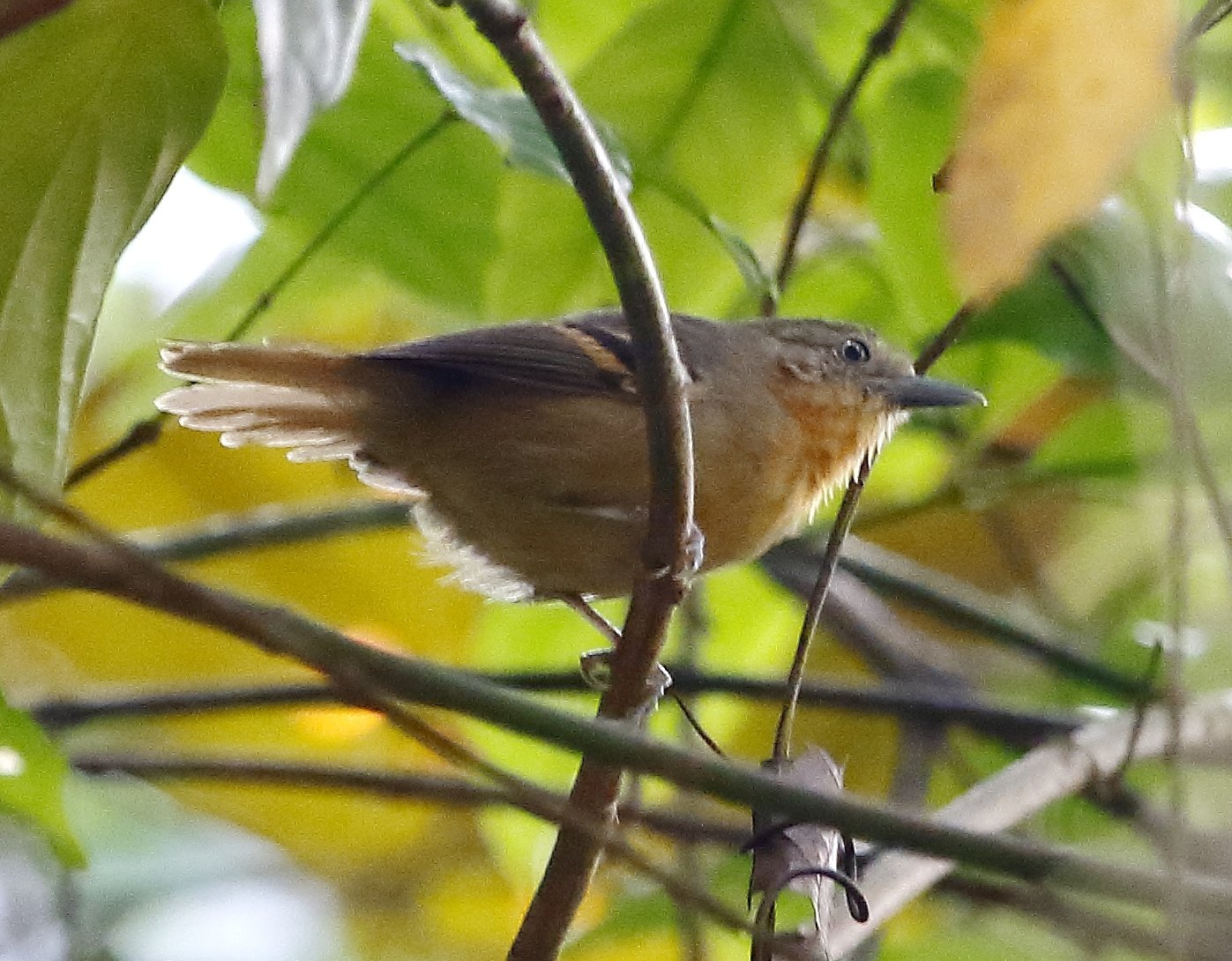
The White-eyed Stipplethroat is a small, brown antwren of the lower storeys of Amazonian rainforest south of the Amazon. Like its relatives it specializes in searching hanging clusters of dead leaves. In the guide area it lives in central and southern Peru and northern Bolivia.
Voice
The song is a series of high, thin, whistled notes that fall slightly in pitch. The call is a short, sharp chek.
Recording: Jacob Wijpkema — CC BY-NC-SA 4.0 · xeno-canto
Identification
11 cm, with a fairly short tail and a pale iris. The male is warm brown above, with a rufous back and black wing coverts with buff spots. The throat is black with fine white stippling, the breast grey and the belly brownish. The female lacks the black throat: throat and breast are plain ochre. Both sexes have the pale iris.
Confusion species
Ornate Stipplethroat Epinecrophylla ornata has a greyer head and underparts, white wing spots and a dark iris; the female has a blackish, white-stippled throat. Rufous-backed Stipplethroat Epinecrophylla haematonota has a dark iris and a brighter rufous back. White-flanked Antwren Myrmotherula axillaris lacks the rufous back and does not specialize in dead leaves.
Habitat
Understorey of humid lowland terra firme and transitional forest, locally with bamboo, up to about 1000 m. It forages in pairs with understorey mixed flocks, probing hanging dead leaves for arthropods. The nest is a globular structure of dead leaves with a side entrance, low in the vegetation.
Where the bird is most at home, classified by the vegetation units of the Andes and the west coast.


Range and movements
Peru: in the central and southern Amazon lowlands, south of the Amazon. Bolivia: in the north. Absent from Colombia, Ecuador and the Galápagos. Outside the guide area in Amazonian Brazil south of the Amazon.
- Resident
- dark = core range, pale = thinly spread
How and when to look
Follow understorey mixed flocks in terra firme forest in Madre de Dios or northern Bolivia and watch for birds hanging from clusters of dead leaves.
Conservation status
Least Concern. The species is widespread, but depends on continuous forest and declines where the forest is cleared.
Scientific name
Epinecrophylla leucophthalma | (Pelzeln, 1868)
Pelzeln described the species in 1868 as Formicivora leucophthalma; because it was later moved to another genus, the author and year stand in brackets. The genus Epinecrophylla was introduced in 2006 by Isler & Brumfield. The genus name combines Greek epi, 'on', nekros, 'dead', and phullon, 'leaf', for the habit of foraging in hanging dead leaves. The species name comes from Greek leukos, 'white', and ophthalmos, 'eye', for the pale iris. The specimen the first description was based on came from Salto do Girão, Rio Madeira, Rondônia, Brazil.