All species › Passerines › Antbirds › Checker-throated Stipplethroat
Checker-throated Stipplethroat | Epinecrophylla fulviventris
Marmerkeelmiersluiper | Hormiguerito barbiescamado | Choquinha-de-garganta-xadrez
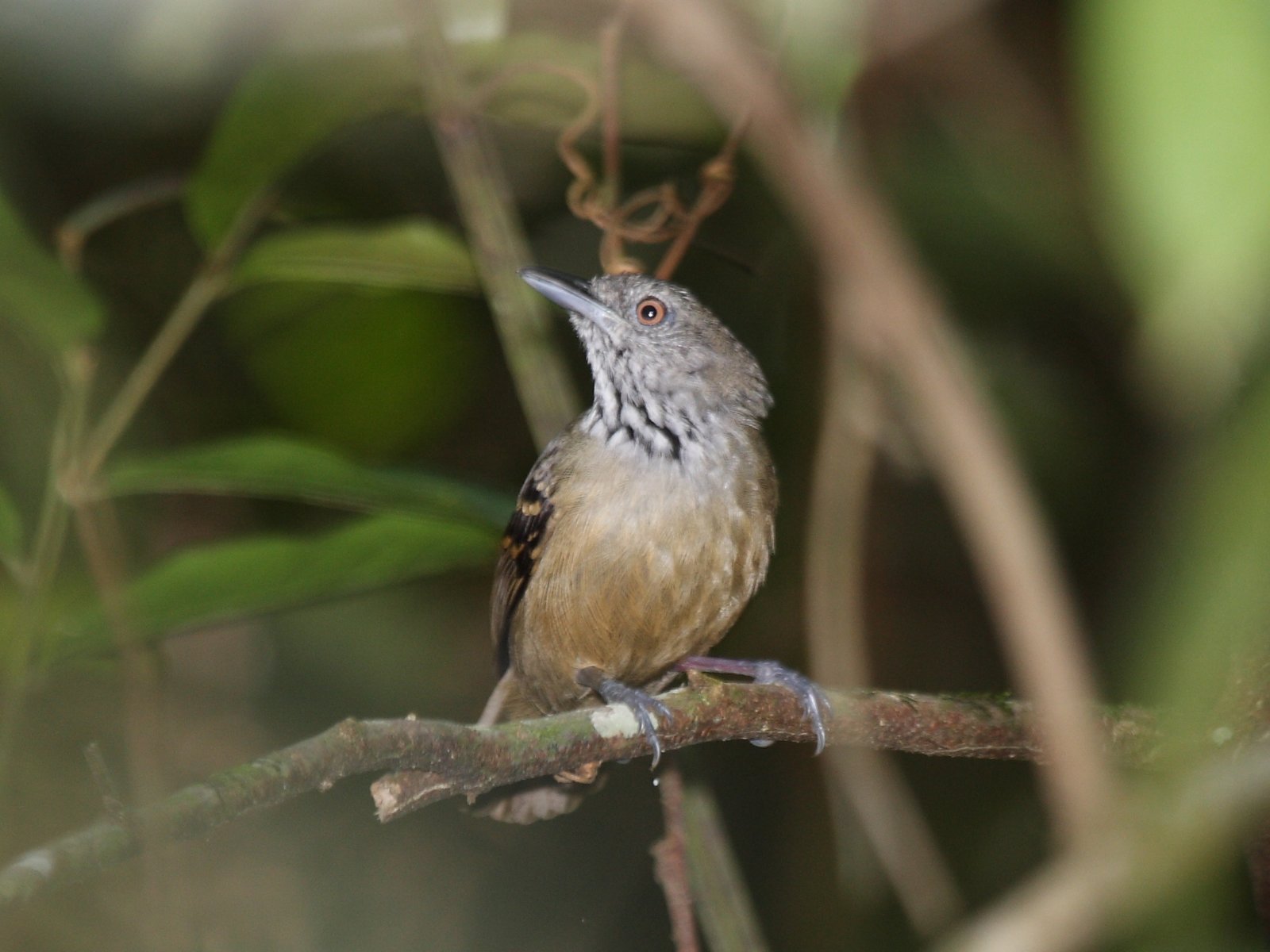
The Checker-throated Stipplethroat is a small, grey-brown antwren of humid forest west of the Andes that specializes in searching dead leaves caught in vine tangles. It owes its name to the black-and-white checkered throat of the male. Pairs and family groups often travel with mixed flocks in the understorey.
Voice
The song is a descending series of high, abrupt notes of varying pace and volume. Calls are a fast rattle and a high peek.
Recording: Sue Riffe — CC BY-NC-SA 4.0 · xeno-canto
Identification
10–11 cm, with a fairly short, rufous tail. The crown and upperparts are grey-brown; the dark wing coverts have pale buff tips that form two rows of spots. The male has a greyish face and a black throat with large white spots, together forming a checkered pattern; the breast is grey and the belly buff. The female has a buff face and a buff throat without black.
Confusion species
White-flanked Antwren Myrmotherula axillaris has white flank plumes; the male is black and grey, with a plain black throat and breast. The male Slaty Antwren Myrmotherula schisticolor is slate-grey with a black throat and breast, the female plain ochre below; it lives mainly higher, in the foothills. Pacific Antwren Myrmotherula pacifica is streaked black and white (male) or has an orange-brown head (female).
Habitat
The understorey and middle levels of humid evergreen lowland and foothill forest and adjacent older secondary forest, especially in dense lianas where dead leaves get caught; in Colombia mostly up to 1200 m, locally to 2000 m, in Ecuador up to about 900 m. In pairs or family groups it searches dead leaves and other trapped debris for cockroaches, crickets, katydids and spiders, often in mixed flocks.
Where the bird is most at home, classified by the vegetation units of the Andes and the west coast.


Range and movements
In Colombia in the Pacific lowlands and in the north, east to the Magdalena Valley. In Ecuador in the western lowlands and foothills, south to near the border with Peru. Not confirmed with certainty in Peru. Absent from Bolivia and the Galápagos. Outside the guide area from Honduras to Panama.
- Resident
- dark = core range, pale = thinly spread
How and when to look
In humid forest of the Chocó region, for example in the lowlands of Esmeraldas or along the Pacific coast of Colombia, look in understorey mixed flocks for a small bird that dives into a cluster of dead leaves.
Conservation status
Least Concern. The population is probably declining through forest loss, but the species has a large range and occurs in several protected areas.
Scientific name
Epinecrophylla fulviventris | (Lawrence, 1862)
Lawrence described the species in 1862 as Myrmetherula fulviventris; because it was later moved to another genus, the author and year stand in brackets. The genus Epinecrophylla was introduced in 2006 by Isler & Brumfield. The genus name combines Greek epi, 'on', nekros, 'dead', and phullon, 'leaf', for the habit of foraging in hanging dead leaves. The species name comes from Latin fulvus, 'tawny', and venter, 'belly', for the tawny belly. The specimen the first description was based on came from Lion Hill (Canal area), Panama.