All species › Passerines › Antbirds › Dot-backed Antbird
Dot-backed Antbird | Hylophylax punctulatus
Zilvervlekmiervogel | Hormiguero lomipunteado | Guarda-várzea
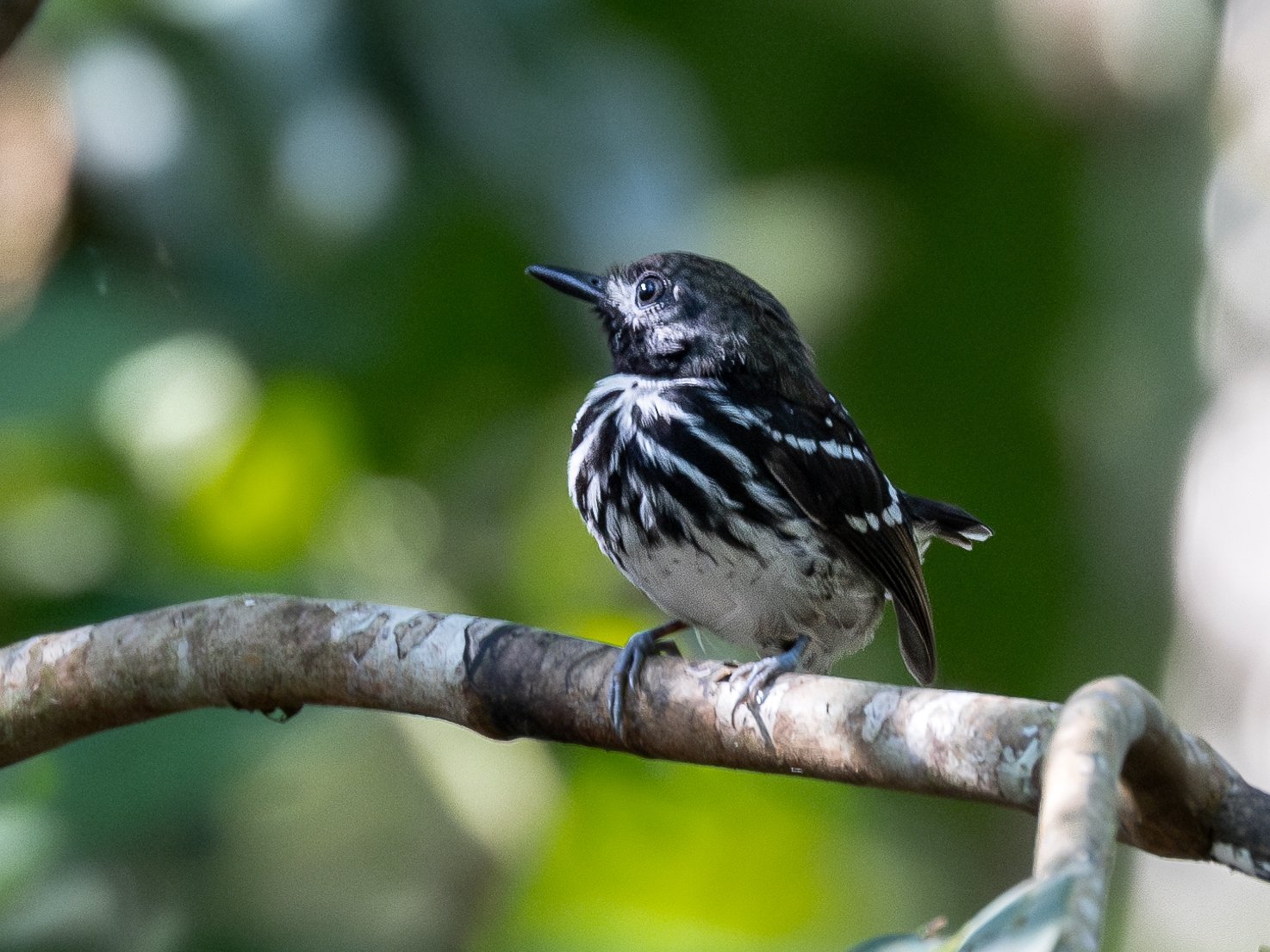
The Dot-backed Antbird is the smallest Hylophylax, an antbird of flooded forest and swampy forest edges along streams and lakes in Amazonia. Pairs live low above the ground or the water. The white dots on its back give it its name.
Voice
The song is a series of a few clear, rising double whistles. Calls are a short chip and a soft rattle.
Recording: Ashley Saunders — CC BY-NC-SA 4.0 · xeno-canto
Identification
10–11 cm, with a short tail. The male has a grey head with paler cheeks, a black throat and a blackish back with white dots and a concealed white patch between the shoulders; the wing coverts are black with white or pale tips. The underparts are white, with a band of black spots across the breast. The female has a pale, buff-tinged throat and paler breast spots.
Confusion species
Spot-backed Antbird Hylophylax naevius has a browner back with buff spots, buff flanks and lives mainly in terra firme. Common Scale-backed Antbird Willisornis poecilinotus has a scaled back and no band of spots on the breast. Band-tailed Antbird Hypocnemoides maculicauda and Black-chinned Antbird Hypocnemoides melanopogon are plain grey below and have a longer bill.
Habitat
Understorey of várzea, igapó and swamp forest, also blackwater forest and along streams and lake shores, up to about 500 m. It forages in pairs for insects and spiders low above the ground or the water. The nest is an open cup low in a shrub.
Where the bird is most at home, classified by the vegetation units of the Andes and the west coast.


Range and movements
Colombia: east of the Andes, mainly in the south-east (Vaupés, Guainía and Amazonas). Ecuador: locally in the eastern lowlands. Peru: in the Amazonian lowlands, mainly in the north and east. Bolivia: in the north (Pando and Beni). Absent from the Galápagos. Outside the guide area in southern Venezuela and Amazonian Brazil.
- Resident
- dark = core range, pale = thinly spread
How and when to look
Search along blackwater streams and in swamp forest, for example around Iquitos or in north-eastern Ecuador, and listen for the clear double whistles low over the water.
Conservation status
Least Concern. The species is locally fairly common in suitable habitat.
Scientific name
Hylophylax punctulatus | (des Murs, 1856)
Des Murs described the species in 1856 as Rhopotera punctulata; because it was later moved to another genus, the author and year stand in brackets. The genus Hylophylax was introduced in 1909 by Ridgway. The genus name comes from Greek hulē, 'forest', and phulax, 'guard'. The species name comes from Latin punctulatus, 'finely dotted'. The specimen the first description was based on came from Upper Amazon (possibly Pebas), Peru.