All species › Passerines › Antbirds › Spot-backed Antbird
Spot-backed Antbird | Hylophylax naevius
Vlekrugmiervogel | Hormiguero dorsipunteado | Guarda-floresta
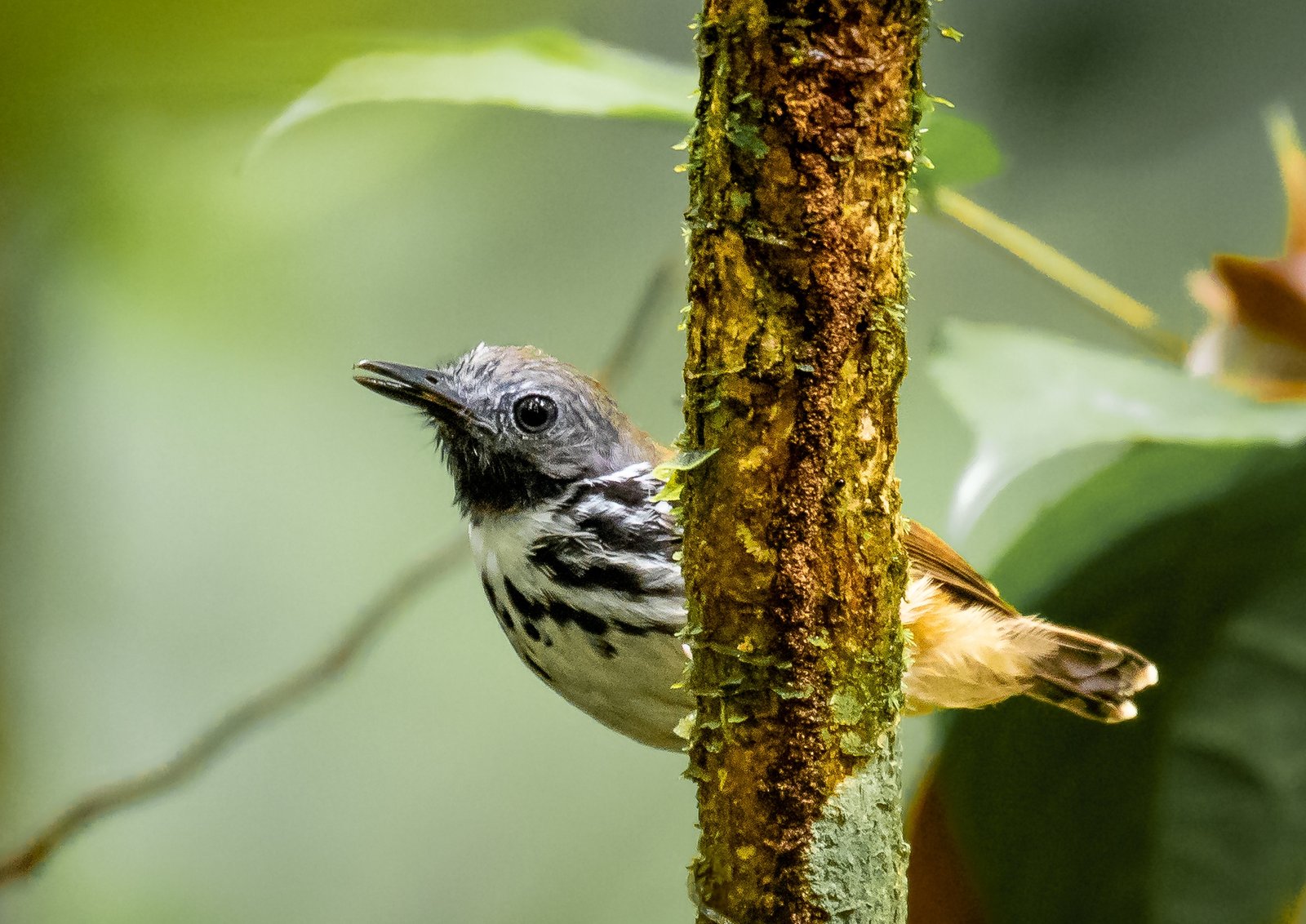
The Spot-backed Antbird is a small antbird of the understorey of terra firme lowland forest throughout Amazonia. Pairs live low in the forest and regularly sing a series of double whistles. It is the eastern counterpart of the Spotted Antbird.
Voice
The song is a series of five to ten double, rather thin whistles, becoming softer and lower towards the end. Calls are a short, descending chew and a dry rattle.
Recording: Christian Kerihuel — CC BY-NC-SA 4.0 · xeno-canto
Identification
11–12 cm, with a short tail. The male has a grey head, a black throat and an olive-brown back with black and buff spots; the wing coverts are black with buff tips. The underparts are white, with a band of black spots across the breast and buff flanks; the tail has a pale terminal band. The female has a whitish throat and warmer buff underparts with less distinct spots.
Confusion species
Dot-backed Antbird Hylophylax punctulatus has white dots on the back, greyer cheeks and whiter underparts and lives mainly in flooded forest. Common Scale-backed Antbird Willisornis poecilinotus has a scaled back, a grey or brown breast without a band of spots and follows ant swarms. Banded Antbird Dichrozona cincta walks on the ground, has a very short tail and a pale rump band.
Habitat
Understorey of humid terra firme lowland forest, locally also old secondary forest and the foot of the Andes, up to about 1000 m. It forages in pairs for insects and spiders low above the ground, sometimes in mixed flocks or at the edge of ant swarms. The nest is an open cup low in a shrub.
Where the bird is most at home, classified by the vegetation units of the Andes and the west coast.


Range and movements
Colombia: east of the Andes, from Meta and Vichada south to Amazonas. Ecuador: in the eastern lowlands and foothills. Peru: throughout the Amazonian lowlands. Bolivia: in the north (Pando, Beni and La Paz). Absent from the Galápagos. Outside the guide area in southern Venezuela, the Guianas and Amazonian Brazil.
- Resident
- dark = core range, pale = thinly spread
How and when to look
In terra firme forest in eastern Ecuador or Peru, listen for the series of double whistles; singing birds usually perch low and can be found with patience.
Conservation status
Least Concern. The species is common and widespread.
Scientific name
Hylophylax naevius | (Gmelin, 1789)
Gmelin described the species in 1789 as Pipra naevia; because it was later moved to another genus, the author and year stand in brackets. The genus Hylophylax was introduced in 1909 by Ridgway. The genus name comes from Greek hulē, 'forest', and phulax, 'guard'. The species name comes from Latin naevius, 'spotted'. The specimen the first description was based on came from Cayenne, French Guiana.