All species › Passerines › Antbirds › Spotted Antbird
Spotted Antbird | Hylophylax naevioides
Vlekborstmiervogel | Hormiguero moteado | Guarda-floresta-pintado
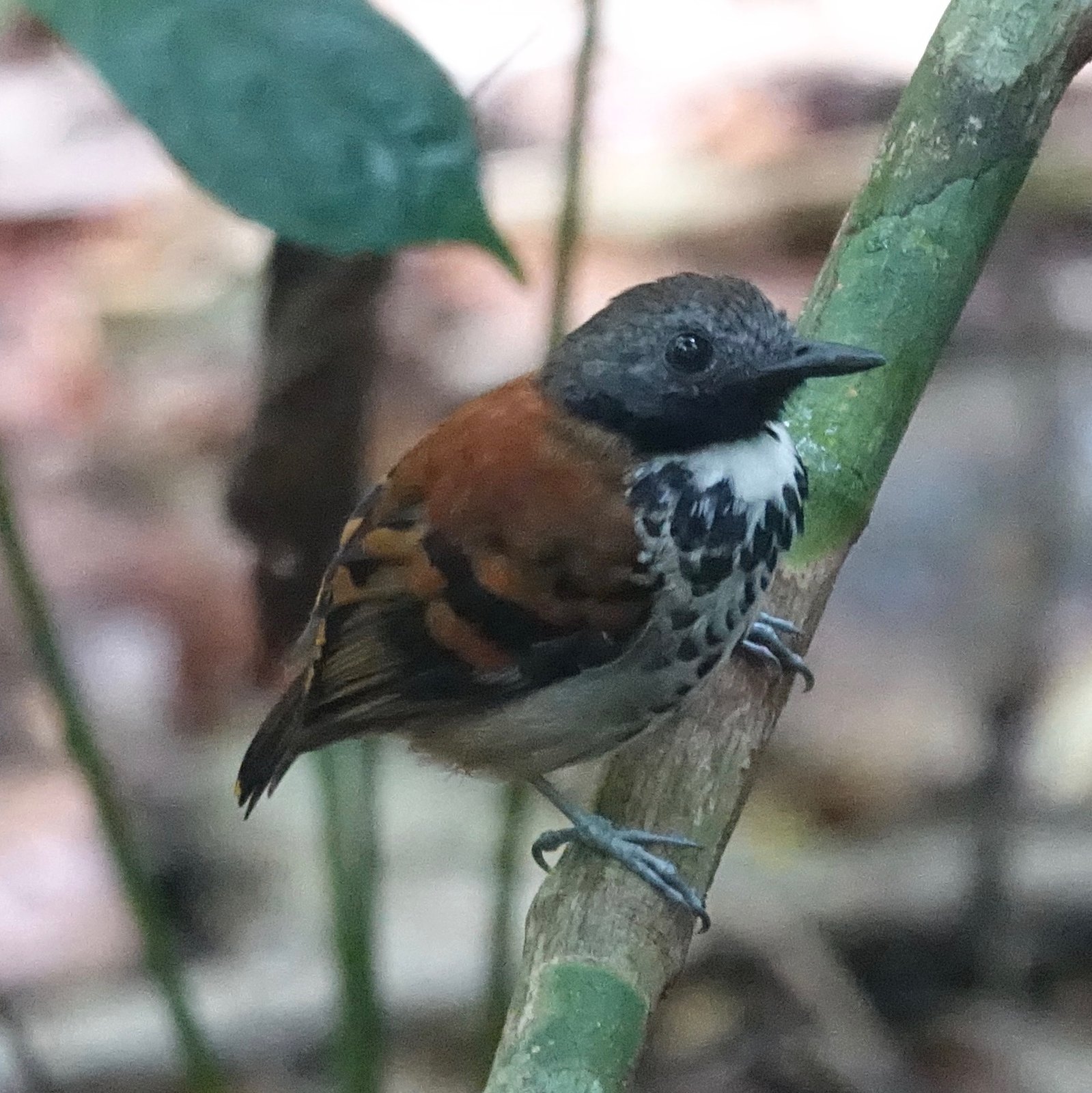
The Spotted Antbird is a small, compact antbird of the understorey of humid lowland forest west of the Andes. A band of black spots across the white breast is its most characteristic feature. It regularly follows army-ant swarms, but is not dependent on them.
Voice
The song is a series of repeated, thin double whistles, fading towards the end. Calls are a short, descending chew and a rasping note.
Recording: Rainforest Connection — CC BY-NC-SA 4.0 · xeno-canto
Identification
11–12 cm, with a short tail. The male has a grey head, a black throat, a rufous-brown back and black wing coverts with two buff wing bars. The underparts are white, with a band of large black spots across the breast; the tail has a pale terminal band. The female is browner, with a paler throat and browner, less distinct breast spots.
Confusion species
Chestnut-backed Antbird Poliocrania exsul is larger, dark below and has bare blue skin around the eye. Stub-tailed Antbird Sipia berlepschi is entirely dark. White-cheeked Antbird Gymnopithys leucaspis follows the same ant swarms, but has white underparts without spots (in the west with black cheeks and brown flanks). East of the Andes lives the related Spot-backed Antbird Hylophylax naevius, with a spotted back.
Habitat
Understorey of humid lowland forest and tall secondary forest, from sea level to about 900 m. It forages in pairs for insects and spiders low above the ground and regularly joins army-ant swarms. The nest is an open cup in the fork of a small shrub low above the ground.
Where the bird is most at home, classified by the vegetation units of the Andes and the west coast.


Range and movements
Colombia: in the Pacific lowlands and in the north, from Urabá and Córdoba east to the middle Magdalena Valley. Ecuador: in the western lowlands, mainly in the north-west, in decreasing numbers further south. Peru: absent. Bolivia: absent. Absent from the Galápagos. Outside the guide area from Honduras to Panama.
- Resident
- dark = core range, pale = thinly spread
How and when to look
Look at army-ant swarms in humid lowland forest in western Colombia or north-western Ecuador; Spotted Antbirds perch low on thin stems there and can also be heard away from swarms.
Conservation status
Least Concern. Fairly common in forest; the species disappears where forest becomes heavily fragmented.
Scientific name
Hylophylax naevioides | (de Lafresnaye, 1847)
De Lafresnaye described the species in 1847 as Conopophaga naevioïdes; because it was later moved to another genus, the author and year stand in brackets. The genus Hylophylax was introduced in 1909 by Ridgway. The genus name comes from Greek hulē, 'forest', and phulax, 'guard'. The species name comes from Latin naevius, 'spotted', with Greek -oidēs, 'resembling'. The specimen the first description was based on came from Panama.