All species › Passerines › Antbirds › White-plumed Antbird
White-plumed Antbird | Pithys albifrons
Witpluimmiervogel | Hormiguero cuerniblanco | Papa-formiga-de-topete
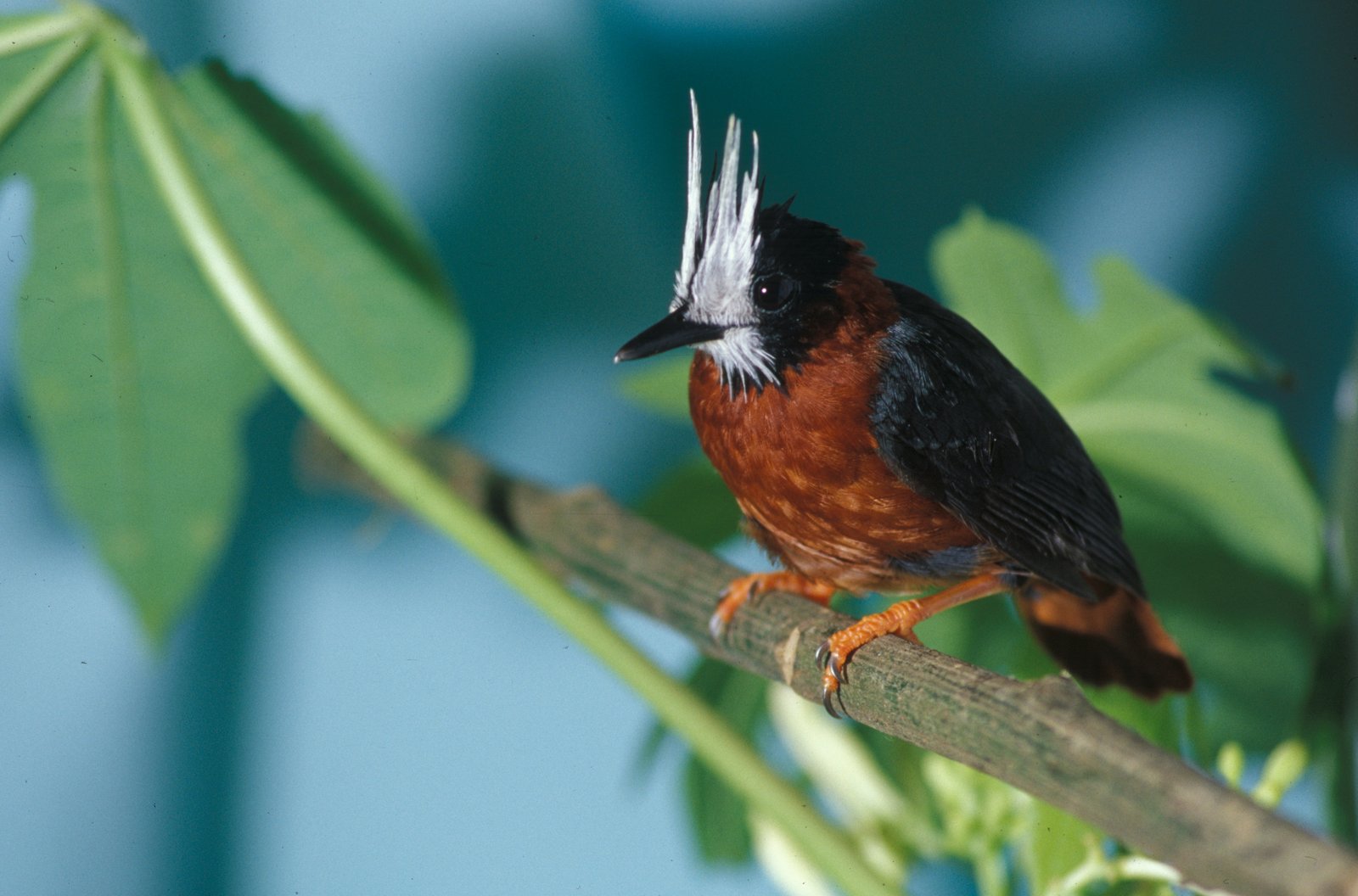
The White-plumed Antbird is a small ant follower with a black face from which long white plumes project on the forehead and chin. It is an obligate ant follower and is often the most numerous species at army ant swarms in Amazonian forest. In the guide area it lives in the lowlands and foothills east of the Andes.
Voice
The song is a short series of high, thin whistles that fall in pitch. At ant swarms it often gives a thin, high tseeuw and a short chip.
Recording: Mauricio Cuellar Ramirez (@Birding.travel) — CC BY-NC-SA 4.0 · xeno-canto
Identification
11–12 cm, compact, with a short tail. Forehead, face and throat are black; two long white plumes rise from the forehead and a white beard-like plume from the chin. Back, wings and crown are slate-grey. A collar across the nape, the rump, the tail and the underparts are chestnut. Legs yellowish-orange. The sexes are alike; young birds largely lack the white plumes and are duller.
Confusion species
White-masked Antbird Pithys castaneus lives only in a small area of northern Peru, is larger, mainly rufous with a black head and a white face, without white plumes. White-cheeked Antbird Gymnopithys leucaspis has brown upperparts, a white throat and breast and blue skin around the eye. Lunulated Antbird Oneillornis lunulatus has a white throat and black-and-white scaled upperparts.
Habitat
Understorey of humid terra firme lowland forest and foothill forest, less often tall secondary forest, up to about 1100 m. It follows army ant swarms and from low saplings catches the arthropods fleeing the ants; often several birds at one swarm. It is seldom seen far from an ant swarm.
Where the bird is most at home, classified by the vegetation units of the Andes and the west coast.


Range and movements
Colombia: east of the Andes, from Meta and Guainía south to Putumayo and Amazonas. Ecuador: in the eastern lowlands and foothills. Peru: in the northern and central Amazonian lowlands, south to Pasco and Junín. Absent from Bolivia and the Galápagos. Outside the guide area in southern Venezuela, the Guianas and northern Brazil.
- Resident
- dark = core range, pale = thinly spread
How and when to look
Search terra firme forest for an army ant swarm; the White-plumed Antbird is often one of the first birds you see there. In Ecuador for example around lodges along the Napo, in Peru around Iquitos.
Conservation status
Least Concern. Widespread and fairly common in undisturbed forest. As an obligate ant follower it disappears from fragmented forest.
Scientific name
Pithys albifrons | (Linnaeus, 1766)
Linnaeus described the species in 1766 as Pipra albifrons; because it was later moved to another genus, the author and year stand in brackets. The genus Pithys was introduced in 1818 by Vieillot. The origin of the genus name is uncertain: it may be based on a Guaraní name used by Félix de Azara, or be a corrupt combination of the genus Pipra, 'manakin', and Modern Latin thlypis, 'warbler'. The species name comes from Latin albus, 'white', and frons, 'forehead', for the white plumes on the head. The specimen the first description was based on came from Cayenne, French Guiana.