All species › Passerines › Antbirds › White-shouldered Antbird
White-shouldered Antbird | Akletos melanoceps
Witschoudermiervogel | Hormiguero hombriblanco | Formigueiro-grande
The White-shouldered Antbird is a large, sturdy antbird of flooded forest and dense riverside growth in western Amazonia. It keeps low in vine tangles and thickets, from which its loud song carries. The two sexes differ strongly in colour.
Voice
The song is a short series that begins with two soft notes, followed by flat notes that grow steadily more intense. It also gives a short chirp, a rattle and a slower, melodic series.
No recording with a suitable Creative Commons licence is available for this species yet.
Identification
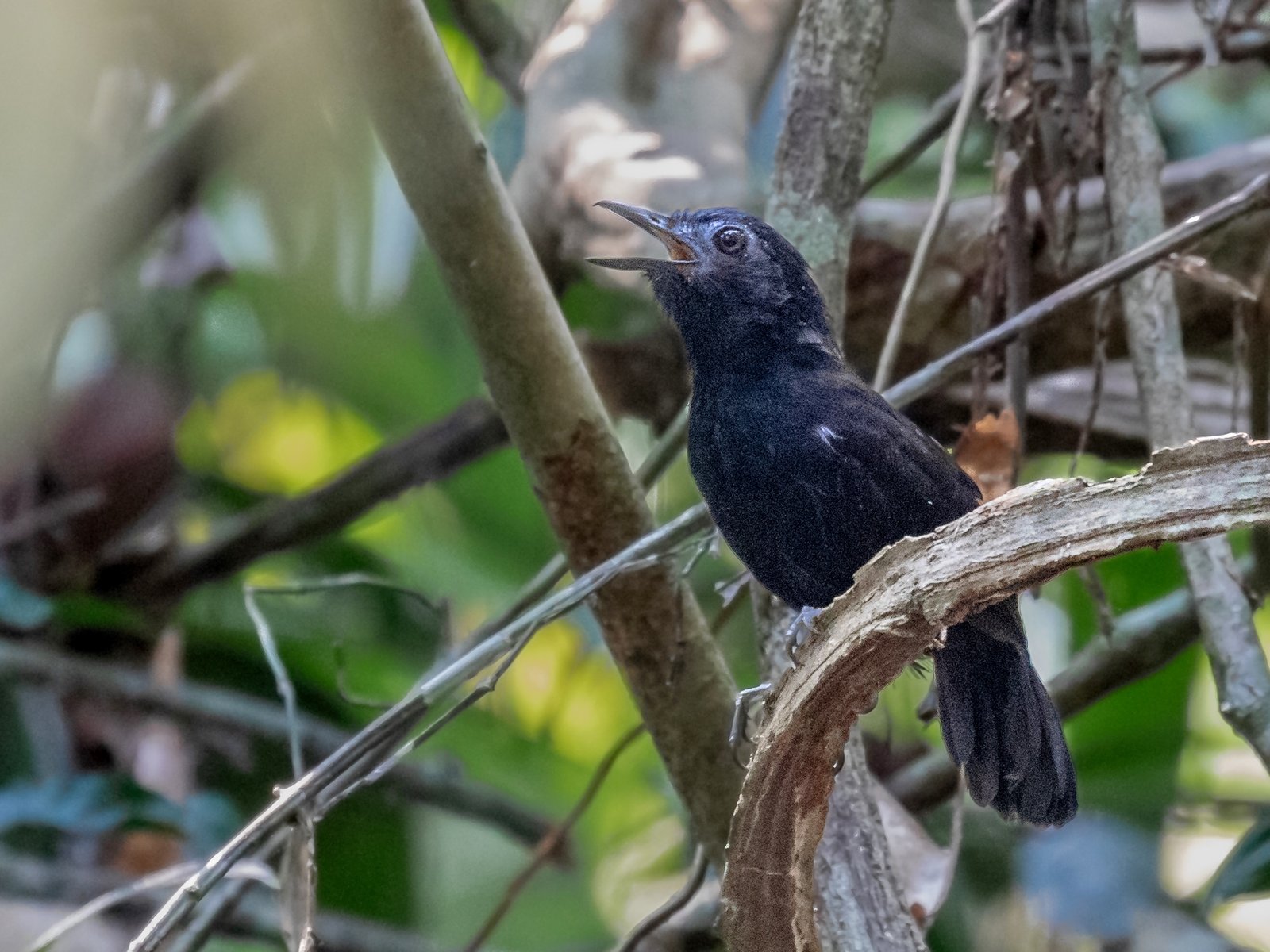
18 cm, with a red iris and a bare blue ring around the eye. The male is almost entirely black, with a small white shoulder patch that is usually visible only in flight or when excited. The female has a black head, neck, upper mantle and upper breast; the rest of the upperparts are rufous, darker on wings and tail, and the underparts are cinnamon-tawny, paler in the centre of the belly.
Confusion species
Goeldi's Antbird Akletos goeldii lives further south, in south-eastern Peru; the male lacks a white shoulder patch but has a hidden white back patch, and the female lacks a black head but has a grey forecrown and a white throat. Sooty Antbird Hafferia fortis lives in terra firme forest; the male is sooty black without white on the wing and the female grey-brown. White-shouldered Antshrike Thamnophilus aethiops is smaller, with a heavy hooked bill and small white spots on the wing coverts.
Habitat
Floor and understorey of evergreen várzea forest, also transitional forest and nearby older secondary forest, favouring shrubbery and vine tangles along rivers and lakes. Up to about 500 m. It forages in pairs low in the vegetation for insects and sometimes follows army-ant swarms. The nest is a cup low in dense vegetation.
Where the bird is most at home, classified by the vegetation units of the Andes and the west coast.


Range and movements
Colombia: in the south-east, from Meta southwards. Ecuador: in the eastern lowlands. Peru: in the north-east and east-centre, to northern Ucayali. Absent from Bolivia and the Galápagos. Outside the guide area in western Brazil, east to the Japurá and Juruá.
- Resident
- dark = core range, pale = thinly spread
How and when to look
Listen along the banks of rivers and lakes in the eastern lowlands of Ecuador, for example around the lodges on the Napo, for the loud song from dense vine tangles, and search the low growth where the sound comes from.
Conservation status
Least Concern. Common in Colombia and Ecuador and fairly common in Peru; the population is considered stable.
Scientific name
Akletos melanoceps | (Spix, 1825)
Spix described the species in 1825 as Thamnophilus melanoceps; because it was later moved to another genus, the author and year stand in brackets. The genus Akletos was introduced in 1948 by Dunajewski. The genus name comes from Greek aklētos, 'uncalled, unbidden', from the negative prefix a- and klētos, 'called'. The species name melanoceps combines Greek melas, 'black', and Latin -ceps, '-headed': 'black-headed'. The specimen the first description was based on came from Rio Içá, Amazonas, Brazil.