All species › Passerines › Antbirds › Black-and-white Antbird
Black-and-white Antbird | Myrmochanes hemileucus
Zwart-witte mierkruiper | Hormiguero negriblanco | Formigueiro-preto-e-branco
The Black-and-white Antbird is a small antbird that lives almost exclusively on young river islands and banks along the Amazon and its large tributaries. It is the only species in its genus. Its habitat is dense, low scrub that is constantly renewed by floods.
Voice
The song is a fast, accelerating series of short, dry notes, often given as a duet by the pair. The call is a short, hoarse chuk.
Recording: JAYRSON ARAUJO DE OLIVEIRA — CC BY-NC-SA 4.0 · xeno-canto
Identification
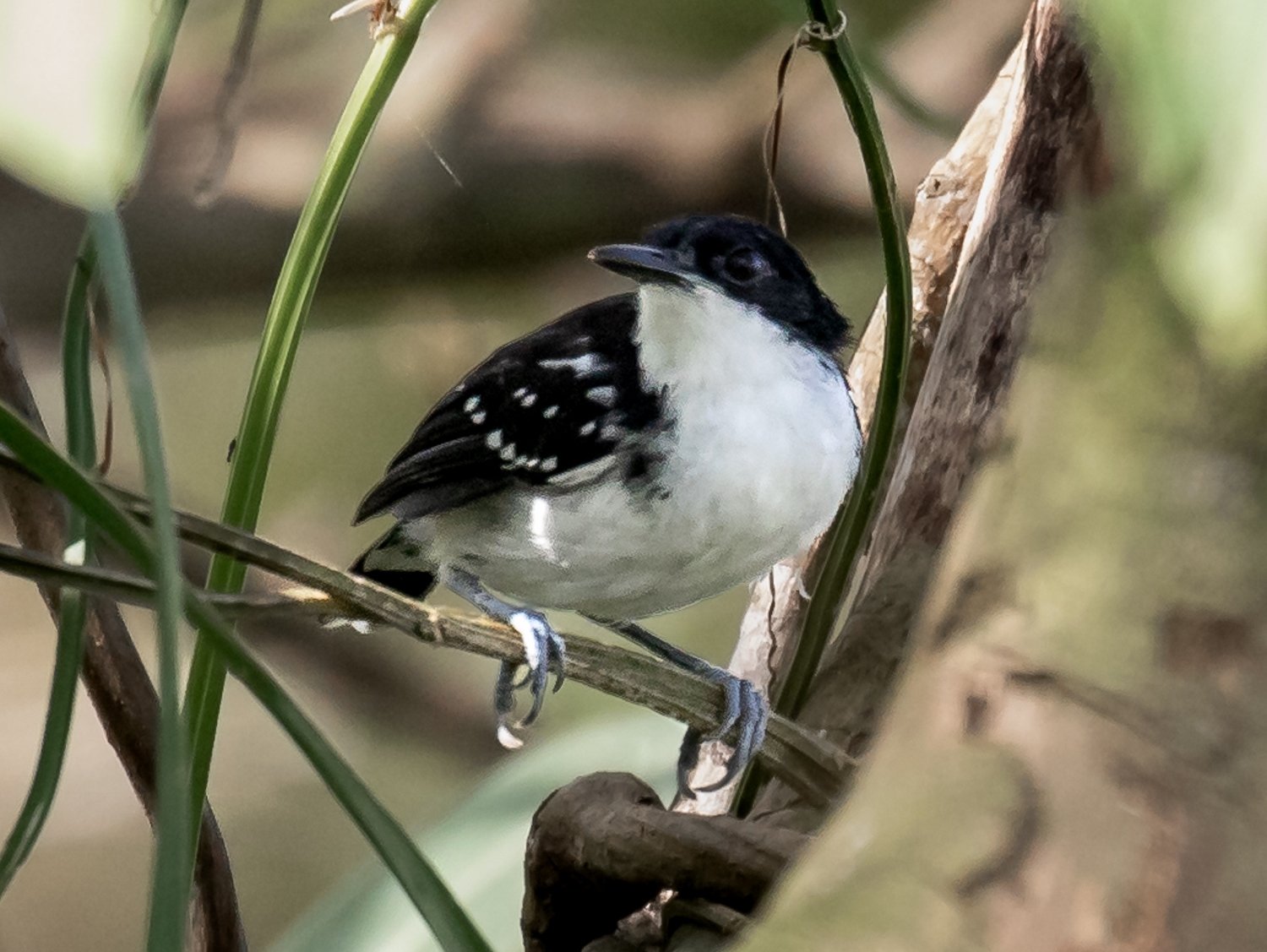
11 cm, with a thin bill and a short tail. The male is black above, with white edges to the wing coverts, and entirely white below. The female closely resembles the male, but has white lores.
Confusion species
Black-chinned Antbird Hypocnemoides melanopogon is grey, with a black throat and white tail tips, and lives along streams and in flooded forest. Band-tailed Antbird Hypocnemoides maculicauda is also grey with a black throat. Ash-breasted Antbird Myrmoborus lugubris also lives on river islands, but is grey above and has a grey breast.
Habitat
Young scrub on river islands and sandbars of large lowland rivers: shrubs, young Cecropia, willow-like shrubs and cane, mostly below 300 m. It forages in pairs low in the vegetation for insects. The nest is a small, open cup low in a shrub.
Where the bird is most at home, classified by the vegetation units of the Andes and the west coast.


Range and movements
Colombia: along the Amazon in the far south. Ecuador: on islands in the Napo and other large rivers in the east. Peru: along the large lowland rivers, mainly in the north and centre. Bolivia: at most a single record. Absent from the Galápagos. Outside the guide area along the Amazon and its tributaries in western Brazil.
- Resident
- dark = core range, pale = thinly spread
How and when to look
Visit young river islands by boat in the Amazon near Iquitos or Leticia, or in the Napo in Ecuador, and listen in the early morning for the fast song from the low scrub.
Conservation status
Least Concern. Its habitat is constantly renewed by river dynamics, but is locally under pressure from farming on the islands.
Scientific name
Myrmochanes hemileucus | (Sclater & Salvin, 1866)
Sclater & Salvin described the species in 1866 as Hypocnemis hemileuca; because it was later moved to another genus, the author and year stand in brackets. The genus Myrmochanes was introduced in 1889 by Allen. The genus name combines Greek murmos, 'ant', with khainō, 'to gape greedily'. The species name comes from Greek hēmi-, 'half', and leukos, 'white', for the black-and-white plumage. The specimen the first description was based on came from Lower Ucayali River, Peru.