All species › Passerines › Antbirds › Recurve-billed Bushbird
Recurve-billed Bushbird | Clytoctantes alixii
Dikbekmiervogel | Hormiguero pico de hacha | Choca-de-bico-recurvo
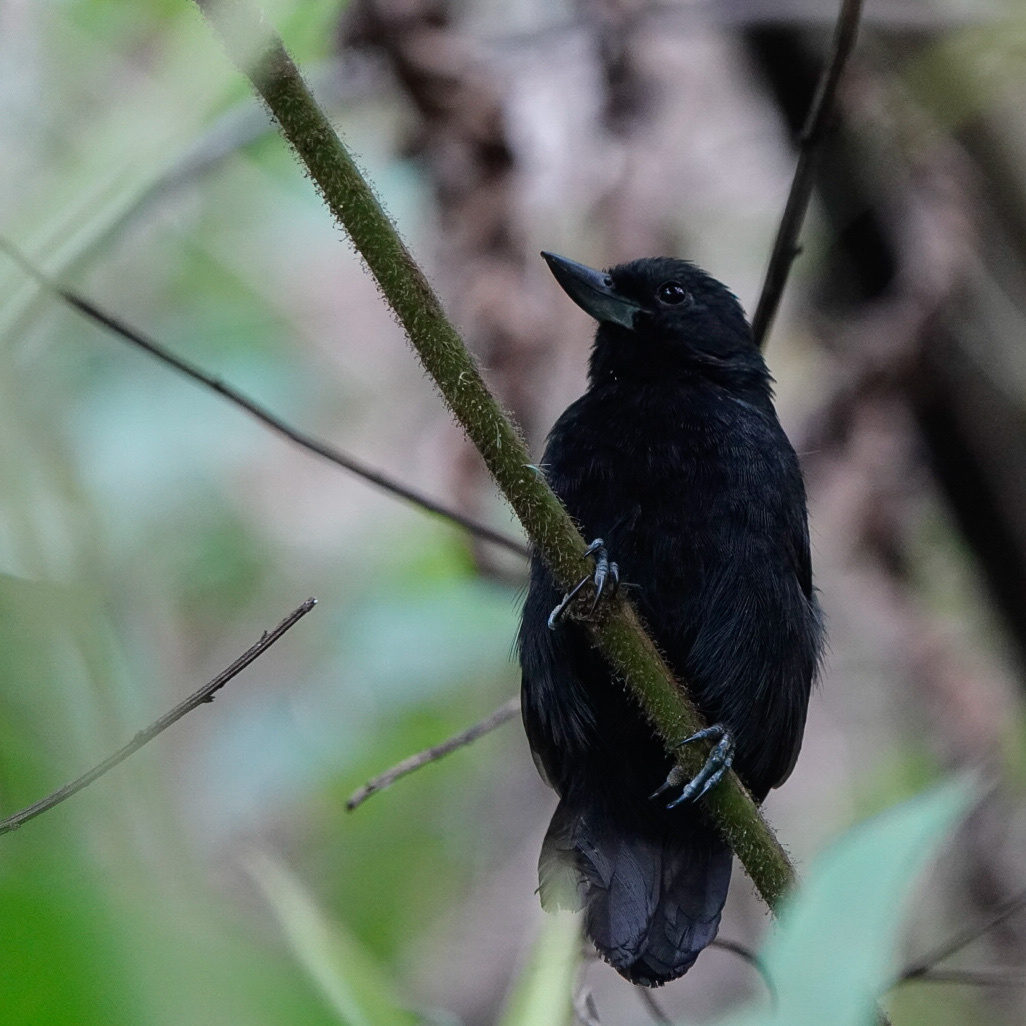
The Recurve-billed Bushbird is a stocky antbird with a very large, laterally compressed bill with a strongly upturned lower mandible, which it uses to break open stems and strip off bark. After a sighting in 1965 it was not seen alive again until 2004; since then it has been rediscovered in Venezuela and northern Colombia. The species is threatened by deforestation.
Voice
The call is a loud, whistled series of usually four short mid-pitched notes. Other vocalizations are poorly described.
Recording: Bram Vogels — CC BY-NC-SA 4.0 · xeno-canto
Identification
16–17 cm, stocky, with a short tail and a large, pale horn-coloured bill that is laterally compressed, with a strongly upturned lower mandible. The male is dark grey with a white interscapular patch; the lores, throat and centre of the upper breast are black, and the wing coverts have small black spots. The female is dark rufous-brown on the crown, back and rump, with blackish wings and tail and rufous-brown underparts, darker on the flanks and undertail.
Confusion species
The male Black-crowned Antshrike Thamnophilus atrinucha has an ordinary hooked bill, a black crown and white wing dots. Great Antshrike Taraba major is larger, with a red iris and white underparts. Black Bushbird Neoctantes niger has a smaller bill and an all-black male; it lives in the Amazon basin and does not overlap with this species.
Habitat
Dense undergrowth and edges of evergreen forest, regenerating clearings and adjacent secondary forest in the foothills, in Colombia mostly between 200 and 1000 m, occasionally to 1150 m, in Venezuela between 300 and 1200 m; in part of Colombia associated with bamboo. It feeds on insects by pecking open stems and pulling off strips of bark. It has been seen at army ant swarms, but not in mixed flocks. In the west of its range it breeds around April and May; little is known about the nest.
Where the bird is most at home, classified by the vegetation units of the Andes and the west coast.


Range and movements
In Colombia scattered in the north, in Antioquia, Santander and Norte de Santander; formerly more widespread. Absent from Ecuador, Peru, Bolivia and the Galápagos. Outside the guide area in the foothills of the Sierra de Perijá in Venezuela.
- Resident
- dark = core range, pale = thinly spread
How and when to look
Search the small nature reserves in the foothills of Antioquia and Norte de Santander where the species was rediscovered after 2005. Listen in dense, regenerating growth for the four-note whistled call.
Conservation status
Endangered. The population is estimated at 150 to 700 mature birds and is declining. Forest in its range has largely been cleared for settlement, farming, logging and mining; national parks in Colombia and Venezuela offer little effective protection, and a few small private reserves are important for the species.
Scientific name
Clytoctantes alixii | Elliot, 1870
Elliot described the species in 1870 and placed it straight away in the genus where it still stands. He introduced the genus Clytoctantes in that same work. The genus name combines Greek klutos, 'renowned, noble', and ktantēs, 'killer', here in the sense of shrike; compare the genus Neoctantes. The species name honours Edouard Alix (1823–1893) of Paris. The specimen the first description was based on came from Río Napo, Ecuador.