All species › Passerines › Antbirds › Rufous-margined Antwren
Rufous-margined Antwren | Herpsilochmus rufimarginatus
Roodvleugelmiersluiper | Tiluchí alirrufo | Chorozinho-de-asa-vermelha
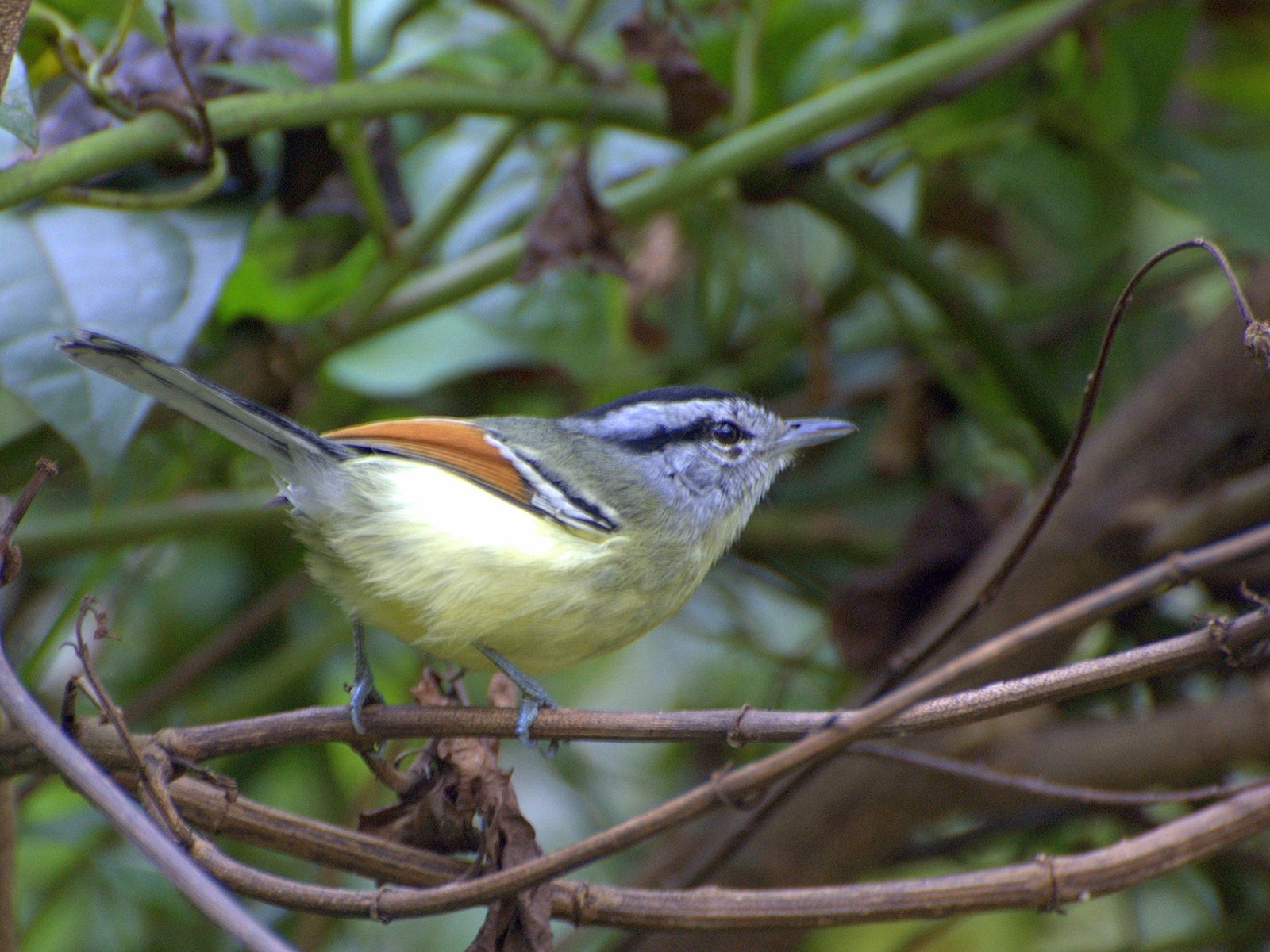
The Rufous-margined Antwren is a small antwren with a rufous wing panel from the Atlantic Forest of south-eastern South America. It does not occur in the guide area. It is included because it was formerly treated as one species with the Rusty-winged Antwren, so old records under this name fall within the guide area.
Voice
The song is a short series of fast notes running into a dry trill, differing in rhythm from that of the Rusty-winged Antwren. Calls are short, nasal notes.
Recording: Aran Rodrigues Cardoso — CC BY-NC-SA 4.0 · xeno-canto
Identification
11–12 cm, slender, with a fine bill and a fairly long black tail with white tips. The male has a black crown, a white supercilium and a black eyestripe; the back is grey with black, and the wings are black with white wing bars and a rufous panel on the flight feathers. The underparts are whitish to pale yellow. The female has a rufous crown and yellower underparts.
Confusion species
Rusty-winged Antwren Herpsilochmus frater is very similar and replaces this species in the guide area; the two differ mainly in song and range. Black-capped Antwren Herpsilochmus atricapillus lacks the rufous wing panel.
Habitat
The canopy and mid-storey of humid lowland and hill forest, forest edges and tall secondary forest; from sea level to about 1000 m. Pairs search outer branches for insects, often with mixed flocks. The nest is a small cup in the fork of a thin branch.
Where the bird is most at home, classified by the vegetation units of the Andes and the west coast.


Range and movements
Does not occur in the guide area; absent from Colombia, Ecuador, Peru, Bolivia and the Galápagos. Outside the guide area in the Atlantic Forest of eastern and south-eastern Brazil, eastern Paraguay and north-eastern Argentina. Older records from the guide area refer to the Rusty-winged Antwren.
- Resident
- dark = core range, pale = thinly spread
How and when to look
Not expected in the guide area; antwrens with a rufous wing panel in the Amazonian lowlands are Rusty-winged Antwrens. In the Atlantic Forest it lives in the canopy of forest edges and in mixed flocks.
Conservation status
Not Evaluated in its current circumscription. The Atlantic Forest is heavily fragmented, but the species tolerates edges and secondary forest.
Scientific name
Herpsilochmus rufimarginatus | (Temminck, 1822)
Temminck described the species in 1822 as Myiothera rufimarginata; because it was later moved to another genus, the author and year stand in brackets. The genus Herpsilochmus was introduced in 1847 by Cabanis. The genus name combines Greek herpō, 'to creep about', and lokhmē, 'thicket, copse'. The species name combines Latin rufus, 'rufous', and marginatus, 'edged', for the rufous edges of the wing feathers. The specimen the first description was based on came from Rio de Janeiro, Brazil.