All species › Passerines › Antbirds › Rusty-winged Antwren
Rusty-winged Antwren | Herpsilochmus frater
Noordelijke roodvleugelmiersluiper | Tiluchí alirrufo norteño | Chorozinho-de-asa-ferrugem
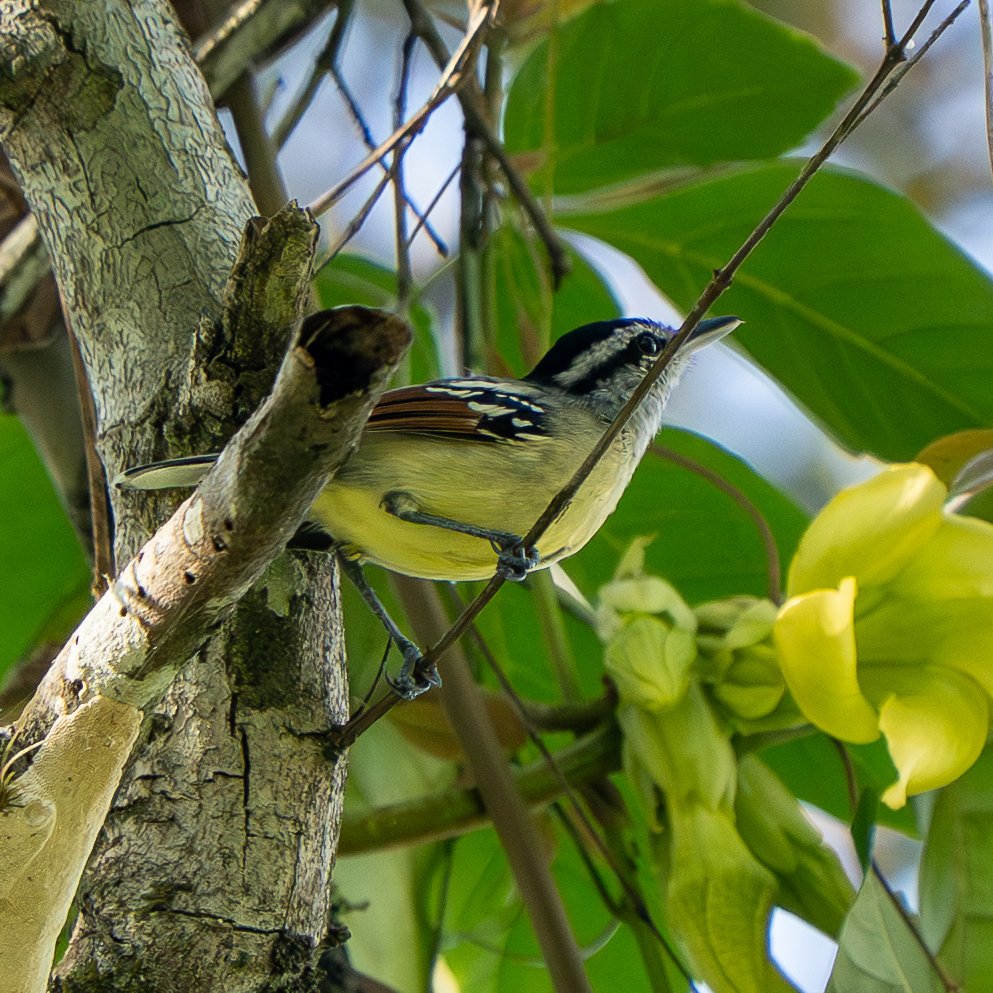
The Rusty-winged Antwren is a small black-and-grey antwren with a rufous wing panel that lives high in the canopy of humid lowland forest. Pairs usually forage with mixed flocks and are mostly detected by their song. It was long treated as one species with the Rufous-margined Antwren of the Atlantic Forest, but differs from it in song and range.
Voice
The song is a short, fast series that starts with a few separate notes and runs into a dry, slightly descending trill; male and female often sing shortly after each other. Calls are short, nasal notes.
Recording: Juan Freile — CC BY-NC-SA 4.0 · xeno-canto
Identification
11–12 cm, slender, with a fine bill and a fairly long black tail with white tips. The male has a black crown, a white supercilium and a black eyestripe; the back is grey with black, and the wings are black with two white wing bars and a rufous panel on the flight feathers. The underparts are white to pale grey, washed yellowish towards the belly. The female has a rufous crown and more strongly yellowish to ochre underparts.
Confusion species
Creamy-bellied Antwren Herpsilochmus motacilloides on the eastern slope of Peru lives higher, in montane forest, and lacks the rufous in the wing. Black-capped Antwren Herpsilochmus atricapillus in Bolivia has no rufous in the wing and greyer underparts. Spot-backed Antwren Herpsilochmus dorsimaculatus and Dugand's Antwren Herpsilochmus dugandi also have wings without a rufous panel. Yellow-breasted Antwren Herpsilochmus axillaris of the foothills has a spotted crown and a yellow breast.
Habitat
The canopy and mid-storey of humid terra firme lowland forest, várzea forest, foothill forest and tall secondary forest, especially along edges and clearings; from sea level to about 1200 m. It searches outer branches and vine tangles for insects and spiders, often with mixed flocks. The nest is a small cup suspended in the fork of a thin branch.
Where the bird is most at home, classified by the vegetation units of the Andes and the west coast.


Range and movements
Colombia: in the north, from east of the Gulf of Urabá to the middle Magdalena valley, and in the lowlands east of the Andes. Ecuador: in the eastern lowlands and foothills. Peru: throughout the Amazonian lowlands and the foothills of the eastern slope. Bolivia: in the lowlands of the north and east, from Pando and Beni to La Paz, Cochabamba and Santa Cruz. Absent from the Galápagos. Outside the guide area in eastern Panama, Venezuela, parts of the Guianas and Amazonian Brazil.
- Resident
- dark = core range, pale = thinly spread
How and when to look
Listen in the canopy of forest edges and along rivers for the short, rattling song and look for the birds in mixed flocks; a canopy tower or a slope with a view into the treetops helps.
Conservation status
Not Evaluated as a separate species. It is widespread in large, continuous forests and also tolerates edges and old secondary forest; locally it loses habitat to deforestation.
Scientific name
Herpsilochmus frater | Sclater & Salvin, 1880
Sclater & Salvin described the species in 1880 and placed it straight away in the genus where it still stands. The genus Herpsilochmus was introduced in 1847 by Cabanis. The genus name combines Greek herpō, 'to creep about', and lokhmē, 'thicket, copse'. The species name comes from Latin frater, 'brother', for its close relationship to another species. The specimen the first description was based on came from Sarayacu, Pastaza, Ecuador.