All species › Passerines › Antbirds › Yellow-breasted Antwren
Yellow-breasted Antwren | Herpsilochmus axillaris
Geelborstmiersluiper | Tiluchí pechiamarillo | Chorozinho-de-peito-amarelo
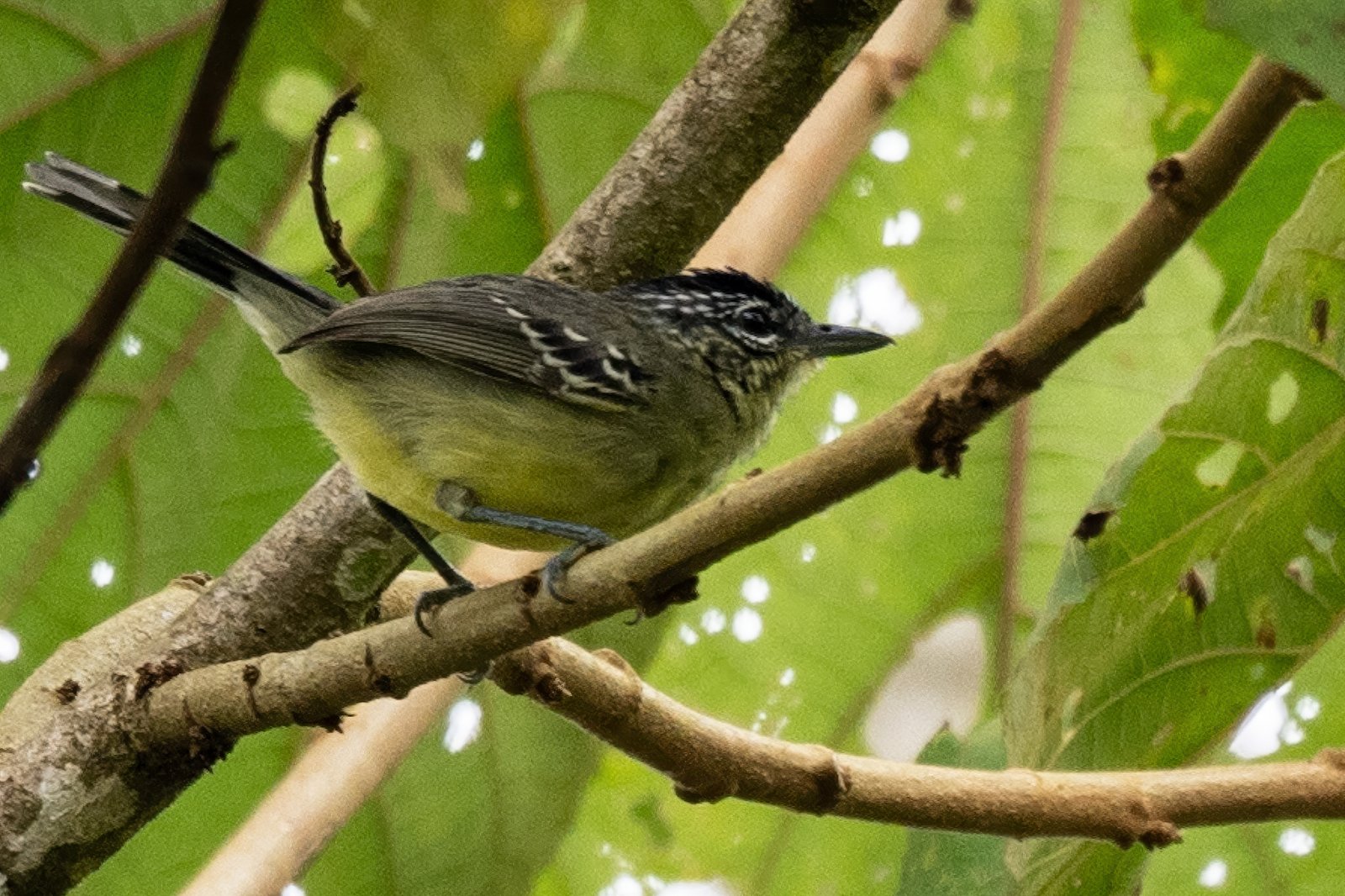
The Yellow-breasted Antwren is an antwren of the lower Andean slopes with yellow underparts and an olive back. It lives high in the canopy of montane forest and travels with mixed flocks of tanagers. Male and female can be told apart by the colour of the crown.
Voice
The song is a short, fast series of notes that accelerates and falls in pitch to a dry trill. Calls are short, nasal notes.
Recording: Mauricio Cuellar Ramirez (@Birding.travel) — CC BY-NC-SA 4.0 · xeno-canto
Identification
11.5 cm, with a fairly long tail. The male has a black crown with fine white dots and grey-and-white sides to the head. The back is olive-grey; the wings are black with white wingbars and edges. The tail is black with white tips. The throat and underparts are yellow, the flanks olive. The female has a rufous crown.
Confusion species
Rusty-winged Antwren Herpsilochmus frater has rufous edges to the flight feathers, a white throat and usually lives lower. Creamy-bellied Antwren Herpsilochmus motacilloides has a grey back and whitish underparts with a creamy-yellow tinge. Ash-throated Antwren Herpsilochmus parkeri has a grey throat and whitish underparts.
Habitat
Canopy of humid lower montane forest and foothill forest, also tall forest edges; about 900 to 2000 m. It searches in pairs for insects in foliage and at the tips of branches, almost always with mixed flocks. The nest is an open cup in a horizontal fork of a branch.
Where the bird is most at home, classified by the vegetation units of the Andes and the west coast.


Range and movements
Colombia: on the Pacific slope of the Western Andes, in the Central Andes and on the east slope of the Eastern Andes. Ecuador: on the east slope of the Andes. Peru: on the east slope of the Andes, from Cajamarca and Amazonas to Cusco and Puno. Bolivia: only a few unconfirmed records from La Paz. Absent from the Galápagos. Does not occur outside the guide area.
- Resident
- dark = core range, pale = thinly spread
How and when to look
Follow mixed flocks in the canopy, for example around Montezuma (Risaralda), along the road from Baeza to Tena in Ecuador or along the Manu road in Peru, and look for a small, yellow-bellied antwren high in the trees.
Conservation status
Least Concern. Fairly common in suitable forest; depends on forest on the Andean slopes, which is heavily cleared in places.
Scientific name
Herpsilochmus axillaris | (Tschudi, 1844)
Tschudi described the species in 1844 as Thamnophilus axillaris; because it was later moved to another genus, the author and year stand in brackets. The genus Herpsilochmus was introduced in 1847 by Cabanis. The genus name combines Greek herpō, 'to creep about', and lokhmē, 'thicket, copse'. The species name comes from Latin axilla, 'armpit', for the axillary feathers under the wing. The specimen the first description was based on came from Peru.