All species › Birds of prey › Kites, Old World vultures, eagles and hawks › White-tailed Kite
White-tailed Kite | Elanus leucurus
Amerikaanse grijze wouw | Milano cola blanca | Gavião-peneira
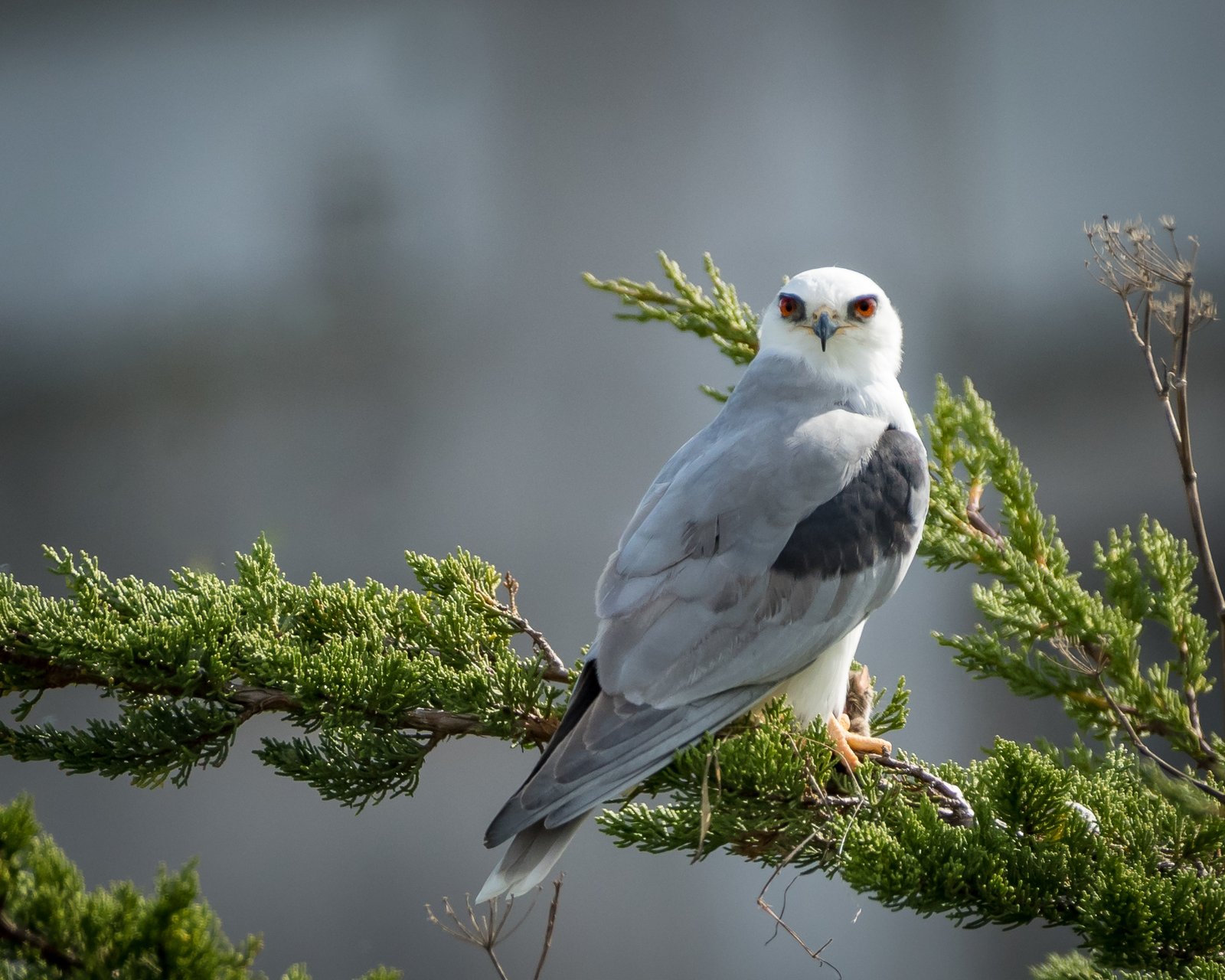
The White-tailed Kite is a pale grey and white raptor of open country that hovers with dangling legs and then drops onto a mouse. With forest clearance and the spread of pasture it has expanded over large parts of South America. Outside the breeding season small groups often roost together in a tree.
Voice
A soft, whistled kewt and a rasping, harsh kree-ek, mainly at the nest and at roosts.
Recording: José María Loaiza B. — CC BY-NC-SA 4.0 · xeno-canto
Identification
35–41 cm, with long, pointed wings and a long white tail. The adult is pale grey above and white on the head and underparts, with a large black patch on the upperwing coverts, a black patch around the eye and a red iris. In flight the underwings are white with a small black carpal patch and dark grey primary tips. The sexes are alike. Juveniles have a rufous-streaked breast, brown fringes to the back feathers and a brownish iris.
Confusion species
Cinereous Harrier Circus cinereus flies low over grassland and has a white rump and a barred tail. White-tailed Hawk Geranoaetus albicaudatus is larger and heavier, with broad wings, a grey head and a white tail with a black subterminal band. Gulls lack the black wing patch and do not hover over land. Black-winged Kite Elanus caeruleus of the Old World has a shorter tail and black undersides to the primaries.
Habitat
Open and semi-open country: grassland, pasture, fields, wet meadows and marsh edges with scattered trees, from sea level to the Andean highlands at about 3000 m. It hunts mainly small rodents, caught after a spell of hovering, supplemented with lizards, insects and small birds. The nest is a stick nest in an isolated tree.
Where the bird is most at home, classified by the vegetation units of the Andes and the west coast.


Range and movements
In Colombia in the Caribbean lowlands, the Llanos, the Magdalena and Cauca valleys and the Bogotá savanna. In Ecuador scarce but increasing, in the western lowlands and the Andean valleys. In Peru scarce and local. In Bolivia in the savannas and pastures of the lowlands in the north and east. Absent from the Galápagos. Outside the guide area from the western and southern United States to Central America, and from Venezuela and Brazil to Argentina and Chile.
- Resident
- dark = core range, pale = thinly spread
How and when to look
Over open pasture and fallow land, look for a pale raptor hovering in the air. At dusk small groups may fly to a shared roost tree.
Conservation status
Least Concern. The species is expanding in the guide area as forest is converted to pasture.
Scientific name
Elanus leucurus | (Vieillot, 1818)
Vieillot described the species in 1818 as Milvus leucurus; because it was later moved to another genus, the author and year stand in brackets. The genus Elanus was introduced in 1809 by De Savigny. The genus name comes from Greek elanos, 'kite'. The species name comes from Greek leukos, 'white', and oura, 'tail'. The specimen the first description was based on came from Paraguay.