All species › Birds of prey › Kites, Old World vultures, eagles and hawks › Pearl Kite
Pearl Kite | Gampsonyx swainsonii
Parelwouw | Elanio perla | Gaviãozinho
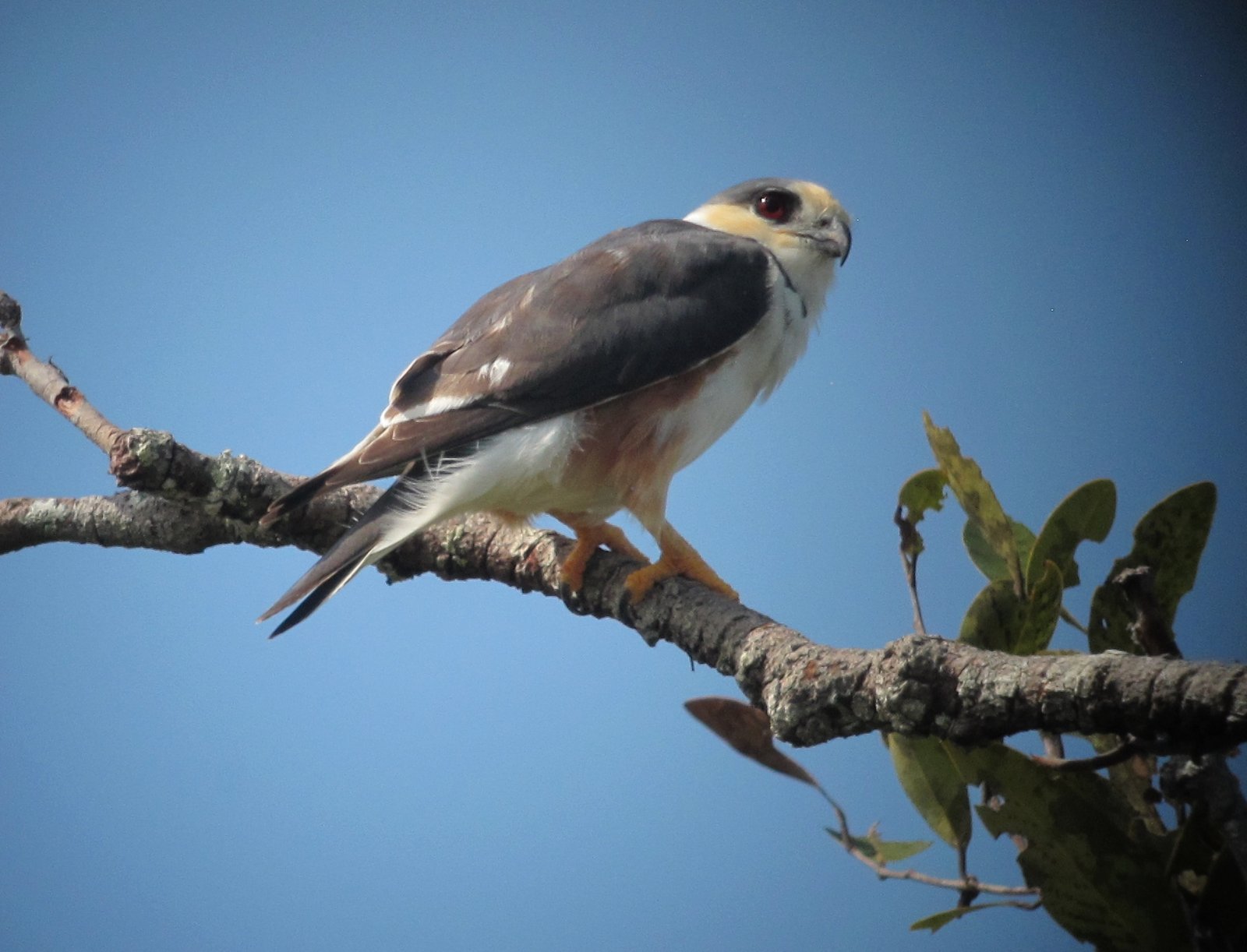
The Pearl Kite is the smallest kite in the Americas, with the size and posture of a small falcon. It often perches upright on a bare branch or wire in semi-open country and hunts lizards and large insects from there. Forest clearance is allowing it to expand its range in the guide area.
Voice
Fairly quiet. At the nest a high, thin, repeated kee-kee-kee and a soft twittering.
Recording: Francisco contreras — CC BY-NC-SA 4.0 · xeno-canto
Identification
20–25 cm, with short, pointed wings and a fairly long tail. The upperparts are slate grey to blackish, with a narrow white nuchal collar. The forehead and cheeks are buff to creamy, and the crown is dark. The underparts are white, with a rufous patch on the thighs and flanks and a dark patch on the side of the breast. In flight the underwings are white with dark flight feathers. The sexes are alike. Juveniles have rufous fringes to the upperpart feathers and a paler, rufous-tinged head.
Confusion species
American Kestrel Falco sparverius has a rufous back and tail and black moustachial stripes. Bat Falcon Falco rufigularis has a dark head, a white throat, a black-barred belly and rufous undertail coverts. Aplomado Falcon Falco femoralis is larger, with a distinct eyestripe and a dark belly band. White-tailed Kite Elanus leucurus is much larger and pale grey above, with black shoulder patches.
Habitat
Semi-open country with scattered trees: savanna, pasture, dry woodland and scrub, forest edges, clearings and plantations, from sea level to about 1500 m, locally higher. It hunts from a perch or in a short, fast flight, taking lizards, large insects and sometimes small birds. The nest is a small stick nest high in a tree.
Where the bird is most at home, classified by the vegetation units of the Andes and the west coast.


Range and movements
In Colombia in the Caribbean lowlands, the Magdalena and Cauca valleys and the Llanos. In Ecuador mainly in the western lowlands, with records from the east. In Peru in the dry north-west and scattered in the eastern lowlands. In Bolivia in the savannas and lowlands of the north and east. Absent from the Galápagos. Outside the guide area from Nicaragua to Venezuela, the Guianas, Brazil, Paraguay and northern Argentina.
- Resident
- dark = core range, pale = thinly spread
How and when to look
In open, lightly wooded farmland, check small raptors on wires and dead branches. In good light the pale head and rufous thighs stand out.
Conservation status
Least Concern. The species benefits from deforestation and is increasingly seen in newly cleared areas.
Scientific name
Gampsonyx swainsonii | Vigors, 1825
Vigors described the species in 1825 and placed it straight away in the genus where it still stands. He introduced the genus Gampsonyx in that same work. The genus name comes from Greek gampsos, 'curved', and onux, 'claw'. The species name honours William Swainson (1789–1855), English naturalist and illustrator who collected the type specimen in Brazil. The specimen the first description was based on came from Bahia tableland, Brazil.