All species › Birds of prey › Ospreys › Osprey
Osprey | Pandion haliaetus
Visarend | Águila pescadora | Águia-pescadora
The Osprey is a raptor that lives almost entirely on live fish, plunging feet first into the water to catch them. It occurs over almost the whole world and forms a family of its own. It does not breed in the guide area: the birds there are North American winterers, and immatures often stay through the northern summer as well.
Voice
A series of clear, whistled notes, chewk-chewk-chewk; seldom heard in the wintering area.
Recording: David Darrell-Lambert — CC BY-NC-SA 4.0 · xeno-canto
Identification
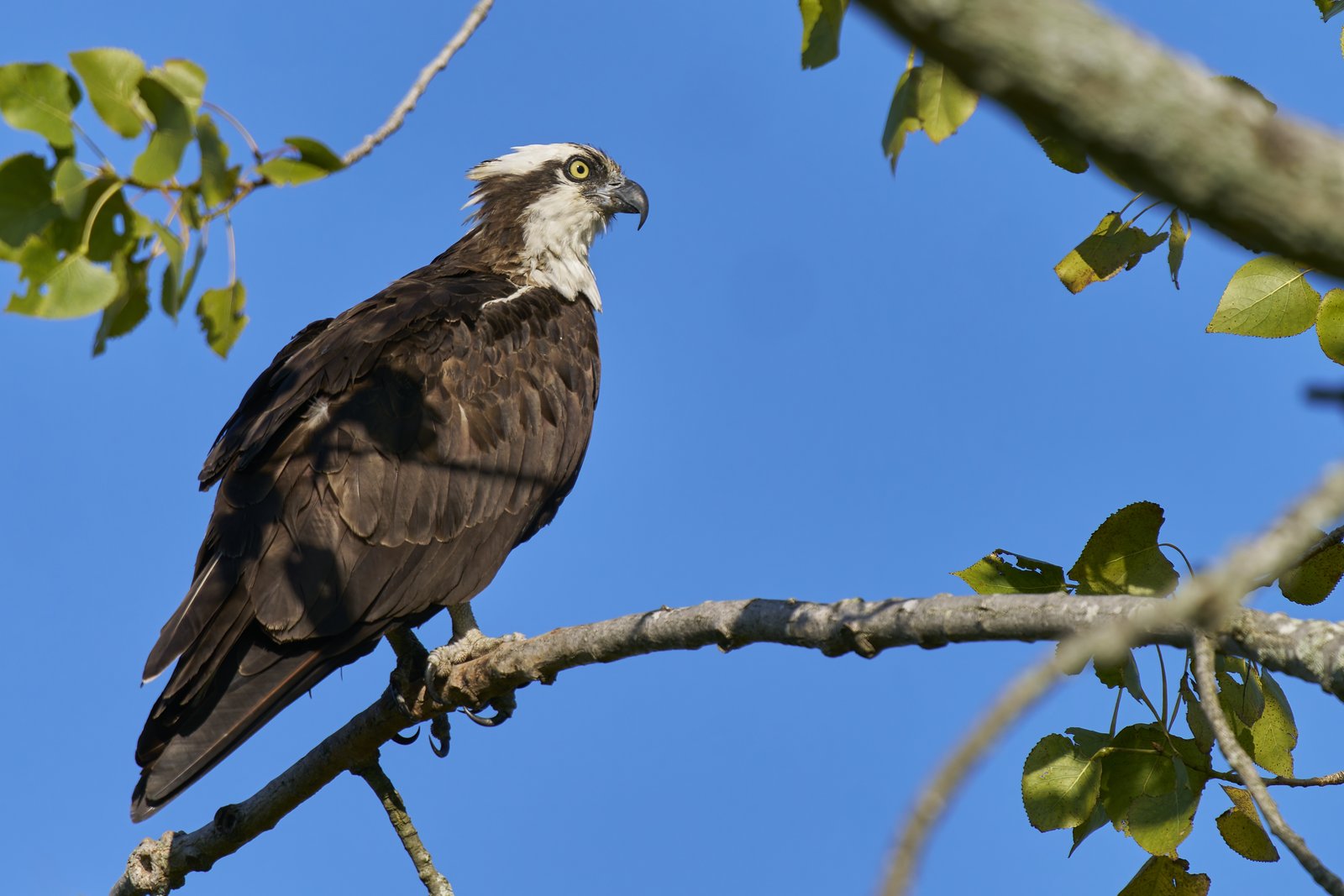
53–61 cm, with long, narrow wings held bent at the wrist, so that in flight the silhouette recalls a large gull. The upperparts are dark brown, the underparts white. The head is white with a broad black eyestripe extending to the nape. Below, white underwing coverts with a black carpal patch and barred flight feathers. Females usually show a more distinct brown breast band. Juveniles have pale edges to the feathers of the upperparts, giving a scaly pattern.
Confusion species
Large gulls such as Kelp Gull Larus dominicanus fly with a similar wing angle, but lack the dark eyestripe and the black carpal patch. Black-collared Hawk Busarellus nigricollis also catches fish, but is rufous, with a pale head, a black throat patch and broad, short wings.
Habitat
Sea coasts, estuaries, lagoons, mangroves, large rivers, lakes and reservoirs, also fish ponds; mainly in the lowlands, rarely at Andean lakes. It catches fish just below the surface after a plunge dive feet first and carries its prey head forward. It perches on posts, dead trees and masts near water.
Where the bird is most at home, classified by the vegetation units of the Andes and the west coast.


Range and movements
In Colombia, Ecuador, Peru and Bolivia a widespread winter visitor along the coast, large rivers and lakes, most numerous in the lowlands; locally also in the Andes. A rare visitor to Galápagos. It breeds in North America and winters from the southern United States to Argentina and Chile; other populations live elsewhere in the world.
- Resident
- dark = core range, pale = thinly spread
How and when to look
Search along coastal mangroves and estuaries, along large rivers in Amazonia and at fish farms; birds often sit for long periods on a favourite post or dead tree over the water.
Conservation status
Least Concern. After a steep decline caused by pesticides (DDT) in the twentieth century, the North American population has recovered and increased.
Scientific name
Pandion haliaetus | (Linnaeus, 1758)
Linnaeus described the species in 1758 as Falco Haliaetus; because it was later moved to another genus, the author and year stand in brackets. The genus Pandion was introduced in 1809 by De Savigny. The genus name refers to Pandion (Pandíōn), a mythical king of Athens in Greek mythology. The species name comes from Greek haliaetos, 'sea eagle', from hals, 'sea', and aetos, 'eagle'. The specimen the first description was based on came from Sweden.