All species › New World vultures › New World vultures › Greater Yellow-headed Vulture
Greater Yellow-headed Vulture | Cathartes melambrotus
Grote geelkopgier | Aura selvática | Urubu-da-mata
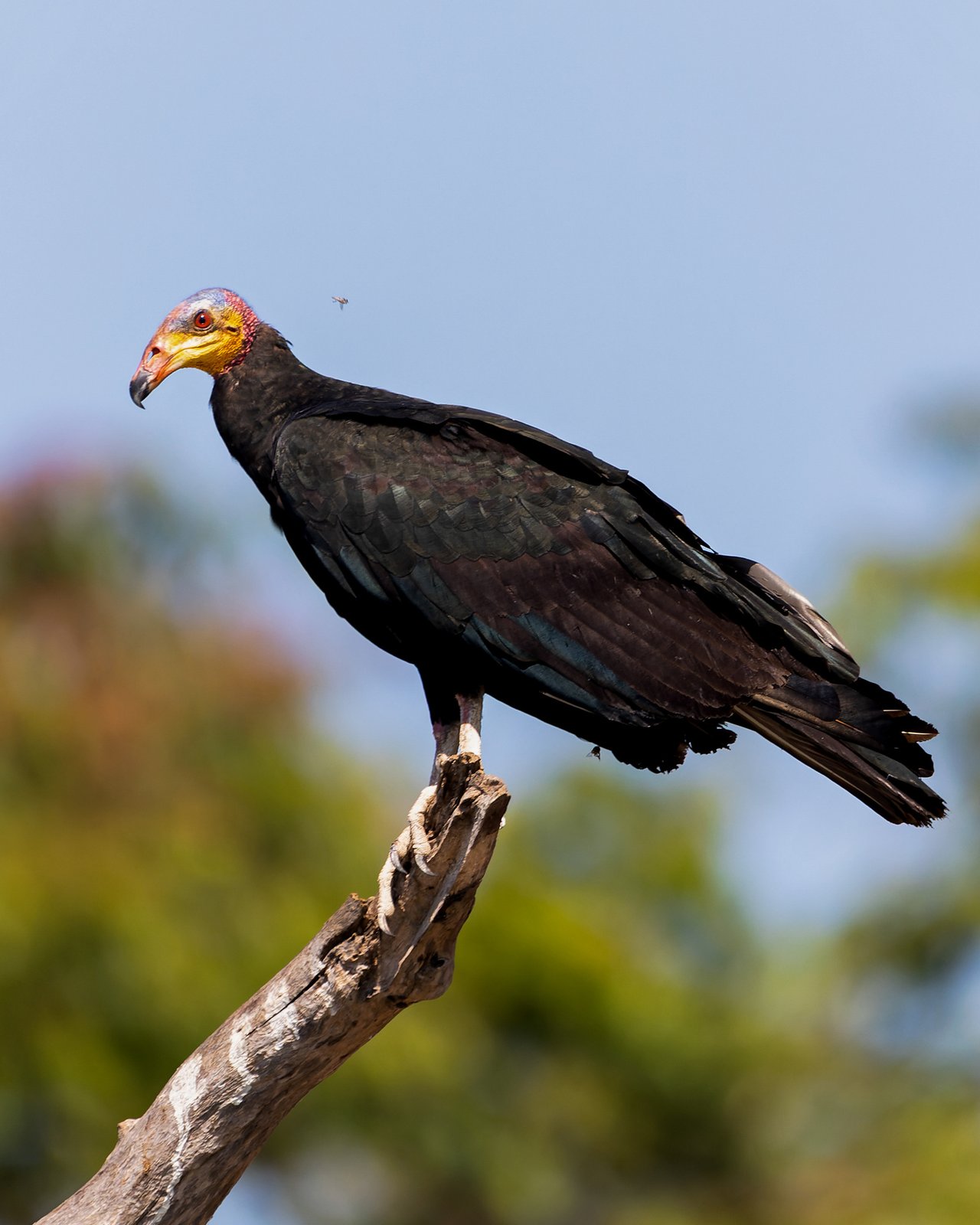
The Greater Yellow-headed Vulture is the vulture of the Amazonian forest. It soars low over the canopy and uses its sense of smell to find carcasses lying beneath the trees; in this way it often leads King and Black Vultures to food. It was described as a separate species only in 1964.
Voice
Silent.
Recording: Cameron Rutt — CC BY-NC-SA 4.0 · xeno-canto
Identification
64–75 cm, with long, broad wings and a fairly long, rounded tail. The plumage is deep black with a greenish or purplish gloss. The bare head is deep yellow, with orange or reddish tones on the forehead and nape. Below, the flight feathers are silvery grey, but the inner primaries are darker and form a dark band. Above, only the shafts of the outer primaries are whitish, without a clear pale patch. Juveniles have a darker, greyish head. The sexes are alike.
Confusion species
Lesser Yellow-headed Vulture Cathartes burrovianus is smaller and slimmer, duller brownish black, with a shorter tail, a pale patch on the upper side of the primaries and no dark band under the inner primaries; it lives in open, wet areas. Turkey Vulture Cathartes aura has a red head as an adult and is browner. Black Vulture Coragyps atratus has a grey head, a short tail and white wingtips.
Habitat
Undisturbed humid lowland forest in Amazonia, both terra firme and várzea, and its edges; also over rivers and clearings. Mostly below 500 m, locally to about 1000 m. It soars low over the canopy and perches on tall bare trees. It feeds on carrion. Little is known about its breeding; it probably nests in tree cavities.
Where the bird is most at home, classified by the vegetation units of the Andes and the west coast.


Range and movements
In Colombia in the east, in Amazonia and the southern Orinoco region. In Ecuador in the Amazonian lowlands. In Peru throughout the Amazonian lowlands east of the Andes. In Bolivia in the lowlands of the north and centre. Absent from Galápagos. Outside the guide area in southern Venezuela, the Guianas and Amazonian Brazil.
- Resident
- dark = core range, pale = thinly spread
How and when to look
Watch over the forest from a canopy tower or riverbank in the Amazonian lowlands, for example at Yasuní in Ecuador or Tambopata in Peru, and compare every low-soaring vulture with Turkey Vulture.
Conservation status
Least Concern. The species depends on large continuous forests and declines locally through deforestation.
Scientific name
Cathartes melambrotus | Wetmore, 1964
Wetmore described the species in 1964 and placed it straight away in the genus where it still stands. The genus Cathartes was introduced in 1811 by Illiger. The genus name comes from Greek kathartēs, 'purifier', after the role of these vultures in clearing away carcasses. The species name comes from Greek melam- (from melas), 'black', after the dark plumage, and brotos, according to Jobling 'of the dead'. The specimen the first description was based on came from Kartabo, Guyana.