All species › New World vultures › New World vultures › Lesser Yellow-headed Vulture
Lesser Yellow-headed Vulture | Cathartes burrovianus
Kleine geelkopgier | Zopilote sabanero | Urubu-de-cabeça-amarela
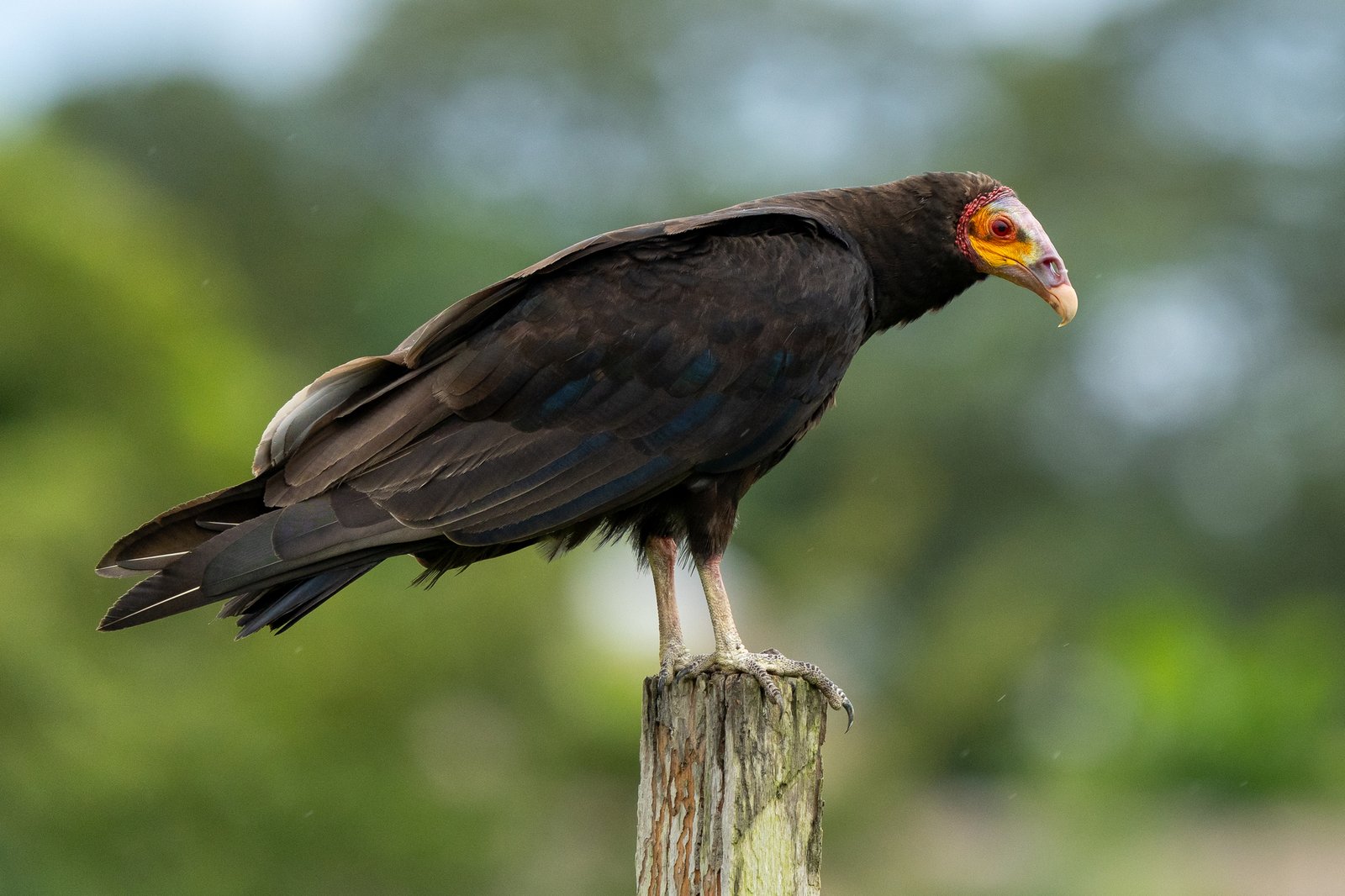
The Lesser Yellow-headed Vulture is the vulture of lowland wet savannas and marshes. It flies low over grassland and shores, often only a few metres up, and locates dead fish, reptiles and small mammals by smell. It closely resembles Greater Yellow-headed Vulture, but the two species are largely separated by habitat: open country versus closed forest.
Voice
Silent; only hissing sounds at carcasses.
Recording: Luiz C. Silva — CC BY-NC-SA 4.0 · xeno-canto
Identification
53–66 cm, smaller and slimmer than Turkey Vulture, with a rather short tail. The plumage is dull blackish brown. The bare head is yellow to orange-yellow, with reddish tones on the forehead and nape and a bluish-grey crown. Below, the flight feathers are silvery grey; the inner primaries are no darker than the rest. Above, the outer primaries show whitish shafts that form a pale patch. Juveniles have a darker head with a pale nape. The sexes are alike.
Confusion species
Greater Yellow-headed Vulture Cathartes melambrotus is larger and glossier black, with a deep yellow head, broader wings, a longer tail and a dark band across the inner primaries below; it flies over closed forest. Turkey Vulture Cathartes aura has a red head as an adult and a longer tail. Black Vulture Coragyps atratus has a grey head, a short tail and white wingtips.
Habitat
Wet savanna, flooded grassland, marshes, riverbanks, rice fields and pasture in the lowlands, mostly below 500 m. It forages in low flight, alone or in small groups, and perches on posts and low trees. It feeds on carrion, especially fish, and small animals. It lays its eggs without a nest on the ground or in a tree cavity.
Where the bird is most at home, classified by the vegetation units of the Andes and the west coast.


Range and movements
In Colombia in the Caribbean lowlands, the Magdalena Valley and the llanos, and locally in Amazonia. In Ecuador rare and local, mainly along rivers in the east. In Peru local in the Amazonian lowlands along large rivers and lakes. In Bolivia widespread on the savannas of Beni and Santa Cruz. Absent from Galápagos. Outside the guide area from eastern Mexico to northern Argentina and Uruguay.
- Resident
- dark = core range, pale = thinly spread
How and when to look
Scan wet savannas from the road in the llanos of Colombia or the Beni in Bolivia, where birds glide low over the grass and along ditches and often perch on posts.
Conservation status
Least Concern. The species is widespread in suitable open country.
Scientific name
Cathartes burrovianus | Cassin, 1845
Cassin described the species in 1845 and placed it straight away in the genus where it still stands. The genus Cathartes was introduced in 1811 by Illiger. The genus name comes from Greek kathartēs, 'purifier', after the role of these vultures in clearing away carcasses. The species name honours Marmaduke Burrough (1798–1844), American physician, consul at Veracruz and collector in Mexico and the Far East. The specimen the first description was based on came from Veracruz (city), Mexico.