All species › New World vultures › New World vultures › Turkey Vulture
Turkey Vulture | Cathartes aura
Kalkoengier | Aura tiñosa | Urubu-de-cabeça-vermelha
The Turkey Vulture is the most widespread vulture in the Americas. It soars low over the land with its wings in a shallow V, constantly rocking from side to side. With its highly developed sense of smell it also finds carcasses hidden beneath the canopy. Several subspecies occur in the guide area, joined in the northern winter by migrants from North America.
Voice
Silent; at carcasses and the nest only hissing and grunting.
Recording: Ed Pandolfino — CC BY-NC-SA 4.0 · xeno-canto
Identification
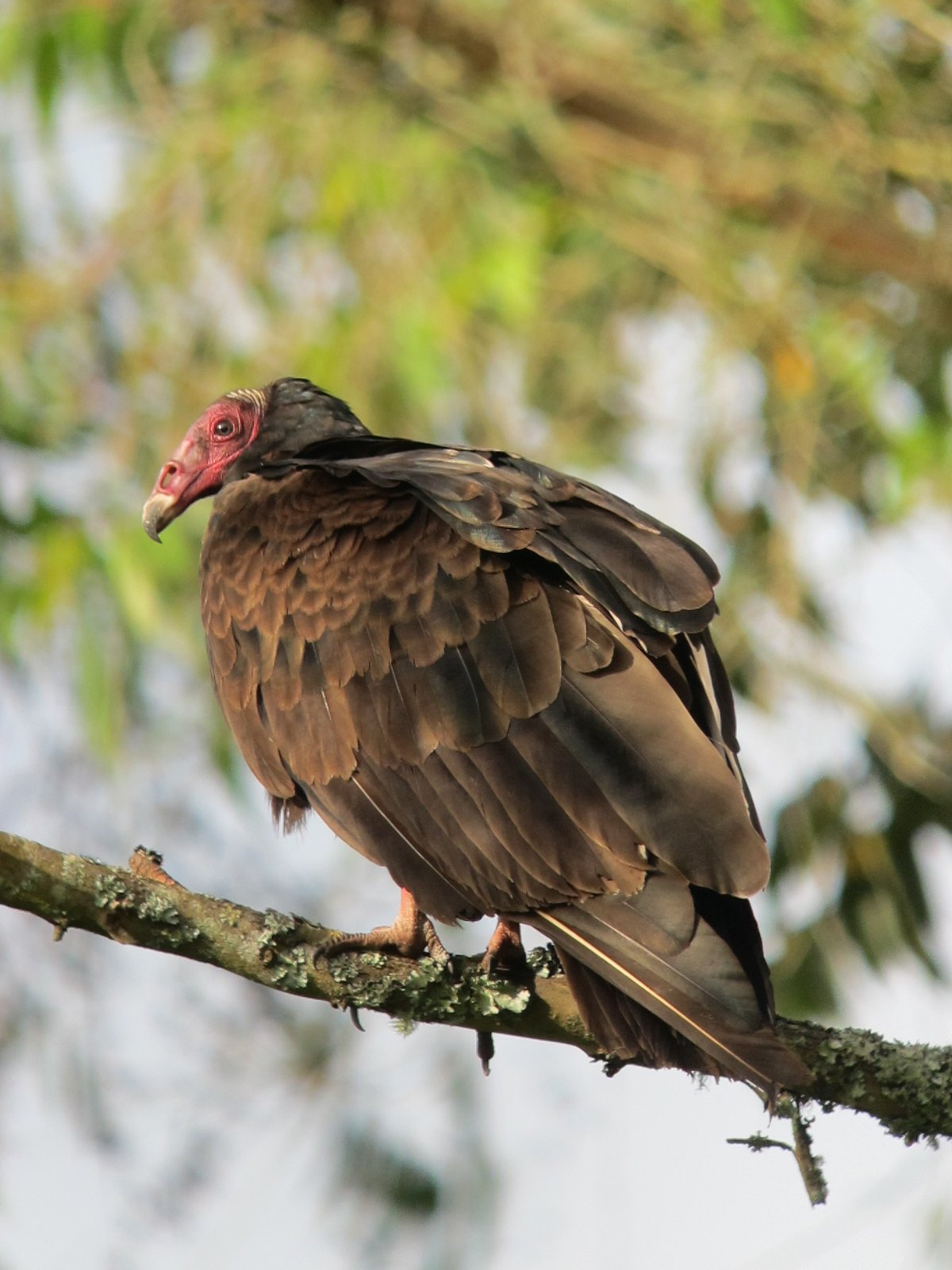
64–76 cm, with long, rather narrow wings and a long tail. The plumage is blackish brown, with brown edges to the feathers of the back and wing coverts. Below, the flight feathers are silvery grey and contrast with the black underwing coverts. Adults have a bare red head and a whitish bill; in some subspecies the hindcrown shows paler, yellowish or whitish markings. Juveniles have a greyish head and a dark bill. The sexes are alike.
Confusion species
Lesser Yellow-headed Vulture Cathartes burrovianus and Greater Yellow-headed Vulture Cathartes melambrotus have a yellow to orange head; Lesser flies low over savanna and marshes, Greater over Amazonian forest. Black Vulture Coragyps atratus has a shorter tail, a grey head and white wingtips and holds its wings flat. Zone-tailed Hawk Buteo albonotatus flies with the same wing posture and is similar in colour, but has a feathered head, a yellow cere and yellow legs, and white bands in the tail.
Habitat
Almost any open and semi-open landscape: coastal desert, beaches, dry scrub, farmland, pasture, forest edges and clearings, also over mountain valleys. From sea level to about 3000 m, locally higher. It feeds mainly on carrion, along the coast also on dead fish and seabirds. It nests on the ground in a rock crevice, a cave, a hollow tree or dense scrub, usually laying two eggs.
Where the bird is most at home, classified by the vegetation units of the Andes and the west coast.


Range and movements
In Colombia, Ecuador, Peru and Bolivia widespread in the lowlands and in the Andes, on both sides of the mountains; very common along the desert coast of Peru. Migrants from North America winter mainly in Colombia and partly further south. Absent from Galápagos. Outside the guide area from southern Canada to Tierra del Fuego.
- Resident
- dark = core range, pale = thinly spread
How and when to look
Everywhere along roads in open country; along the coast of Peru birds fly low over beaches and cliffs. During migration periods large groups of migrating birds can sometimes be seen in northern Colombia.
Conservation status
Least Concern. The species is widespread and numerous; locally it suffers from poisoned bait and lead poisoning.
Scientific name
Cathartes aura | (Linnaeus, 1758)
Linnaeus described the species in 1758 as Vultur Aura; because it was later moved to another genus, the author and year stand in brackets. The genus Cathartes was introduced in 1811 by Illiger. The genus name comes from Greek kathartēs, 'purifier', after the role of these vultures in clearing away carcasses. The species name aura goes back to Aurouá, an indigenous Mexican name for this vulture. The specimen the first description was based on came from Veracruz, Mexico.