All species › New World vultures › New World vultures › Black Vulture
Black Vulture | Coragyps atratus
Zwarte gier | Zopilote negro | Urubu-preto
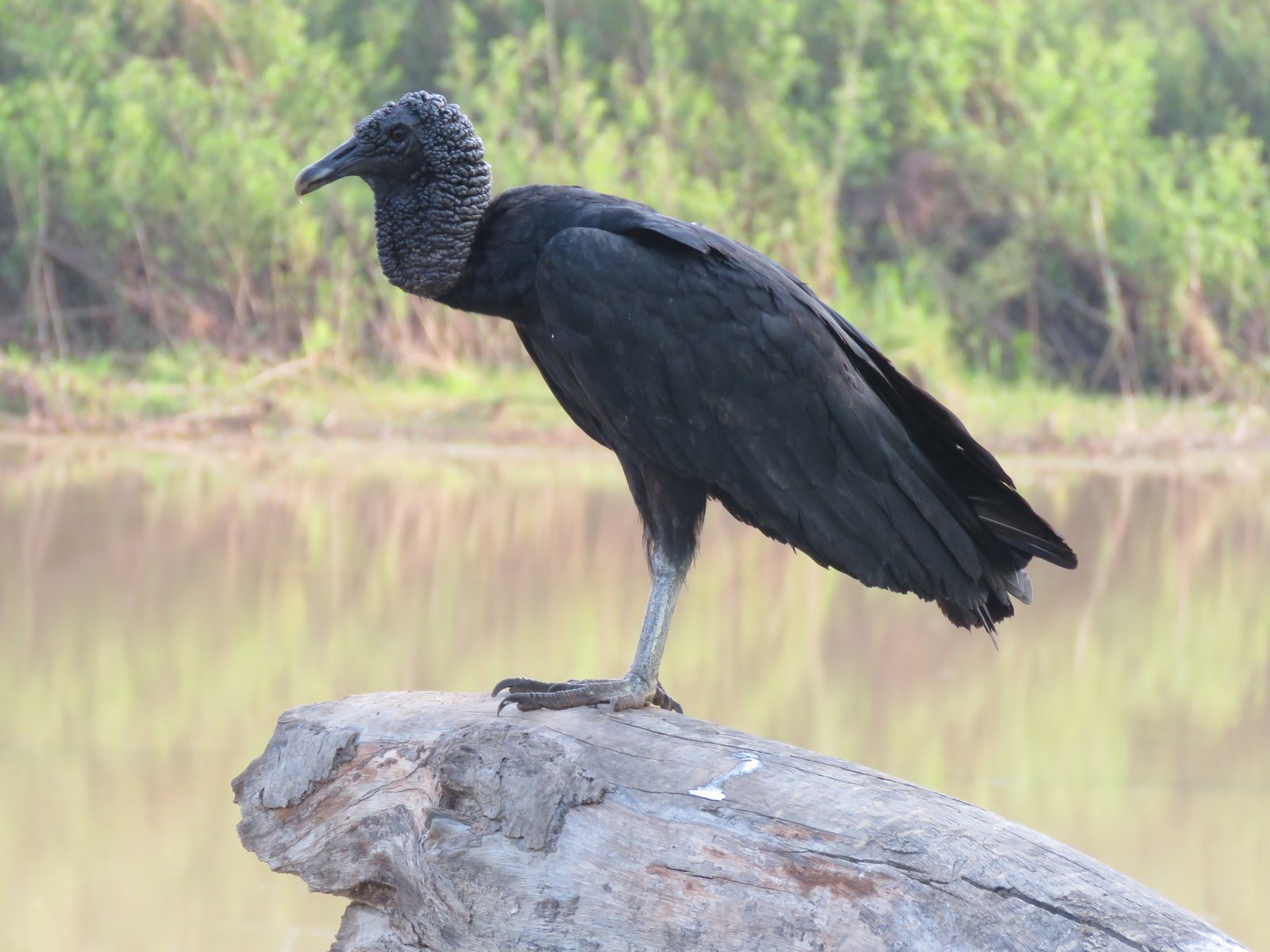
The Black Vulture is the commonest vulture of the guide area and follows people into the largest cities. It lives in groups, roosts communally on roofs and trees, and gathers in large numbers at rubbish dumps and fish markets. Unlike Turkey Vulture and the yellow-headed vultures it has a weak sense of smell and finds food by sight, often by following other vultures.
Voice
Largely silent. At carcasses and roosts it hisses, blows and grunts.
Recording: JAYRSON ARAUJO DE OLIVEIRA — CC BY-NC-SA 4.0 · xeno-canto
Identification
56–66 cm, stocky, with short, broad wings and a short, square tail which the feet almost reach. The plumage is dull black. The bare head and neck are blackish grey and wrinkled. In flight a large whitish patch at the base of the primaries stands out, above and below. It flies with bursts of quick, shallow wingbeats alternating with short glides, the wings held flat. The sexes are alike; juveniles have a smoother, blacker head.
Confusion species
Turkey Vulture Cathartes aura has a longer tail and longer wings with pale flight feathers below, soars with its wings in a V and rocks; adults have a red head. Lesser Yellow-headed Vulture Cathartes burrovianus and Greater Yellow-headed Vulture Cathartes melambrotus have a yellow to orange head and no white patch at the wingtip. Young King Vultures Sarcoramphus papa are larger and broader-winged. Black Caracara Daptrius ater has an orange face and a white band in the tail.
Habitat
Open and semi-open country: cities, villages, rubbish dumps, harbours, beaches, riverbanks, pasture and forest edges; avoids closed forest. Mainly in the lowlands and in valleys up to about 2500 m, locally higher. It eats carrion, refuse and dung, and sometimes kills young or weak animals. It nests on the ground in a hollow, on a ledge, in a cave or in an abandoned building, usually laying two eggs.
Where the bird is most at home, classified by the vegetation units of the Andes and the west coast.


Range and movements
In Colombia, Ecuador, Peru and Bolivia widespread and common in the lowlands and the lower and middle parts of the Andes, on both sides of the mountains and along the entire Pacific coast. Absent from Galápagos. Outside the guide area from the eastern United States to central Chile and Argentina.
- Resident
- dark = core range, pale = thinly spread
How and when to look
Everywhere in and around towns and at fishing harbours along the coast; in Lima and Guayaquil groups perch on roofs and lamp posts. Rubbish dumps often hold hundreds of birds.
Conservation status
Least Concern. The species benefits from refuse and deforestation and has increased in large parts of the guide area.
Scientific name
Coragyps atratus | (Bechstein, 1793)
Bechstein described the species in 1793 as Vultur atratus; because it was later moved to another genus, the author and year stand in brackets. The genus Coragyps was introduced in 1853 by Le Maout. The genus name is a contraction of Greek korax, 'raven', and gyps, 'vulture': 'raven-vulture'. The species name comes from Latin atratus, 'clothed in black', after the black plumage. The specimen the first description was based on came from St. Johns River, Florida, USA.