All species › New World vultures › New World vultures › Andean Condor
Andean Condor | Vultur gryphus
Andescondor | Cóndor andino | Condor-dos-andes
The Andean Condor is one of the largest flying birds in the world and the best-known bird of the Andes. It soars for hours without a wingbeat along mountain walls and over the high plateaus, and along the coast of Peru it descends to the sea. The species appears on the coats of arms of Colombia, Ecuador and Bolivia, yet it has become rare in the north of its range.
Voice
Largely silent. At carcasses and roosts it gives hissing, blowing and soft grunting sounds.
Recording: Fernando Castro — CC BY-NC-SA 4.0 · xeno-canto
Identification
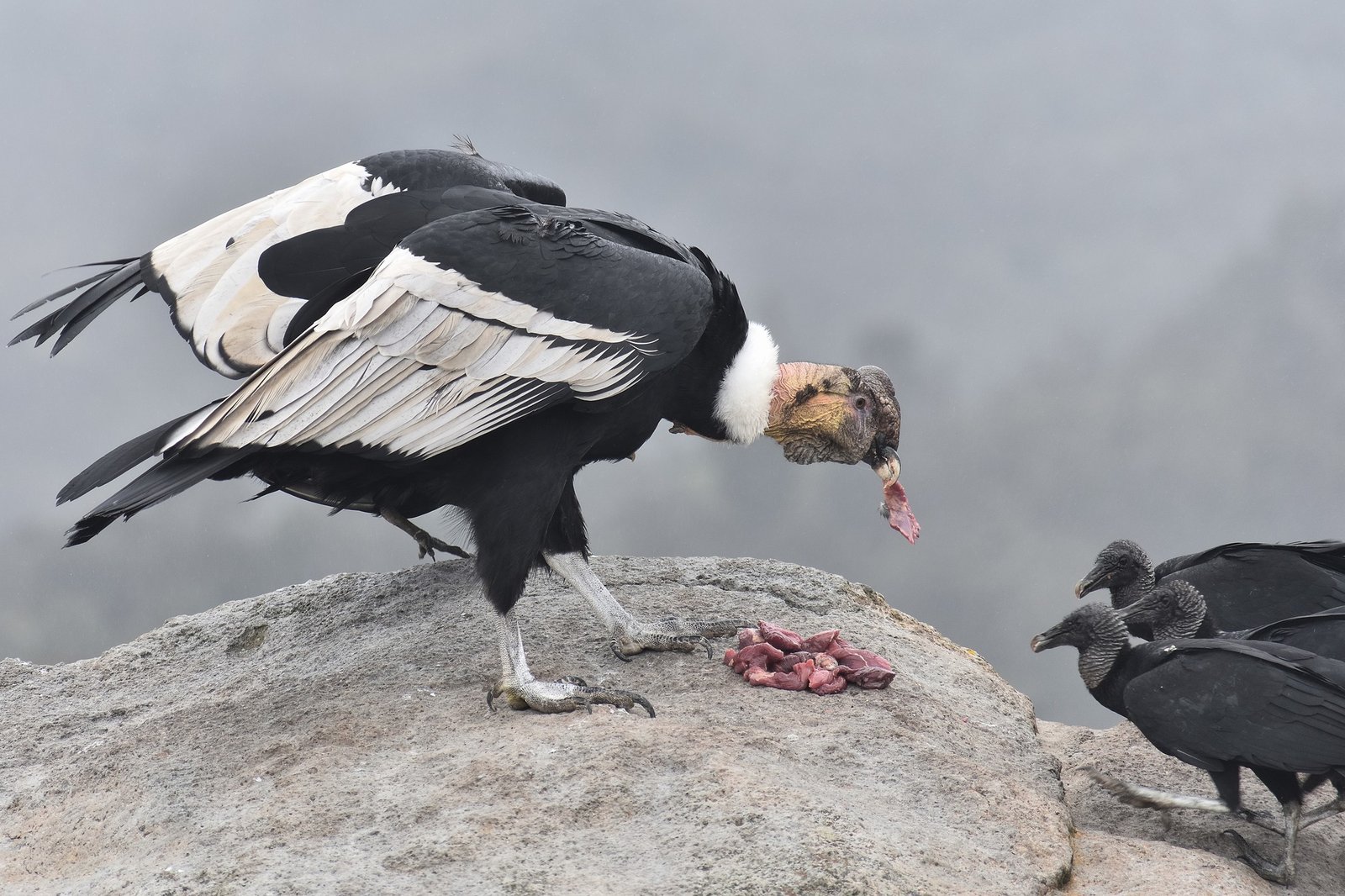
100–130 cm, with very long, broad wings with deeply fingered primaries and a short tail. Adults are black with a white ruff of downy feathers around the neck and a large white panel on the upperwing; from below the wing looks mostly dark. The head and neck are bare and grey to reddish. The male is larger, with a fleshy comb on the head and a dark eye; the female lacks the comb and has a red eye. Juveniles are uniformly greyish brown, without the white ruff and with a brownish bare head; adult plumage is reached only after several years. Soars on flat, horizontally held wings.
Confusion species
Black Vulture Coragyps atratus and Turkey Vulture Cathartes aura are much smaller, with relatively shorter wings; Black Vulture has a white patch at the wingtip, while Turkey Vulture soars with its wings in a V and has pale flight feathers below. Black-chested Buzzard-Eagle Geranoaetus melanoleucus is much smaller, with a short wedge-shaped tail and pale underparts. Young condors are best identified at a distance by their size and flat wing posture.
Habitat
Open mountain country with cliffs and gorges, mainly between 3000 and 5000 m: páramo, jalca and puna, with deep canyons where the birds rise on thermals. In Peru also along the desert coast and rocky shores, where it visits stranded animals and sea lion colonies. It feeds on carrion, both of wild animals and of livestock. It nests in a cavity or on a ledge in a steep cliff and lays a single egg every other year.
Where the bird is most at home, classified by the vegetation units of the Andes and the west coast.


Range and movements
In Colombia rare and very scattered in the three cordilleras and the Sierra Nevada de Santa Marta, partly as a result of reintroduction. In Ecuador a small population in the high Andes, mainly in the north and centre. In Peru throughout the Andes and locally along the coast, most numerous in the south. In Bolivia in the Andes, locally fairly common. Absent from Galápagos. Outside the guide area very rare in Venezuela, and further south through Chile and Argentina to Tierra del Fuego.
- Resident
- dark = core range, pale = thinly spread
How and when to look
The Cruz del Cóndor in the Colca Canyon in southern Peru is the best-known site: in the morning the condors rise there on the first thermals along the canyon wall, often at close range. In Ecuador they can be seen around the cliffs of Antisana.
Conservation status
Vulnerable. The species breeds very slowly and suffers from poisoning, mainly from poisoned bait set for predators, from lead poisoning and from persecution by livestock farmers. Numbers have declined most in the north of the range; reintroduction programmes are under way in Colombia and elsewhere.
Scientific name
Vultur gryphus | Linnaeus, 1758
Linnaeus described the species in 1758 and placed it straight away in the genus where it still stands. He introduced the genus Vultur in that same work. The genus name is Latin vultur, 'vulture'. The species name comes from a variant of Greek grupos, 'hook-nosed', after the hooked bill. The specimen the first description was based on came from Chile.