All species › New World vultures › New World vultures › King Vulture
King Vulture | Sarcoramphus papa
Koningsgier | Zopilote rey | Urubu-rei
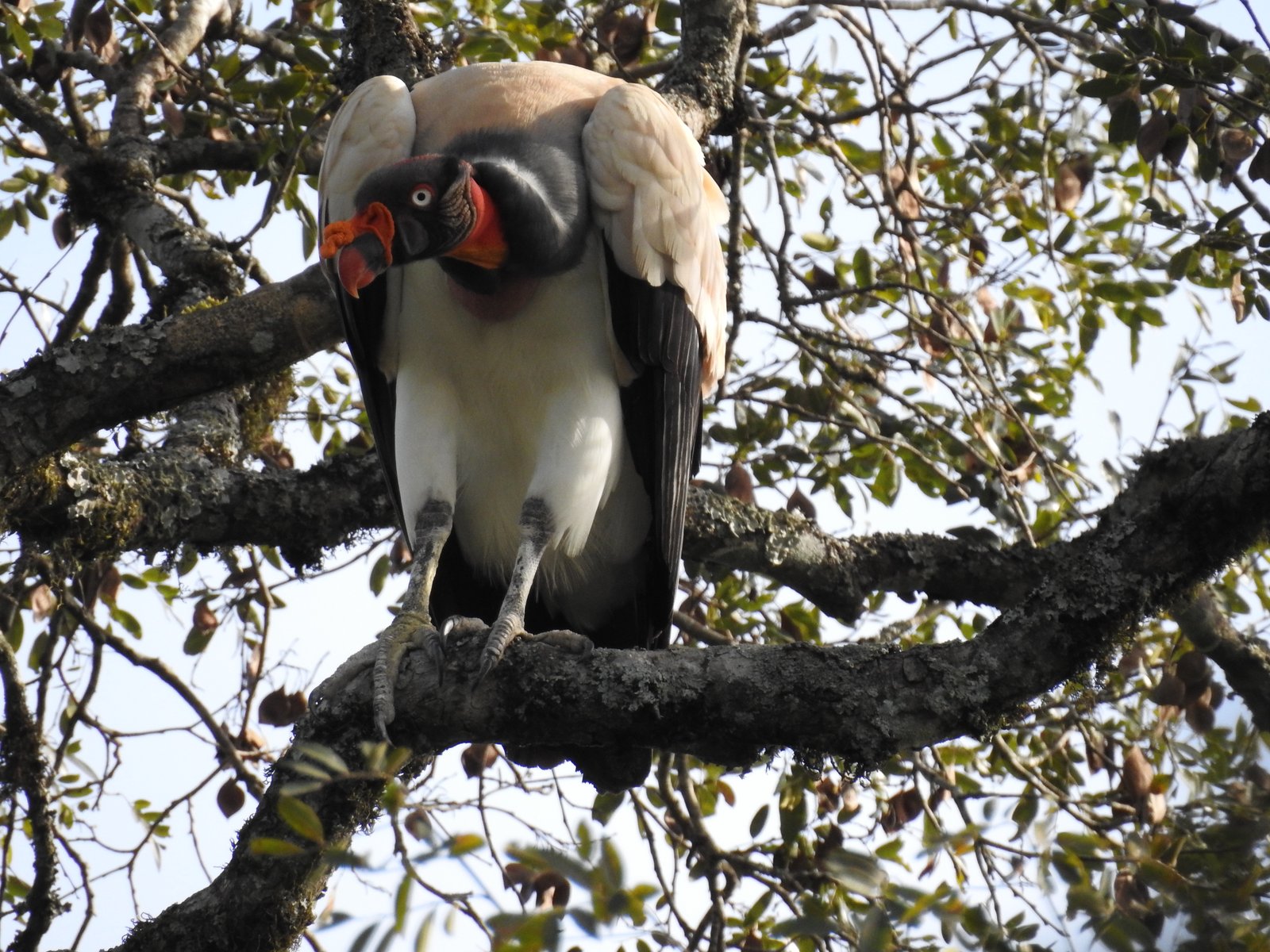
The King Vulture is the only species in its genus and the American vulture with the most colourful head. It lives over lowland forest, where it soars high, usually alone or in pairs. At a carcass it displaces the smaller vultures; with its powerful bill it tears open hides that the other species cannot open. It searches mainly by sight and often follows the yellow-headed vultures, which find carrion by smell.
Voice
Usually silent. At carcasses and at the nest it gives low croaks, hisses and blowing sounds.
No recording with a suitable Creative Commons licence is available for this species yet.
Identification
71–81 cm, with broad wings and a short, broad tail. Adults have creamy white body feathers and wing coverts, black flight feathers and a black tail; in flight the white body and white forewing contrast with the black trailing edge. A grey ruff surrounds the neck. The bare head and neck are coloured orange, red, yellow and purple, with an orange fleshy caruncle at the base of the bill and a white iris. The sexes are alike. Juveniles are uniformly slate grey to blackish brown with a dark head; adult plumage is acquired gradually over four to five years, through intermediate plumages with white patches on the belly and underwing.
Confusion species
Wood Stork Mycteria americana is also white in flight with black flight feathers and a black tail, but has a long, outstretched neck and long legs. Young King Vultures resemble Black Vulture Coragyps atratus, but are larger, with broader wings and without a sharply defined white patch at the wingtip. Andean Condor Vultur gryphus is much larger, with a white neck ruff and white on the upperwing, and lives high in the Andes.
Habitat
Undisturbed humid lowland and foothill forest, also savanna and drier woodland where enough forest remains; mostly below 1500 m, occasionally higher. It soars high above the canopy and perches on tall, bare trees. It feeds on carrion, from large mammals to fish and reptiles. It lays a single egg without a nest in a hollow stump, a tree cavity or among roots on the forest floor.
Where the bird is most at home, classified by the vegetation units of the Andes and the west coast.


Range and movements
In Colombia in the lowlands and foothills on both sides of the Andes. In Ecuador more common in the east than in the west, where it has become rare. In Peru in the Amazonian lowlands and eastern foothills, and locally in the dry north-west (Tumbes). In Bolivia in the lowlands of the north and east. Absent from Galápagos. Outside the guide area from southern Mexico to northern Argentina.
- Resident
- dark = core range, pale = thinly spread
How and when to look
On clear mornings, once thermals start, watch from a canopy tower or an opening with a wide view over the forest. In Amazonia, for example at Manu and Tambopata in Peru, the species regularly soars over rivers and forest edges.
Conservation status
Least Concern. The species has a large range, but declines where forest is cleared and has become rare outside large forest tracts.
Scientific name
Sarcoramphus papa | (Linnaeus, 1758)
Linnaeus described the species in 1758 as Vultur Papa; because it was later moved to another genus, the author and year stand in brackets. The genus Sarcoramphus was introduced in 1805 by Duméril. The genus name comes from Greek sarx, 'flesh', and rhamphos, 'hooked bill', after the fleshy growth on the bill. The species name is Latin papa, 'bishop', after the white plumage that recalls a bishop's robes. The specimen the first description was based on came from Suriname.