All species › Owls › Owls › Bare-shanked Screech Owl
Bare-shanked Screech Owl | Megascops clarkii
Kaalpootschreeuwuil | Autillo serrano | Corujinha-de-pernas-nuas
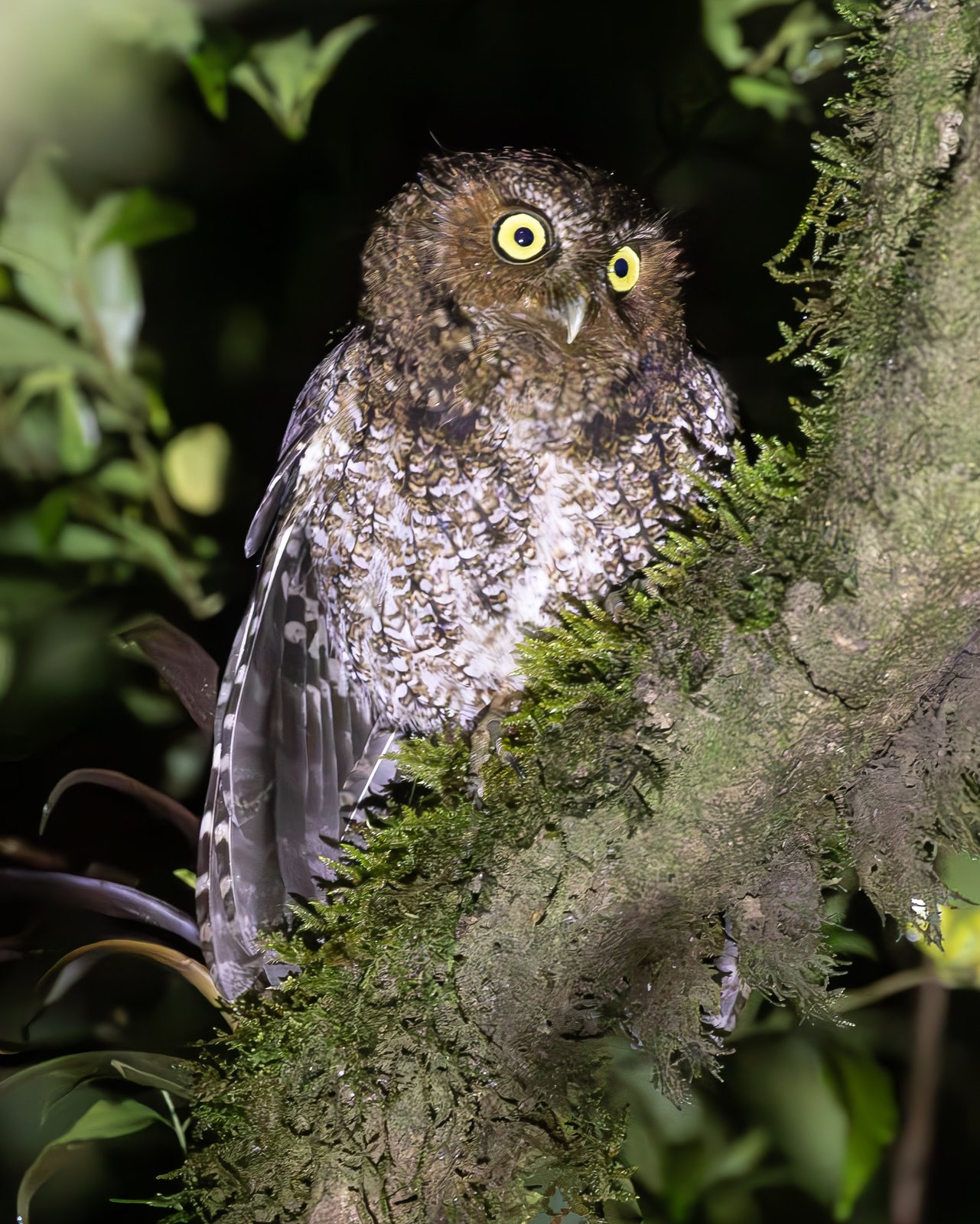
The Bare-shanked Screech Owl is a fairly large, warm brown screech owl of montane forest in Costa Rica and Panama. Its name refers to the unfeathered lower part of the legs. In the guide area it is known only from a few records in the far north-west of Colombia, on the Panama border, and is treated as a rare vagrant.
Voice
A short series of deep, soft notes in a fixed rhythm, roughly hoo hoo hoo-hoo, the last notes faster.
Recording: Teet Sirotkin — CC BY-NC-SA 4.0 · xeno-canto
Identification
23–25 cm, with short ear tufts and yellow eyes. The upperparts are warm rufous-brown with fine black spots; the facial disc is cinnamon without an obvious dark rim. The underparts are rufous-brown, paler on the belly, with a pattern of whitish, dark-edged spots and narrow dark streaks. The lower part of the legs is bare and pink to greyish. The sexes are alike.
Confusion species
Middle American Screech Owl Megascops guatemalae is smaller, with feathered legs and a clearer herringbone pattern on the underparts. Tropical Screech Owl Megascops choliba is smaller and greyer, with a black rim to the facial disc, and lives lower in open woodland. White-throated Screech Owl Megascops albogularis is darker, with a white throat and almost no ear tufts.
Habitat
Humid montane forest and cloud forest, mainly in the middle and upper strata and at forest edges, in Costa Rica and Panama roughly between 900 and 2500 m. It feeds on large insects and other invertebrates, also small vertebrates. It nests in tree cavities.
Where the bird is most at home, classified by the vegetation units of the Andes and the west coast.


Range and movements
In Colombia only a few records in the mountains of the far north-west, on the Panama border. Absent from Ecuador, Peru, Bolivia and the Galápagos. Outside the guide area in the mountains of Costa Rica and Panama.
How and when to look
In the guide area out of reach of an ordinary trip. Records in the border region with Panama are worth documenting with sound recordings and photographs.
Conservation status
Least Concern. In its core range the species suffers from the loss of montane forest.
Scientific name
Megascops clarkii | (Kelso & Kelso, 1935)
Kelso & Kelso described the species in 1935 as Otus clarkii; because it was later moved to another genus, the author and year stand in brackets. The genus Megascops was introduced in 1848 by Kaup. The genus name comes from Greek megas, 'great', and skōps, a small owl (scops owl). The species name honours the Revd Harry M. Clark, an American minister who encouraged Leon Kelso in ornithology. The specimen the first description was based on came from Calobre, Veraguas, Panama.