All species › Owls › Owls › Chaco Owl
Chaco Owl | Strix chacoensis
Chacobosuil | Cárabo chaqueño | Coruja-do-chaco
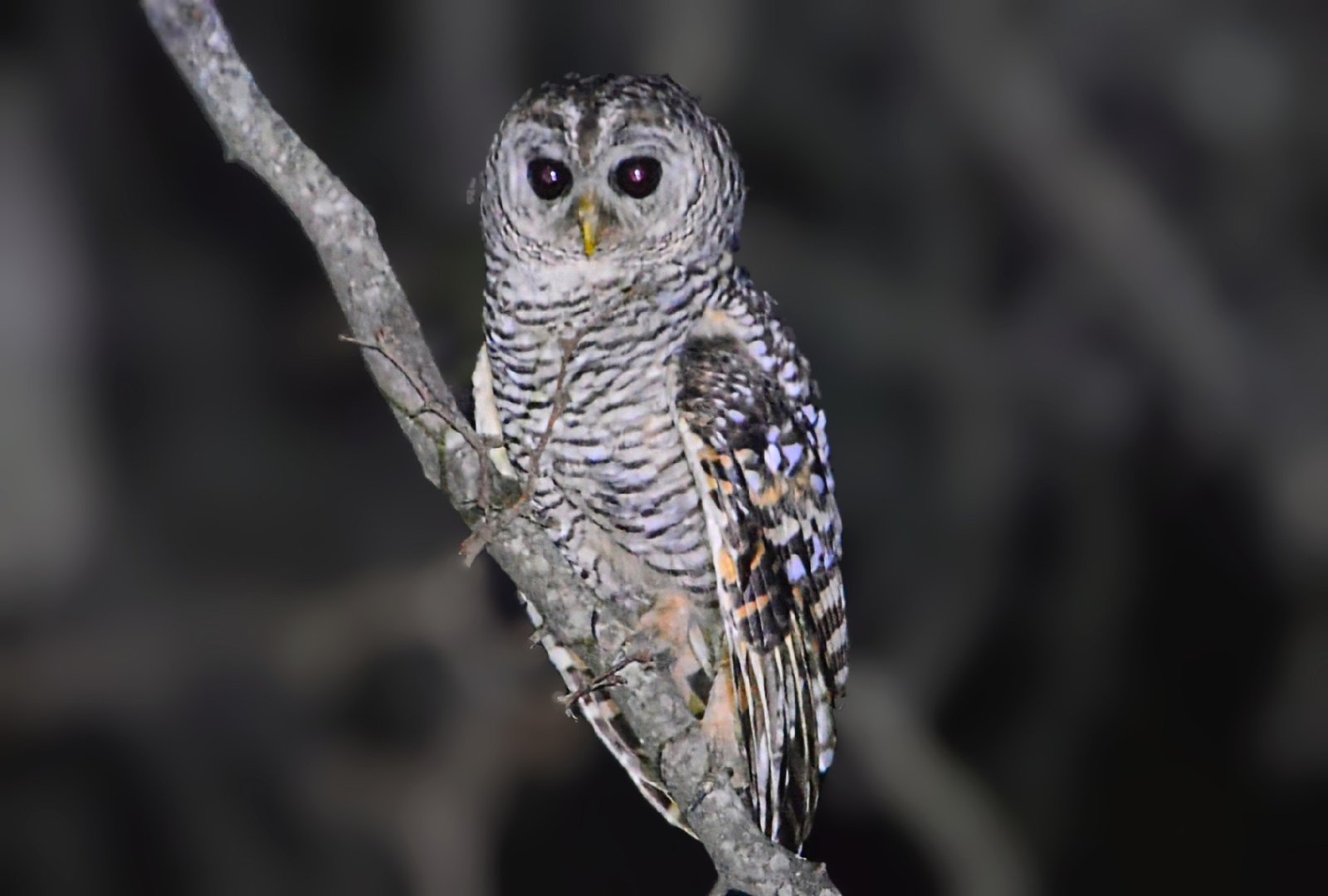
The Chaco Owl is a medium-sized, greyish-brown wood owl of the dry forests of the Chaco. It was long regarded as a subspecies of the Rufous-legged Owl of Chile and Argentina. In the guide area it occurs only in south-eastern Bolivia.
Voice
A series of deep, hoarse, somewhat croaking notes that accelerates and ends in a drawn-out note, mainly after dusk.
Recording: Fabrice Schmitt — CC BY-NC-SA 4.0 · xeno-canto
Identification
35–38 cm, with a round head without ear tufts, dark eyes and a yellowish bill. The facial disc is whitish to pale grey, with dark concentric lines, a dark rim and white brows. The upperparts are greyish brown, densely barred and spotted white and pale brown. The underparts are whitish with dense, narrow dark brown bars. The feathered legs are whitish to pale buff. The sexes are alike.
Confusion species
Rufous-legged Owl Strix rufipes of Chile and Argentina is darker and more rufous, with a rufous facial disc and reddish legs; it does not occur in the guide area. Mottled Owl Strix virgata is browner, with streaks rather than bars on the underparts, and lives in more humid forest. Striped Owl Asio clamator and Great Horned Owl Bubo virginianus have obvious ear tufts.
Habitat
Dry Chaco woodland, thorn scrub and open dry forest with cacti, also in the transition to the dry valleys at the foot of the Andes, roughly up to 1000 m, locally higher. It hunts at night for small rodents, birds, lizards and large insects. It probably nests in tree cavities.
Where the bird is most at home, classified by the vegetation units of the Andes and the west coast.


Range and movements
Does not occur in Colombia, Ecuador, Peru or on the Galápagos. In Bolivia only in the south-east, in the Chaco of Santa Cruz, Chuquisaca and Tarija. Outside the guide area in western Paraguay and northern and central Argentina.
- Resident
- dark = core range, pale = thinly spread
How and when to look
After dusk, listen for the series of deep calls in dry Chaco woodland in south-eastern Bolivia; the owl often perches on a low branch at the edge of a road or clearing.
Conservation status
Least Concern. The species is locally common, but Chaco woodland is being cleared on a large scale for farming and ranching.
Scientific name
Strix chacoensis | Cherrie & Reichenberger, 1921
Cherrie & Reichenberger described the species in 1921 and placed it straight away in the genus where it still stands. The genus Strix was introduced in 1758 by Linnaeus. The genus name comes from Latin strix (Greek strinx), 'owl', in antiquity a screeching bird of the night. The species name refers to the Gran Chaco of South America. The specimen the first description was based on came from Fort Wheeler, Chaco, Paraguay.