All species › Owls › Owls › Rufous-banded Owl
Rufous-banded Owl | Strix albitarsis
Witbroekbosuil | Cárabo patiblanco | Coruja-de-faixa-ruiva
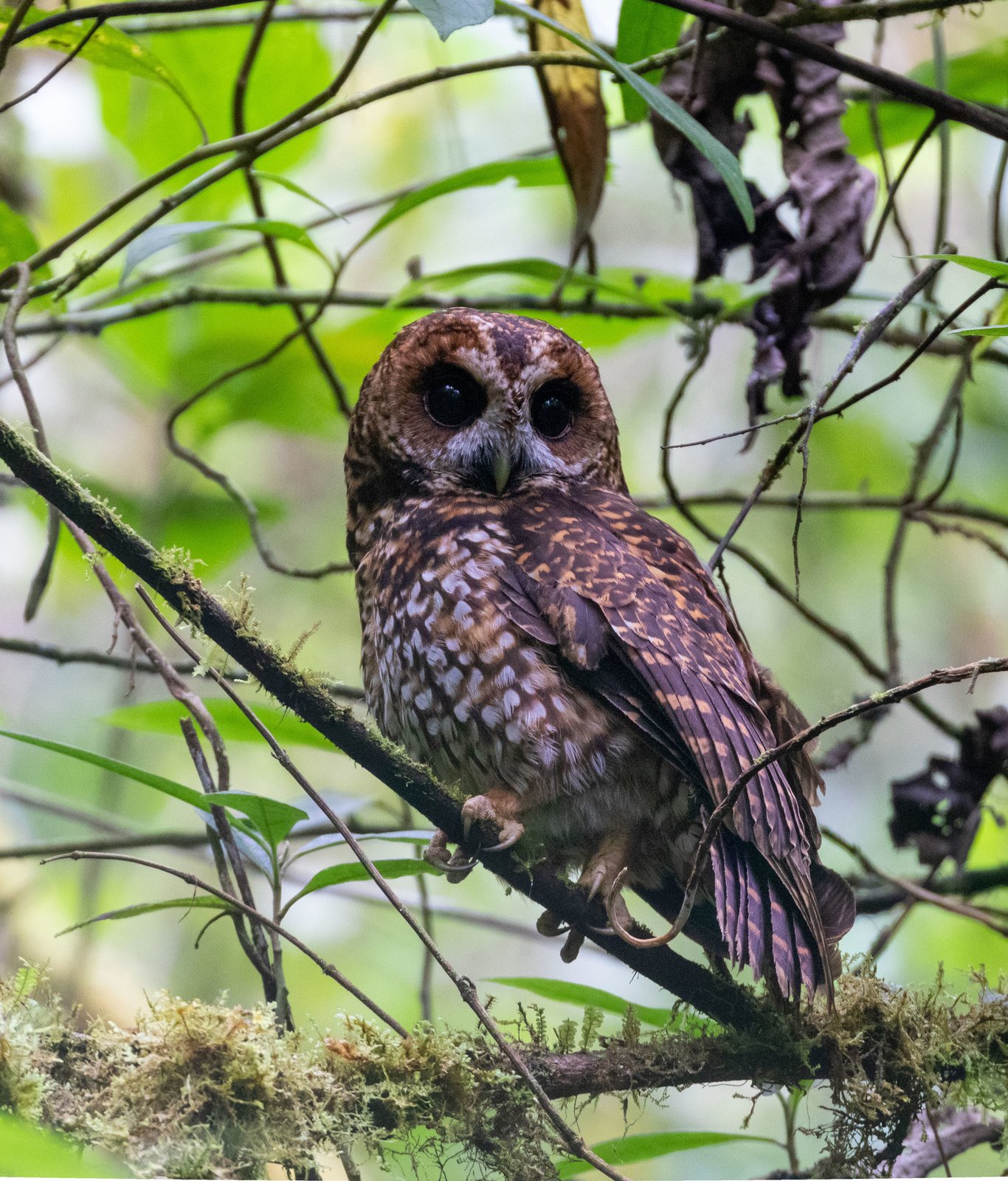
The Rufous-banded Owl is a medium-sized, dark owl without ear tufts of the cloud forest of the Andes, from Venezuela to Bolivia. The whole plumage is densely barred rufous and black, with white spots on the underparts. The Dutch and Spanish names refer to the whitish feathered legs.
Voice
A rhythmic series of deep, hollow notes with a louder final note, hu, hu-hu-hu-HOO, often in duet, mainly in the first hours after dusk.
Recording: Jorge L. Peña — CC BY-NC-SA 4.0 · xeno-canto
Identification
30–36 cm, with a round head, dark eyes and a yellowish bill. The facial disc is rufous with fine dark lines and whitish brows. The crown and upperparts are blackish brown, densely barred with rufous and ochre. The breast is barred rufous, the belly paler, with large, white, dark-edged spots. The tail is dark with narrow rufous bands. The feathered legs are whitish to pale yellow. The sexes are alike.
Confusion species
Mottled Owl Strix virgata lives lower, has streaked underparts and lacks the dense rufous barring. Buff-fronted Owl Aegolius harrisii is much smaller, with plain ochre underparts and a pale, black-edged facial disc. Band-bellied Owl Pulsatrix melanota lives lower, in the foothills, and has a dark face with white brows and a brown breast band. Screech owls Megascops are smaller and have ear tufts.
Habitat
Cloud forest, upper montane forest and their edges, also old secondary forest, roughly between 1700 and 3500 m. It hunts at night in the middle levels and lower branches for large insects, small rodents and birds. It probably nests in tree cavities; little is known about the nest.
Where the bird is most at home, classified by the vegetation units of the Andes and the west coast.


Range and movements
In Colombia in all three Andean ranges. In Ecuador on both slopes of the Andes. In Peru on the eastern slope along the whole length of the country, in the north also locally on the western slope. In Bolivia in the Yungas on the eastern slope, south to Cochabamba and Santa Cruz. Absent from the Galápagos. Outside the guide area only in the Andes of western Venezuela.
- Resident
- dark = core range, pale = thinly spread
How and when to look
After dusk, listen for the rhythmic calls along mountain roads through cloud forest; the owl responds to the calls of its own species and then sometimes comes to a branch above the road.
Conservation status
Least Concern. The species is scarce and patchily distributed, and depends on continuous montane forest, which is becoming fragmented in many parts of the Andes.
Scientific name
Strix albitarsis | (Bonaparte, 1850)
Bonaparte described the species in 1850 as Syrnium albitarse; because it was later moved to another genus, the author and year stand in brackets. The genus Strix was introduced in 1758 by Linnaeus. The genus name comes from Latin strix (Greek strinx), 'owl', in antiquity a screeching bird of the night. The species name comes from Latin albus, 'white', and tarsus, 'tarsus': 'white-legged'. The specimen the first description was based on came from Bogotá, Colombia.