All species › Owls › Owls › Black-banded Owl
Black-banded Owl | Strix huhula
Zwartgestreepte bosuil | Cárabo negro | Coruja-preta
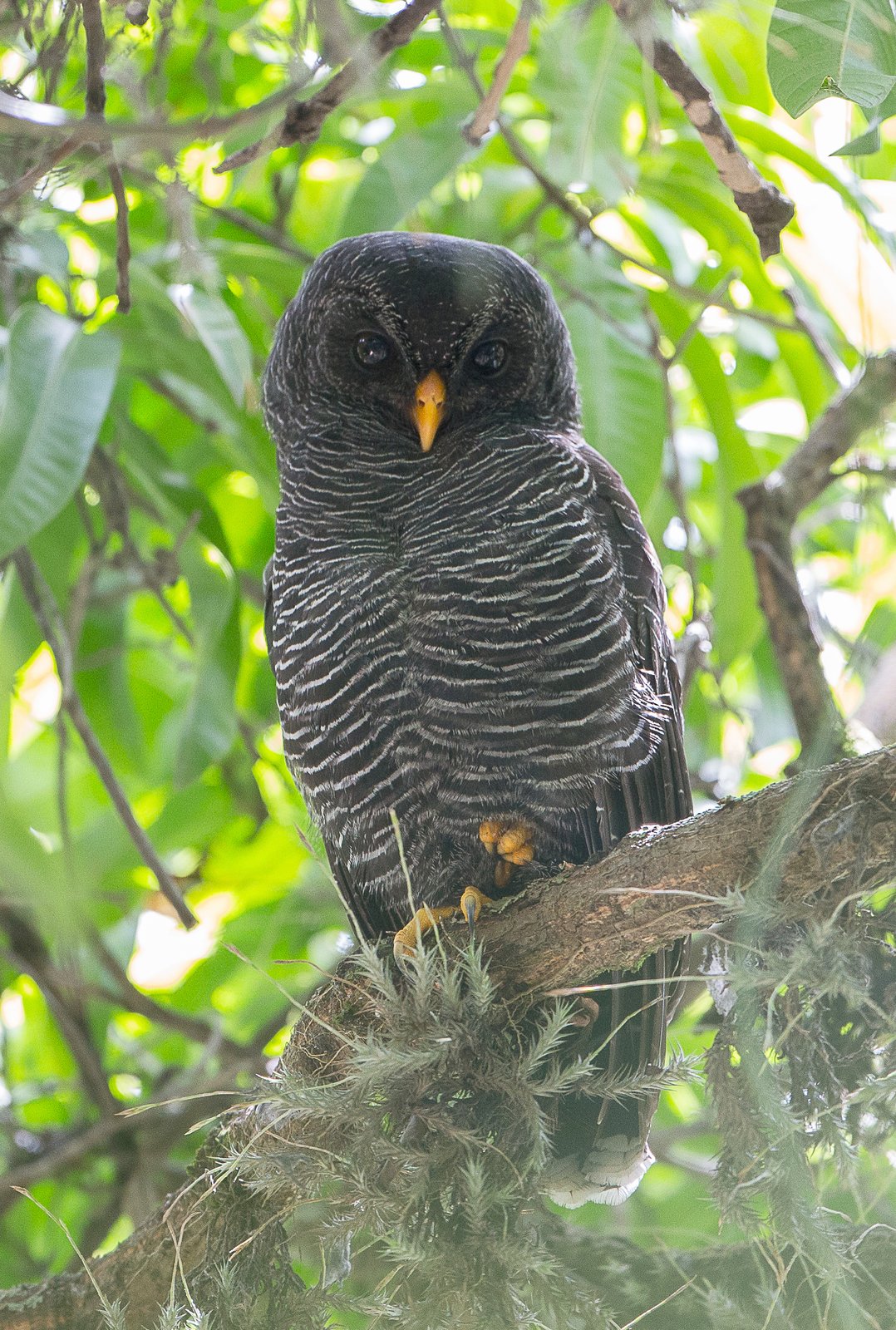
The Black-banded Owl is a medium-sized, black owl without ear tufts, finely barred white from head to tail. It is the eastern counterpart of the Black-and-white Owl and lives in the Amazonian lowlands and foothills east of the Andes. It lives mainly in the canopy of tall forest and is usually only heard.
Voice
A series of deep, hollow notes ending in a louder, rising note, hu-hu-hu-HOO, and a single, rising whooOOO, mainly after dusk and before dawn.
Recording: Juan Freile — CC BY-NC-SA 4.0 · xeno-canto
Identification
30–36 cm, with a round head, dark eyes and a yellowish bill. The whole plumage is black to blackish brown, with fine, regular white bars; on the upperparts the bars are narrower and more irregular, on the underparts broader and denser. The facial disc is black with narrow, white concentric lines. The tail is black with a few narrow white bands. The feet are yellowish. The sexes are alike.
Confusion species
Black-and-white Owl Strix nigrolineata has a plain black back and crown and white underparts with narrow black bars; it lives west of the Andes. Mottled Owl Strix virgata is brown, with a pale facial disc and streaked underparts. Band-bellied Owl Pulsatrix melanota is larger, with orange-brown eyes, white brows and a brown breast band.
Habitat
Tall terra firme rainforest, várzea forest, gallery forest and forest edges, also secondary forest with old trees, from the lowlands to about 1000 m, locally higher in the foothills. It hunts at night in the canopy and middle levels for large insects, bats, small rodents and frogs. It nests in tree cavities.
Where the bird is most at home, classified by the vegetation units of the Andes and the west coast.


Range and movements
In Colombia in the lowlands east of the Andes, in Amazonia and the Orinoco basin. In Ecuador in the eastern lowlands and foothills. In Peru in the eastern lowlands and foothills. In Bolivia in the lowlands of the north and east. Absent from the Galápagos. Outside the guide area in Venezuela, the Guianas, Brazil, Paraguay and north-eastern Argentina.
- Resident
- dark = core range, pale = thinly spread
How and when to look
After dusk, listen for the deep calls from a clearing, a riverbank or a canopy tower in Amazonian forest. The owl often perches high in a tree at the edge of a clearing.
Conservation status
Least Concern. The species has a large range, but is tied to forest and declines where rainforest is cleared.
Scientific name
Strix huhula | Daudin, 1800
Daudin described the species in 1800 and placed it straight away in the genus where it still stands. The genus Strix was introduced in 1758 by Linnaeus. The genus name comes from Latin strix (Greek strinx), 'owl', in antiquity a screeching bird of the night. The species name comes from Huhul, a French onomatopoeic name for this owl used by Levaillant in 1799. The specimen the first description was based on came from Cayenne, French Guiana.