All species › Owls › Owls › Black-and-white Owl
Black-and-white Owl | Strix nigrolineata
Zwart-witte bosuil | Búho blanquinegro | Coruja-preta-e-branca
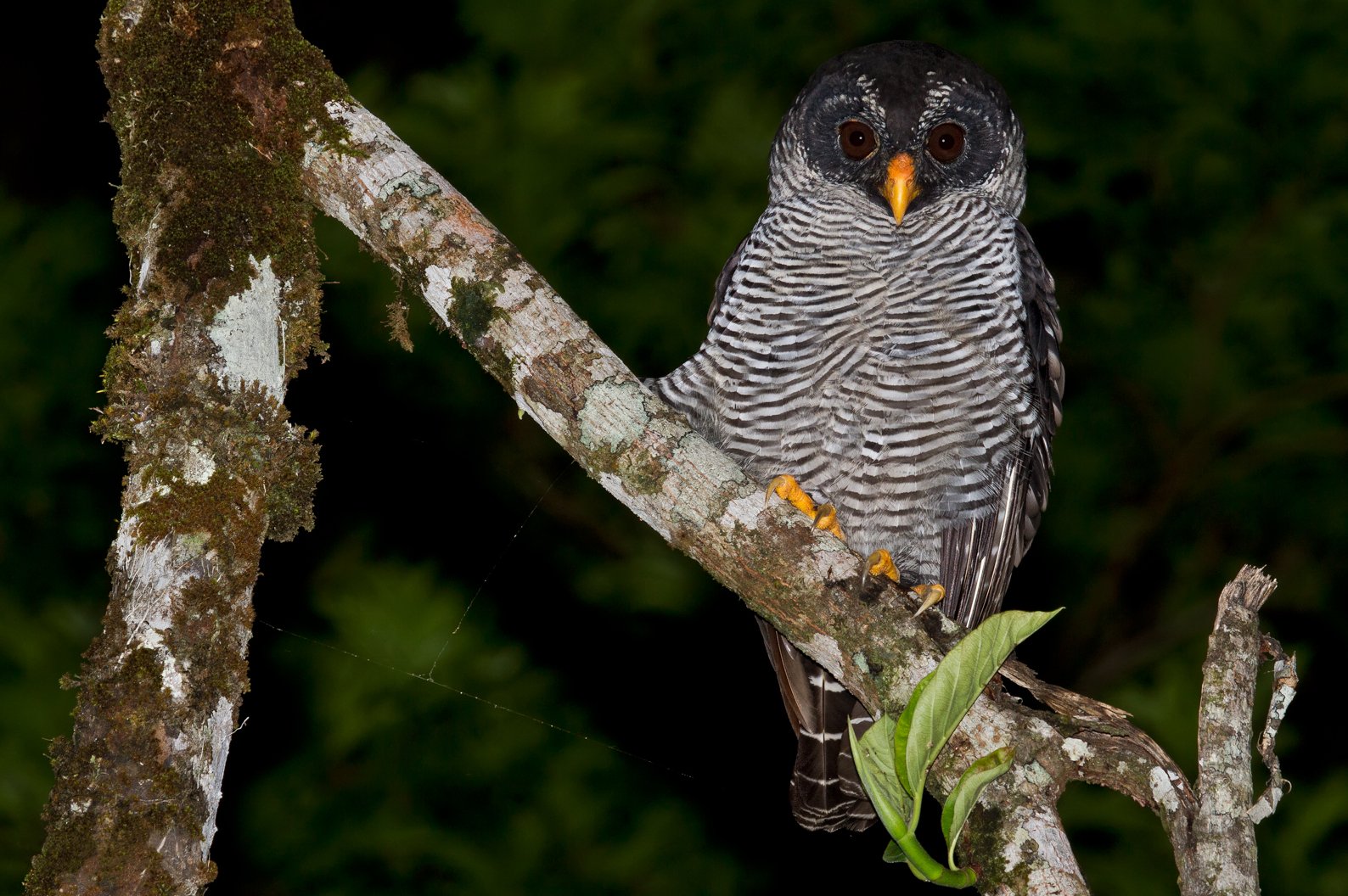
The Black-and-white Owl is a medium-sized owl without ear tufts, with a black face and black upperparts and white, finely black-barred underparts. It lives in the lowlands of Central America and north-western South America. It quite often hunts bats and large insects around street lights and lit buildings at the forest edge.
Voice
A deep, rising call, whoo-WHOO, or a series of short, hollow notes followed by a louder final note, hu-hu-hu-HOO, mainly after dusk. Also a high, hoarse scream.
Recording: Juan Freile — CC BY-NC-SA 4.0 · xeno-canto
Identification
35–40 cm, with a round head, dark eyes and a yellow-orange bill. The face, crown and upperparts are blackish brown to black, with a narrow, white-barred band framing the face. The breast, belly and thighs are white with dense, narrow black bars. The tail is black with a few narrow white bands. The feet are yellow-orange. The sexes are alike; the female is slightly larger. Young birds are whitish and downy with a dark face.
Confusion species
Black-banded Owl Strix huhula is very similar, but is finely barred white on the upperparts as well and lacks a plain black back; it lives east of the Andes, so the two species barely overlap in the guide area. Mottled Owl Strix virgata is brown, with a pale facial disc and streaked underparts. Spectacled Owl Pulsatrix perspicillata is larger, with yellow eyes, white 'spectacle' lines and a dark breast band.
Habitat
Humid and semi-humid lowland forest, forest edges, secondary forest, mangroves and plantations with trees, also in villages and along roads at the forest edge, from sea level to about 1200 m, locally higher. It hunts at night for bats, large insects, small rodents and frogs, often at artificial lights. It nests in a tree cavity or in a recess in a thick tree.
Where the bird is most at home, classified by the vegetation units of the Andes and the west coast.


Range and movements
In Colombia in the lowlands of the Pacific coast, the Caribbean coast and the Magdalena and Cauca valleys. In Ecuador in the western lowlands and foothills. In Peru only in the far north-west, scarce. Absent from Bolivia and the Galápagos. Outside the guide area from southern Mexico to north-western Venezuela.
- Resident
- dark = core range, pale = thinly spread
How and when to look
At night, check street lights and lit buildings at the edge of lowland forest in western Colombia and Ecuador; the owl often sits on a branch or wire close to the lamp, waiting for bats and insects.
Conservation status
Least Concern. The species tolerates some forest fragmentation, but depends on large trees and disappears where forest is cleared completely.
Scientific name
Strix nigrolineata | (Sclater, 1859)
Sclater described the species in 1859 as Ciccaba nigrolineata; because it was later moved to another genus, the author and year stand in brackets. The genus Strix was introduced in 1758 by Linnaeus. The genus name comes from Latin strix (Greek strinx), 'owl', in antiquity a screeching bird of the night. The species name comes from Latin niger, 'black', and lineatus, 'lined': 'black-lined'. The specimen the first description was based on came from Oaxaca, Mexico.