All species › Owls › Owls › Mottled Owl
Mottled Owl | Strix virgata
Bonte bosuil | Búho café | Coruja-do-mato
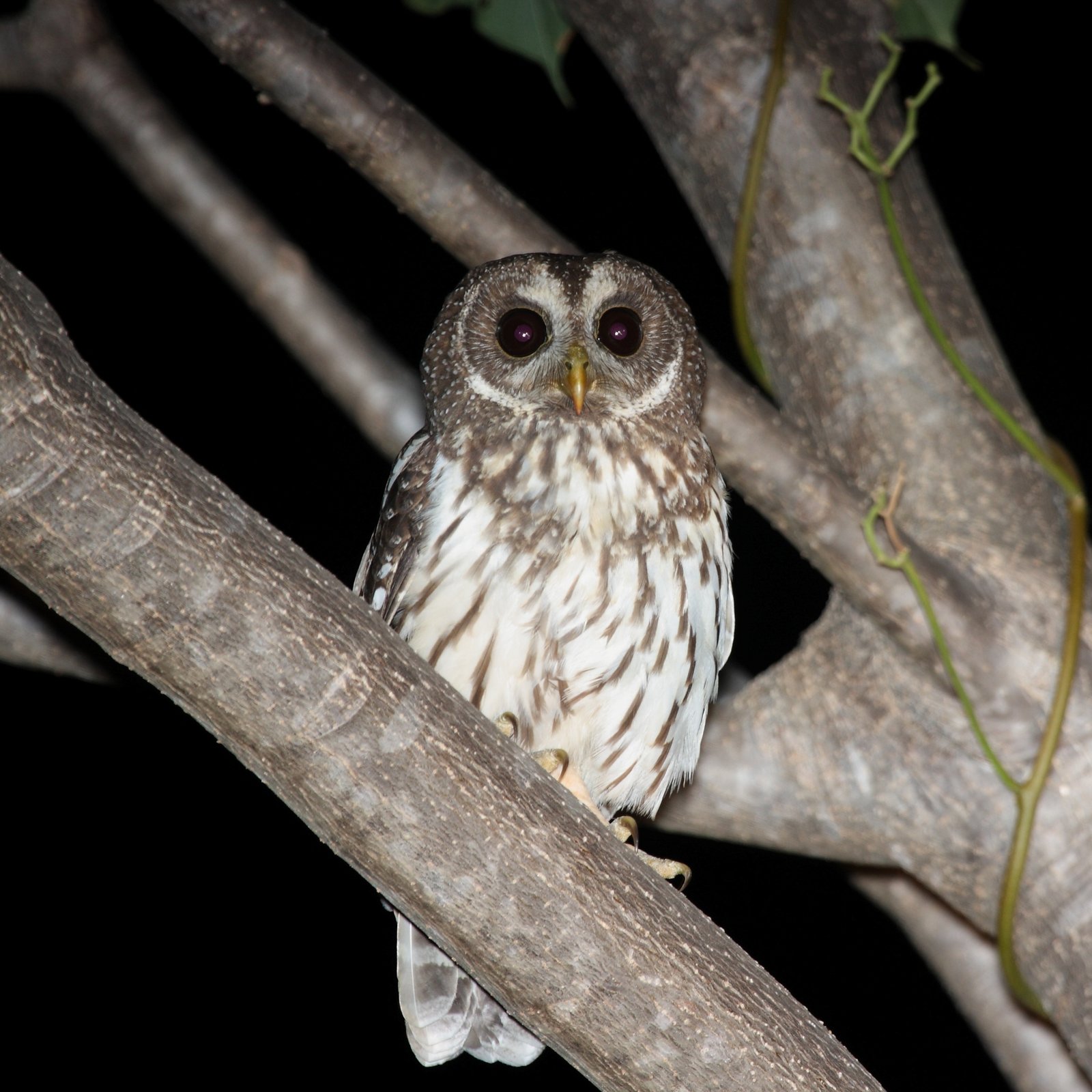
The Mottled Owl is a medium-sized, brown owl without ear tufts and with dark eyes, found across much of Central and South America. It lives mainly at forest edges, in secondary forest and in semi-open country with trees, also close to villages and plantations. In the guide area it is the commonest Strix of the lowlands and lower slopes west of the Andes.
Voice
A series of deep, hollow hoots, hoo-hoo… hoo-hoo, often swelling and fading, mainly after dusk. Also a drawn-out, hoarse, cat-like scream.
Recording: Miguel Angelo Biz — CC BY-NC-SA 4.0 · xeno-canto
Identification
30–38 cm, with a round head, dark eyes and a brown facial disc with whitish brows and whiskers. The upperparts are dark brown, finely spotted and barred with pale brown and white. The breast is mottled brown, and the rest of the underparts buff to whitish with coarse, dark streaks. The bill is greyish yellow. Paler and darker morphs occur. The female is larger than the male; the sexes are otherwise alike. Young birds are whitish and downy with a browner face.
Confusion species
Black-banded Owl Strix huhula is black all over with fine white bars and lacks streaks. Rufous-banded Owl Strix albitarsis lives higher in cloud forest and is densely barred rufous, with white spots on the underparts. Crested Owl Lophostrix cristata has long, white ear tufts and plainer underparts. Young Spectacled Owls Pulsatrix perspicillata are much larger and whitish with a black face.
Habitat
Humid and dry lowland forest, forest edges, secondary forest, gallery forest, shade plantations and park-like country, from sea level to about 2000 m, locally higher. It hunts at night from a perch, taking large insects, small rodents, bats, birds and frogs. It nests in tree cavities or in the hollow between thick branches.
Where the bird is most at home, classified by the vegetation units of the Andes and the west coast.


Range and movements
In Colombia widespread in the lowlands and on the lower slopes, on both sides of the Andes. In Ecuador mainly in the western lowlands and foothills, scarcer east of the Andes. In Peru in the north-west and locally in the eastern lowlands and foothills. In Bolivia in the lowlands of the north and east. Absent from the Galápagos. Outside the guide area from Mexico to north-eastern Argentina.
- Resident
- dark = core range, pale = thinly spread
How and when to look
After sunset, listen for the deep hoots along forest edges, plantations and park-like country in the lowlands. The owl often comes to lit places that attract insects and then perches low on a branch.
Conservation status
Least Concern. The species tolerates forest fragmentation and secondary forest well and is common in many areas.
Scientific name
Strix virgata | (Cassin, 1849)
Cassin described the species in 1849 as Syrnium virgatum; because it was later moved to another genus, the author and year stand in brackets. The genus Strix was introduced in 1758 by Linnaeus. The genus name comes from Latin strix (Greek strinx), 'owl', in antiquity a screeching bird of the night. The species name comes from Latin virgatus, 'striped'. The specimen the first description was based on came from Bogotá, Colombia.