All species › Owls › Owls › Band-bellied Owl
Band-bellied Owl | Pulsatrix melanota
Gestreepte briluil | Búho ventribandeado | Murucututu-de-barriga-listrada
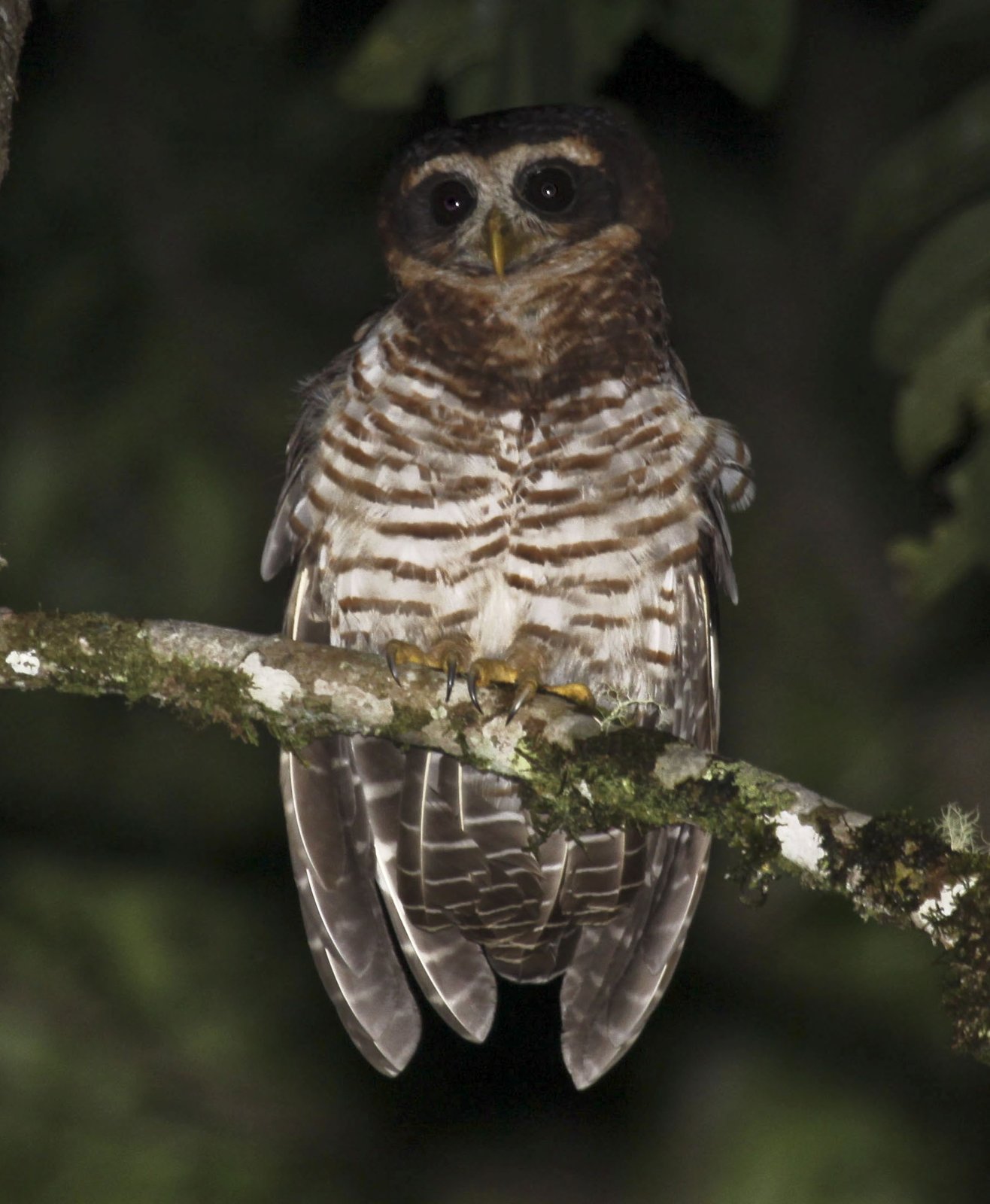
The Band-bellied Owl is the spectacled owl of the foothills: more lightly built than Spectacled Owl, with a barred belly and dark eyes. It lives in foothill and lower montane forest on the eastern slope of the Andes, from Colombia to Bolivia. Little is known about its habits.
Voice
A short purring sound followed by a rapid series of popping notes, prrr-poop-poop-POOP-poop, with the emphasis on the third note.
Recording: Elvis felipe quintero — CC BY-SA 4.0 · xeno-canto
Identification
44–48 cm, with a round head without ear tufts. The face is dark brown, with broad white eyebrows and white stripes below the eyes that together form spectacles. The eyes are dark reddish brown to blackish brown. A white throat patch, bordered dark, with a white half-collar below. The upperparts are dark brown with paler spots; the wings and tail are narrowly barred white. A broad brown band crosses the breast; the rest of the underparts are whitish to pale buff with rufous to dark brown bars. The sexes are alike.
Confusion species
Spectacled Owl Pulsatrix perspicillata is heavier, has a plain yellowish belly and yellow eyes, and usually lives lower. Rufous-banded Owl Strix albitarsis lives higher in cloud forest, is barred rufous and lacks white spectacles. Black-banded Owl Strix huhula is black with fine white barring.
Habitat
Humid foothill forest and lower montane rainforest, also forest edges and locally more open woodland, roughly between 700 and 1600 m, sometimes lower. The diet probably consists of small mammals and large insects. Little is known about the nest and breeding biology.
Where the bird is most at home, classified by the vegetation units of the Andes and the west coast.


Range and movements
In Colombia on the eastern slope of the Andes in the south. In Ecuador on the eastern slope. In Peru along the eastern slope. In Bolivia on the eastern slope of the Andes in the west of the country. Absent from the Pacific side and the Galápagos. Does not occur outside the guide area.
- Resident
- dark = core range, pale = thinly spread
How and when to look
Listen at night at lodges in the foothills of the eastern slope, such as in eastern Ecuador and along the roads that descend from the Andes to the lowlands in Peru. Birds often perch at mid-level along forest edges.
Conservation status
Least Concern. Clearing of foothill forest for farming and road building reduces its habitat locally.
Scientific name
Pulsatrix melanota | (Tschudi, 1844)
Tschudi described the species in 1844 as Noctua melanota; because it was later moved to another genus, the author and year stand in brackets. The genus Pulsatrix was introduced in 1848 by Kaup. The genus name is New Latin pulsatrix, 'female attacker', from Latin pulsator, 'beater, attacker', and pulsare, 'to beat'. The species name comes from Greek melas, 'black', and nōtos, 'back': 'black-backed'. The specimen the first description was based on came from Peru.