All species › Owls › Owls › Spectacled Owl
Spectacled Owl | Pulsatrix perspicillata
Briluil | Búho de anteojos | Murucututu
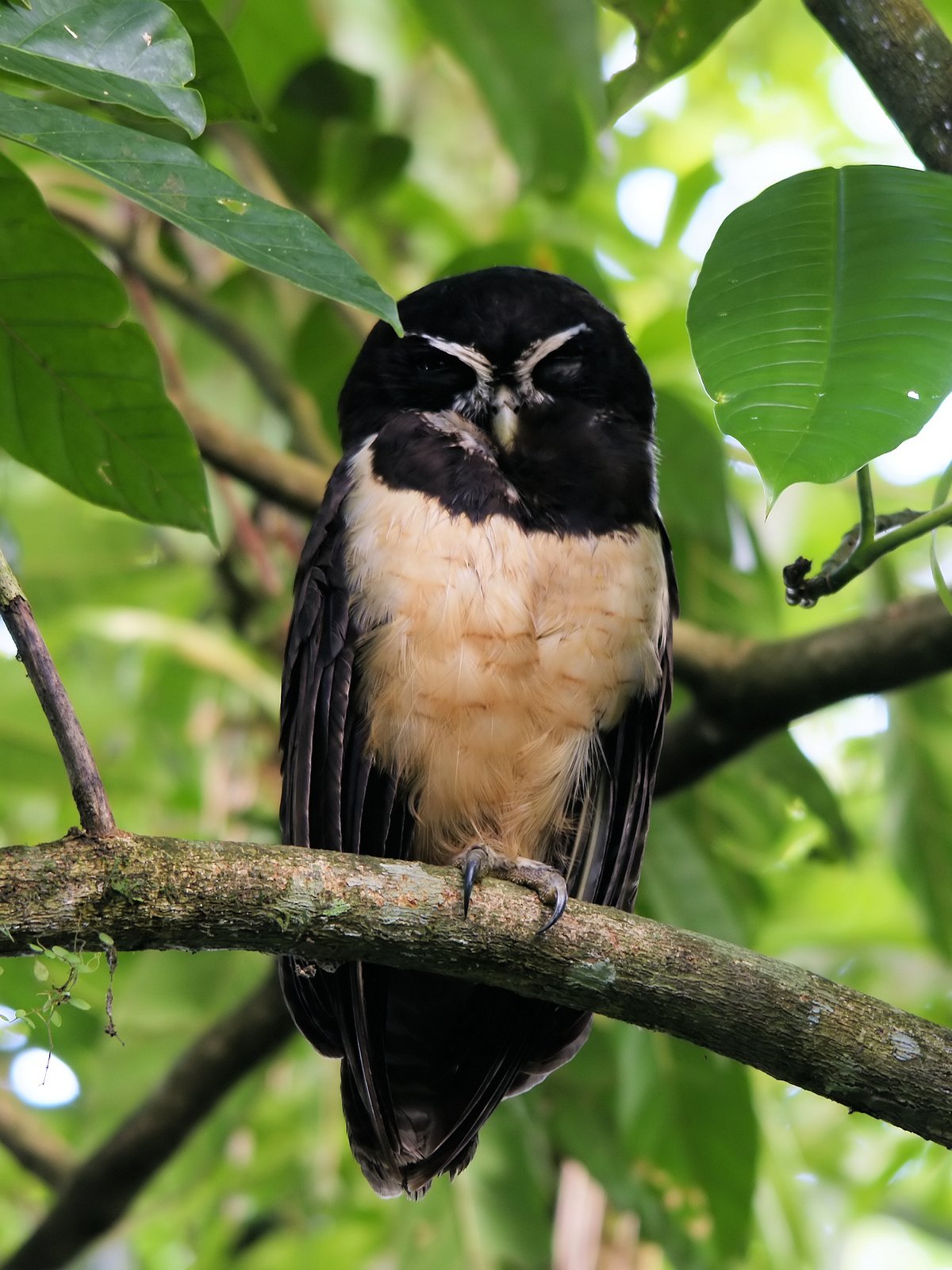
The Spectacled Owl is one of the largest owls of tropical lowland forest: a dark brown owl without ear tufts, with white 'spectacles' around the yellow eyes. It ranges from Mexico to northern Argentina and in the guide area occurs on both sides of the Andes. Young birds show the reverse pattern: white, with a black face.
Voice
A series of rapid, low, knocking notes, pook-pook-pook-pook-pook, accelerating and dropping slightly in pitch, like a sheet of metal being shaken. The female answers with a higher series; young birds give a high, hoarse whistle.
Recording: JAYRSON ARAUJO DE OLIVEIRA — CC BY-NC-SA 4.0 · xeno-canto
Identification
43–52 cm, with a round head without ear tufts. The face is dark chocolate brown, with white eyebrows and white stripes along the bill, and the eyes are yellow to orange-yellow. The throat is white. The upperparts and a broad breast band are dark brown, and the rest of the underparts are plain yellowish to pale buff. The female is larger than the male, but otherwise the sexes are alike. Young birds are white with a black, heart-shaped face and dark wings; they keep this plumage for a long time.
Confusion species
Band-bellied Owl Pulsatrix melanota lives higher in the foothills, has barred underparts and dark eyes. Crested Owl Lophostrix cristata has long white ear tufts and no breast band. Black-banded Owl Strix huhula is black with fine white barring and lacks white spectacles.
Habitat
Humid lowland forest, várzea, gallery forest, older secondary forest and forest edges, in the west also semi-evergreen forest, up to about 1500 m. It hunts from a perch for small mammals such as opossums, rodents and bats, and for birds, large insects, frogs and crabs. It nests in a large tree cavity.
Where the bird is most at home, classified by the vegetation units of the Andes and the west coast.


Range and movements
In Colombia over most of the lowlands, on both sides of the Andes. In Ecuador in the west and in the eastern lowlands. In Peru in the eastern lowlands and locally in the north-west. In Bolivia in the lowlands of the north and east. Absent from the Galápagos. Outside the guide area from southern Mexico to northern Argentina.
- Resident
- dark = core range, pale = thinly spread
How and when to look
Listen at dusk for the knocking call at clearings, riverbanks and forest edges around lowland lodges. By day it sometimes roosts fairly openly on a horizontal branch below the canopy.
Conservation status
Least Concern. The species tolerates some forest disturbance, but disappears where large trees are lacking.
Scientific name
Pulsatrix perspicillata | (Latham, 1790)
Latham described the species in 1790 as Strix perspicillata; because it was later moved to another genus, the author and year stand in brackets. The genus Pulsatrix was introduced in 1848 by Kaup. The genus name is New Latin pulsatrix, 'female attacker', from Latin pulsator, 'beater, attacker', and pulsare, 'to beat'. The species name comes from Latin perspicillatus, 'spectacled', after the white markings around the eyes. The specimen the first description was based on came from Cayenne, French Guiana.